
Precision Breeding in England: Navigating the New Regulatory Framework
9 December 2025
Authored and Edited by Hannah Whitmore, Ph.D.; K. Victoria Barker, Ph.D.; Victoria A. Randall, Ph.D.
On 13 November 2025, England introduced the Genetic Technology (Precision Breeding) Regulations 2025, creating a new regulatory framework for precision bred plants. This move departs from EU GMO (genetically modified organism) rules and aims to accelerate crop innovation while ensuring food and feed safety. Post-Brexit, this represents a significant departure from EU practice.
What is Precision Breeding?
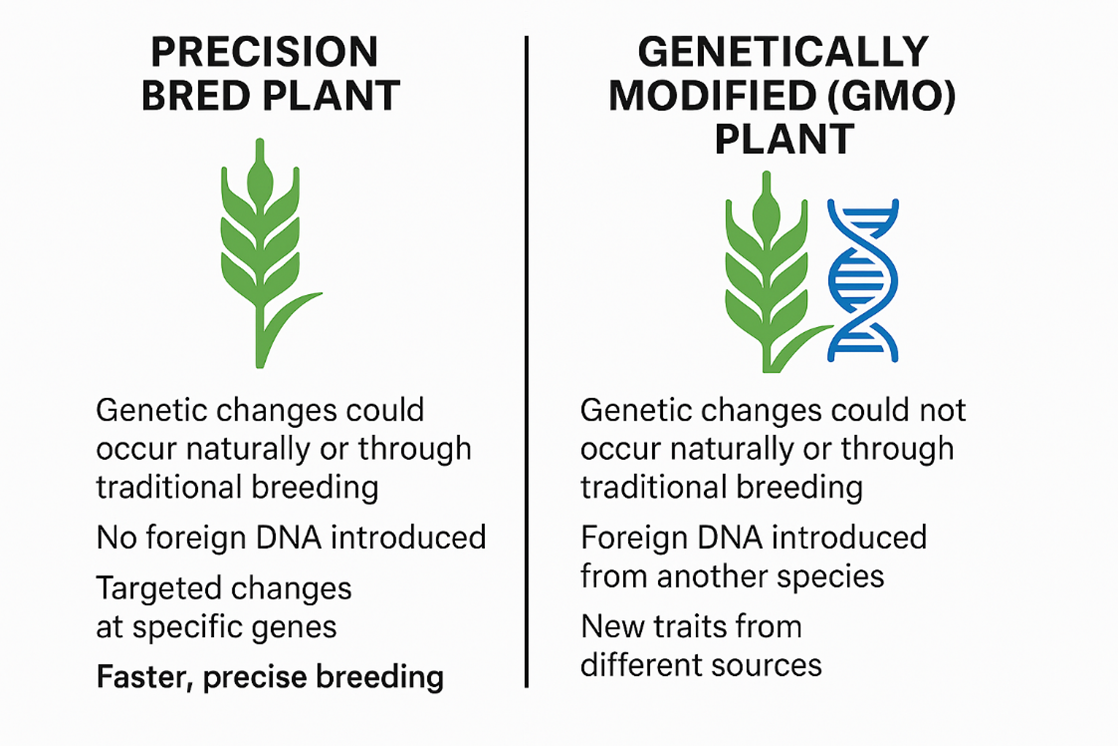
Selective breeding has been known for millennia. In a selective breeding process, a crop with one desirable characteristic is cross bred with another crop having a second desirable characteristic. For example, it is desirable for wheat plants to have large ears or grain heads to maximise yield, and short stalks to minimise falling and wind damage. A precision bred process is similar, but uses CRISPR and other targeted gene editing techniques to produce plants whose genetic changes could have occurred naturally or through traditional selective breeding methods, but in a significantly reduced time frame. In precision breeding methods, no genetic material from unrelated species is introduced. The resulting organism is considered equivalent to one produced by conventional breeding, provided the changes are within the species’ natural gene pool. For example, you will never create a glow-in-the-dark plant using precision breeding, but these are perfectly possible as a GMO. This definition distinguishes precision bred plants from GMOs, which typically involve introducing foreign DNA, earning the nickname “frankenfoods” in the popular press when they were introduced in the 1990s.
There are several gene-edited crops already approved for sale globally. Japan began marketing a high-GABA tomato, linked to lowering blood pressure in 2021; the US sell oil from soybeans which were edited to provide an improved fatty acid profile; and Argentina sell a potato which was edited to reduce enzymatic browning.
For plant breeders, these changes carry significant implications for innovation, compliance, and the future of our food systems. It creates a more favourable environment for deploying advanced breeding techniques and bringing new varieties to market. With climate change, this is even more important. It further allows England to position itself as a hub for agricultural innovation, and to deliver crops that are more resilient, nutritious, and sustainable, as food waste is significantly impacted by consumer preference for an appealing visual.
From GMO restrictions to Precision Breeding Freedom
Before these regulations came into force, precision bred plants were treated as GMOs under both UK and EU law. This classification imposed a heavy regulatory burden. Breeders faced extensive risk assessments, mandatory traceability and labelling requirements, and lengthy authorisation processes for marketing food and feed derived from the plants. These obligations were designed for transgenic organisms but applied equally to precision bred plants, even when the genetic changes could have occurred naturally or through conventional breeding. The result was a bottleneck for innovation: the cost and complexity of compliance often deterred investment and slowed the adoption of promising technologies.
What the New Regulations Allow
Precision bred plants are now recognised as distinct from GMOs in England. Under the new 2025 framework, breeders of precision bred plants who plan to release or market a precision bred plant (or food and feed derived from it), must notify the Department for Environment, Food and Rural Affairs (DEFRA), provide the required information, and observe a minimum notice period of 20 days. This replaces the GMO approval process with a mechanism designed to provide consumer protection and environmental safety without stifling innovation. For marketing food and feed derived from precision bred plants, businesses must obtain a “precision bred confirmation” and a marketing authorisation. These can be checked on the two new registers which have been introduced:
- Precision breeding register, which records authorised organisms;
- Food and feed register, which lists approved products.
Applicants must demonstrate that the genetic changes to the plant do not negatively impact nutritional quality, toxicity, allergenicity, or introduce unsafe features.
Conclusion
The UK Government’s motivation appears to be post-Brexit regulatory divergence to improve innovation and make England a hub for agri-tech. The new framework aims to accelerate development of climate-resilient and disease-resistant crops and attract investment into the UK’s biotech sector. These changes also bring strategic alignment with countries like the US, Canada, Australia, and the Philippines, which already have more permissive frameworks for gene-edited crops. This positions England competitively in global agricultural innovation markets and potentially opens new trade routes with these countries.
However, divergence within the UK remains a challenge as England now also diverges from Scotland, where precision breeding regulations are not enforced. The Scottish Government has chosen to maintain regulatory alignment with the EU on genetic technologies, meaning precision bred crops authorised in England cannot automatically be marketed north of the border. This creates a fragmented domestic market and complicates supply chains for breeders and food producers operating across the UK. Furthermore, exports to the EU will still face the same lengthy GMO approval process until reforms are finalised for “new genomic techniques” in Europe, a process that is progressing slowly.
The Genetic Technology (Precision Breeding) Regulations 2025 are the start of an important moment for plant breeding in England. By carving out a distinct regulatory space for precision bred plants, England has embraced a more innovation-friendly approach than its European counterparts. For breeders, technology companies, and stakeholders across the human and animal food chain, the door is open for agri-tech progress.
Related Practices
Related Offices
Contacts


Copyright © 2025 Finnegan, Henderson, Farabow, Garrett & Dunner, LLP.
DISCLAIMER: Although we wish to hear from you, information exchanged in this blog cannot and does not create an attorney-client relationship. Please do not post any information that you consider to be personal or confidential. If you wish for Finnegan, Henderson, Farabow, Garrett & Dunner, LLP to consider representing you, in order to establish an attorney-client relationship you must first enter a written representation agreement with Finnegan. Contact us for additional information. One of our lawyers will be happy to discuss the possibility of representation with you. Additional disclaimer information