Chemicals, Industrials, and Materials
About
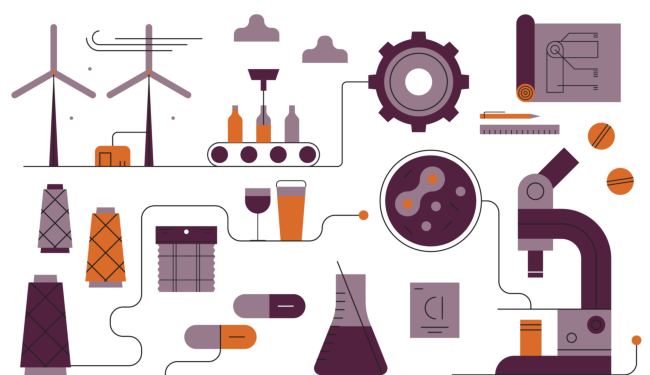
By applying technology to raw materials, we transform elements into the products that support daily life and keep commerce flowing. Technical advances in manufacturing processes coupled with advances in engineering materials have led to incredible innovations across industries, from additive manufacturing to textiles, from clean energy to food products. To be competitive, companies that make physical things are market driven towards developing products that are greener, smarter, and all around better. Finnegan has worked for decades with clients contributing at all points on the supply chain, helping to protect their ideas and novel approaches for meeting consumer demands.
Industries
Additive Manufacturing
Additive manufacturing, also known as 3D printing, is a disruptive technology with far-reaching implications for manufacturers, consumers, and intellectual property owners.
Artificial Intelligence (AI) and Machine Learning (ML)
Advancements in artificial intelligence (AI) present novel challenges for businesses looking to invest in intellectual property. Protecting those investments and understanding the innovation landscape is where Finnegan comes in.
Chemical
From basic elements to highly specialized goods, chemicals play a fundamental role in everything from the raw materials used in manufacturing to the high-tech products that allow us to communicate, travel, eat, and save lives.
Clean Energy and Renewables
Innovative technologies that produce renewable, clean, efficient, and affordable energy are paramount in the quest to solve some of the world’s most pressing challenges.
Food and Beverage
It is no surprise that food and beverage companies invest substantial resources creating new products and unique ways to package and market them. Companies must protect these investments by obtaining and protecting the underlying intellectual property rights that result from their innovation.
Manufacturing
Manufacturing powers the world’s economy and is a large, diverse, and highly innovative sector. From farm machinery to chemicals to telecommunications and everything in between, manufacturing plays a crucial role in producing goods across all aspects of the economy.
Nanotechnology
Innovative companies are developing products with myriad applications, such as tiny batteries, nano-structured surfaces that ward off bacteria, magnetically-controlled microbots, and nanofilament-impregnated contact lenses capable of enabling an HD virtual reality or augmented reality display at a user’s eye.
Oil and Gas
The oil and gas industry is investing in advances in both upstream and downstream sectors of the industry, from exploration to field and pipeline development to refining.
Textiles
From protecting vulnerable crops, helping doctors improve their patient’s lives, and monitoring your vital signs, to improving the comfort of your clothing—textiles are everywhere. Textiles comprise a broad and diverse range of products used in myriad applications.
Experience
Advised a consumer-focused private investment firm on healthcare regulatory aspects of its definitive agreement to acquire a majority stake in a skin barrier and skin health brand.
Secured a decisive victory for client US Synthetic Corp. (USS) at the ITC. After a full hearing, the ALJ found that respondents infringed multiple claims of USS’s patent and that the claims were valid and supported by a domestic industry, but an initial Commission ruling under § 101 temporarily prevented a finding of violation of Section 337. The Federal Circuit reversed the § 101 ruling, and on remand the ITC found a violation and issued a limited exclusion order barring infringing polycrystalline diamond products from entry into the United States, securing final relief for USS.
337-TA-1236, ITC, Judge Elliot
IL-2024-000026, UK High Court
Finnegan assists Archer Aviation, a leading urban air mobility company responsible for designing, developing, manufacturing, and operating electric vertical takeoff and landing aircrafts to carry passengers, with strategic global patent prosecution, litigation, enforcement, IP transactions, trade secret counseling, trademark and copyright matters, and competitive intelligence initiatives.