
Federal Court Orders Rebel Creamery to Redesign Packaging and Disgorge $23.8 Million in Van Leeuwen Trade Dress Case
October 7, 2026
Authored and Edited by Nessa Khandaker; Jenevieve J. Maerker
In a sweet win for frozen dessert brand Van Leeuwen Ice Cream, a New York federal court held that Rebel Creamery intentionally copied Van Leeuwen’s packaging, infringing and diluting its distinctive trade dress, and ordered Rebel to redesign its packaging and disgorge $23.785 million in profits.
Van Leeuwen’s claims were directed at the overall commercial impression created by Rebel’s packaging, rather than any name or logo infringement. Van Leeuwen’s success highlights the importance of a precise trade dress definition, establishing a distinctive overall combination when individual elements are commonplace, and strong evidence showing consumer confusion. The decision also underlines that trade dress can provide powerful protection for packaging alone, and that, in addition to injunctive relief, findings of intentional copying can result in a substantial profits award.
Background
Since 2016, Van Leeuwen has been selling dairy ice cream with a trade dress comprising cardboard monochromatic pints with matching monochromatic lids; use of a primarily pastel color palette and pastel-tinted hues; black script typeface lettering with an exaggerated capital letter appearing across the front of the ice cream pint with additional descriptive writing in black lettering; and an overall minimalistic design aesthetic.
Rebel Creamery entered the market the following year with ice cream packaged in pints featuring what the court later described as a "near-identical color scheme and script," together with certain keto-related design elements (including a black circle stating the number of net carbs or grams of sugar, and language around the lid touting keto features).

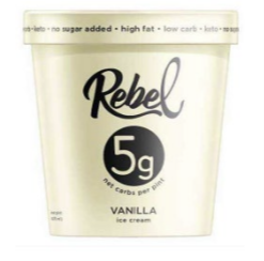
In 2021, Van Leeuwen sued Rebel for trade dress infringement, unfair competition, reverse confusion, and dilution. Rebel denied that Van Leeuwen had protectable trade dress and raised a “good faith remote user” defense.
Decision
The court found that Van Leeuwen had defined its trade dress in a “sufficiently objective and specific manner,” meaning it had provided “more than adequate precision” to put Rebel on notice of what it sought to protect. The court assessed the elements of Van Leeuwen’s pleaded trade dress holistically, rather than individually, and held that the combination of pastel colors, script typeface, negative space, and packaging material created a consistent overall look. As to the packaging material, the court did not treat cardboard containers as protectable in isolation; rather, it noted that Van Leeuwen’s cardboard packaging was a choice, because it had considered using a plastic container, and emphasized that the analysis looks to “the trade dress as a whole.”
Rebel argued that Van Leeuwen’s trade dress was functional or commonplace, including the use of colors to denote flavors (such as green for mint). The court disagreed, noting that Rebel had not explained why flavor colors had to be pastel, or what was functional about certain pastel shades that did not correspond to flavors at all (such as purple for chocolate fudge brownie). The court therefore found Van Leeuwen’s trade dress to be arbitrary and thus inherently distinctive. The court also rejected Rebel’s arguments that black script lettering and minimalist designs were commonplace. In addressing this point, the court noted that the functionality analysis looks to the trade dress as a whole, and not individual elements of the trade dress.
Consumer confusion became a central battleground in the case, with the parties advancing competing narratives supported by different aspects of the evidentiary record. Van Leeuwen alleged both traditional confusion (i.e., that consumers would believe Rebel’s products came from Van Leeuwen) and reverse confusion (i.e., that consumers would believe Van Leeuwen’s products came from Rebel). Rebel argued that consumers would not be misled, pointing to the parties’ different branding and product offerings. It relied particularly on consumer sophistication, arguing that keto ice cream buyers were especially discerning. The court, however, rejected this view, finding that ice cream is an impulse purchase made by hurried shoppers viewing packaging only briefly. On balance, the court found that the confusion factors weighed in favor of Van Leeuwen on the strength of its substantial evidence, including a survey yielding a net confusion rate of 34.3% and anecdotal evidence of grocery employee confusion and actual consumer confusion.
As to bad faith, the court found the overall appearance of the two lines of products too similar to be coincidental. Further, the court was skeptical of Rebel’s testimony concerning the development of its packaging and noted that Rebel, without proper explanation, produced no documents capturing the development of its packaging that predate the final product. Rebel also did not win on its “good faith remote user” defense, which applies where a junior user first adopts a similar trade dress in a geographically remote market where the senior user’s trade dress is unknown, and does so in good faith. Here, Rebel first used its packaging in a region where Van Leeuwen was already sold. Moreover, even if Rebel had been a remote user of the trade dress, Rebel did not establish that it acted in good faith.
After finding for Van Leeuwen on its trade dress infringement and dilution claims, the court ordered Rebel to redesign its packaging and awarded Van Leeuwen $23.785 million in Rebel’s profits from the infringing sales. Although Rebel argued that demand for its product was driven by its keto-friendly positioning rather than its packaging, the court only partially accepted that argument, reducing the profits award by one-third from the $35.5 million initially calculated.
What’s Next?
Since the decision, Rebel has filed a notice of appeal and commenced Chapter 11 bankruptcy proceedings in Utah. The bankruptcy filing automatically stays further proceedings against Rebel, which may delay collection of the monetary judgment and could complicate any proceedings to enforce the injunction.
For brands, this case underscores the value of treating packaging as a protectable asset: maintaining a consistent visual identity, documenting the development of packaging designs, and monitoring close market entrants. It also shows that trade dress claims are strongest where the brand can define the overall look with precision and support confusion allegations with concrete evidence.
The case is Van Leeuwen Ice Cream LLC v. Rebel Creamery LLC, 1:21-cv-02356 (E.D.N.Y. July 16, 2026).
Related Practices
Related Industries
Related Offices
Contacts

- Nessa Khandaker
- Associate
- London
- +44 (0)20 7864 2828

- Jenevieve J. Maerker
- Of Counsel
- Boston, MA
- +1 617 646 1655
Copyright © 2026 Finnegan, Henderson, Farabow, Garrett & Dunner, LLP.
DISCLAIMER: Although we wish to hear from you, information exchanged in this blog cannot and does not create an attorney-client relationship. Please do not post any information that you consider to be personal or confidential. If you wish for Finnegan, Henderson, Farabow, Garrett & Dunner, LLP to consider representing you, in order to establish an attorney-client relationship you must first enter a written representation agreement with Finnegan. Contact us for additional information. One of our lawyers will be happy to discuss the possibility of representation with you. Additional disclaimer information.