
EPR Academy, Part 4 of 6: Choosing Between EPR, IPR, PGR, and Reissue
July 1, 2026
By Lionel M. Lavenue; Dara M. Emami; Guanshi Li, P.E.; Joshua A. Sprague Oliveira; Caitlin T. Coverstone

- EPR’s Flexibility and Grant Rates Drive Strategic Value: EPR offers a unique combination of broad availability, flexible timing, and high grant rates, making it an increasingly attractive alternative to IPR and PGR in many situations.
- Key Differences Among USPTO Post-Grant Proceedings Matter: Although IPR, PGR, and reissue may serve overlapping purposes, each proceeding presents distinct advantages, limitations, and strategic considerations that can significantly impact patent enforcement and validity challenges.
- Choosing the Right Proceeding Can Shape Patent Strategy: Understanding when to use EPR—and when another USPTO proceeding is the better fit—can be critical to maximizing leverage in patent prosecution, licensing, and litigation.
Intro & Recap
So far, the first, second, and third installments of Finnegan’s EPR Academy series have provided a deep dive into ex parte reexamination (EPR), including navigating the EPR process from requests to reexamination certificates and even appeals. If you haven’t seen them, be sure to give them a read.
Now, with this fourth installment, we are looking at how EPR compares to a few other, related but distinct, proceedings and options available at the patent office: inter partes review (IPR), post grant review (PGR), and reissue.
Comparing EPR to Other Proceedings
With a strong understanding of EPR and the lifecycle of these proceedings, knowing when to use an EPR is key, particularly when compared to other options available to patent owners and third-party requesters at the USPTO. Figure 1, below, provides a high-level summary of the comparison between EPR, IPR, PGR, and reissue.
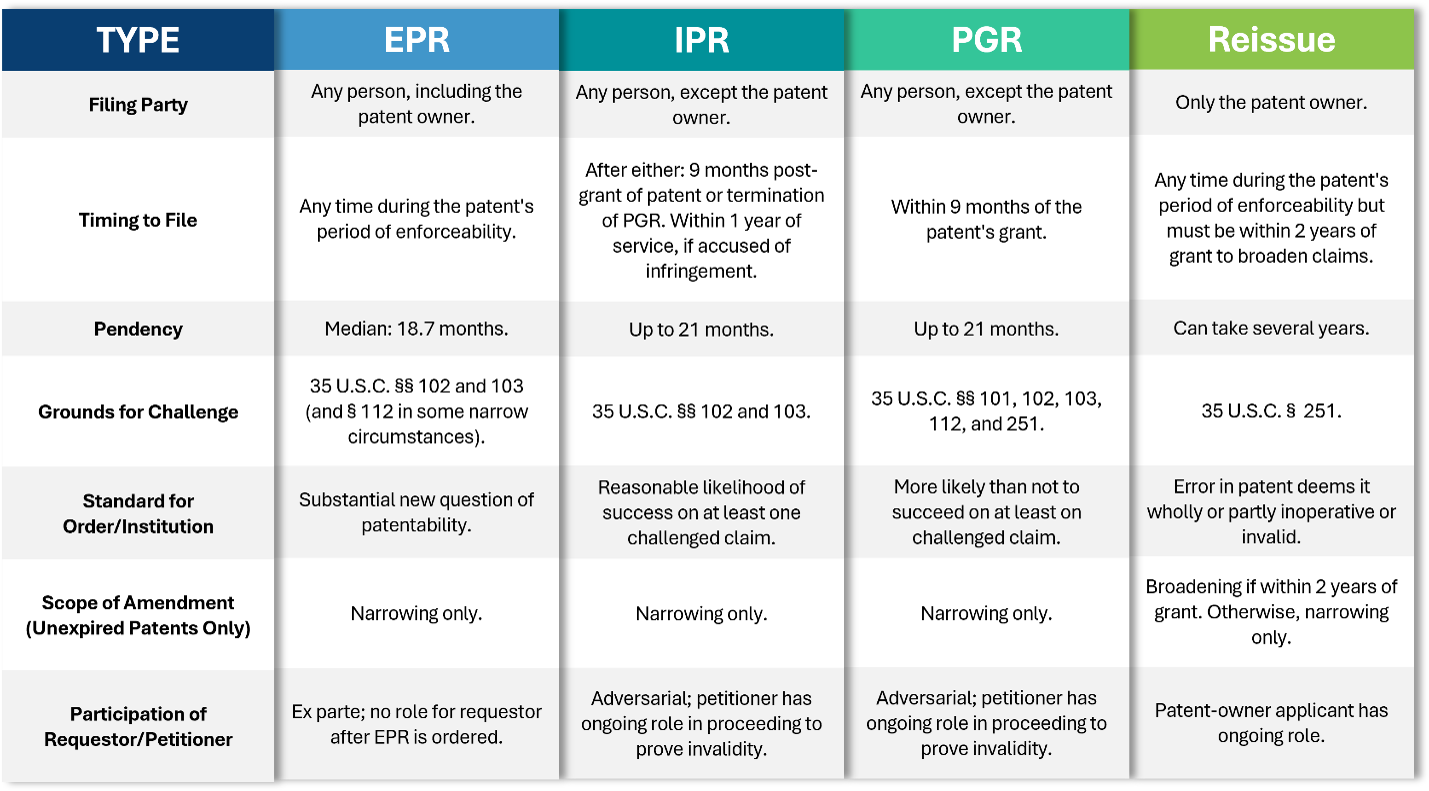
Figure 1: Summary of the differences and similarities between EPR, IPR, PGR, and Reissue. (Fig. 1 Alt. Text: Table comparing EPR, IPR, PGR, and reissue by listing the type of proceeding horizontally, and several categories related to these proceedings vertically. The categories these proceedings are compared across are: filing party, timing to file, pendency, grounds for challenge, standard for order/institution, scope of amendment, and participation of requester/petitioner.)
EPR versus IPR, PGR, and Reissue.
Several features distinguish EPR from other USPTO post-grant proceedings, including its availability to any requester, the ability to seek reexamination at any point during a patent’s enforceable life, its limited grounds for challenging validity, the threshold for ordering reexamination, the statutory three-month deadline for whether to grant a request, the “special dispatch” requirement, the opportunity for claim amendment, and its ex parte nature.[1]
These characteristics make EPR particularly effective in situations that align with its strengths, while making it less suitable for circumstances that require different capabilities or tradeoffs. Two very notable characteristics are the three-month decision window and “special dispatch,” as these characteristics allow EPR to proceed expeditiously.
By statute, the decision on whether to order EPR must occur within 3 months of a request’s filing; however, through Q3 of 2025, an EPR order was provided within 1.64 months of filing, on average.[2] While the average pendency from filing an EPR request to the issuance of a certificate is 25.1 months, this is likely impacted by outliers, as the median pendency is 18.7 months.[3] The overall pendency appears to be going down in 2025, though, with an average pendency from filing to EPR certificate of 16.6 months through Q3.[4]
However, a recent change to the procedures carried out in EPR may impact these timing considerations. In April of 2026, the USPTO announced a new procedure allowing patent owners to submit a pre-order paper to inform the Examiner’s SNQP determination.[5] This pre-order paper must be filed within 30 days of the date the third-party requester serves their request on the patent owner.[6] It is too early to say how this is impacting the pendency or order rate of EPRs, but it will likely increase the former and decrease the latter.
Further, EPR proceedings benefit from a statutory “special dispatch” requirement that requires the USPTO to handle them on an expedited basis. [7] Under this mandate, reexaminations generally take priority over all other matters before the USPTO. The only proceedings that receive higher priority are reexaminations and reissue applications that are involved in active litigation. [8] As a result, EPRs are often resolved more quickly than other USPTO proceedings.
EPR v. IPR
Although EPR and IPR share the common objective of challenging patent validity before the USPTO, they differ in several important respects. Both proceedings are broadly available to third-party challengers; however, unlike EPR, an IPR petition may not be filed by the patent owner and must identify real parties in interest.[9] Further, the role of the challenger differs substantially between the two proceedings. In EPR, a third-party requester’s participation is largely limited and generally ends after the requester’s reply.[10] In contrast, an IPR petitioner remains a full participant throughout the proceeding, actively litigating the case before the PTAB.[11]
Regarding timing of petitioning for IPR, an IPR petition cannot be filed until nine months after the patent is granted, or the termination of a PGR, if one is instituted.[12] Further, if the petitioner is served with a complaint alleging infringement of the patent, they must petition for IPR within a year of that service.[13] EPR, however, can be requested at any time during the patent’s period of enforceability.[14]
Turning to scope, in both EPR and IPR, the challenger can only rely upon patents and printed publications to support grounds for invalidity under 35 U.S.C. § 102 or 103.[15] However, in EPR, grounds under 35 U.S.C. § 112 can be raised by examiners in narrow circumstances, such as where there is an amendment being proposed.[16]
EPR also offers a potential advantage with respect to speed. The USPTO must determine whether to grant an EPR request within three months of filing.[17] In contrast, an IPR Institution decision is generally not issued until approximately six months after the petition is filed, reflecting the patent owner’s three-month period to oppose institution and the director’s subsequent three-month period to determine whether to institute.[18] Consequently, EPRs tend to reach resolution more quickly than IPRs, with recent pendency statistics showing that EPR proceedings are resolved approximately 10% faster on average.[19]
EPR also offers a more accessible path to institution than IPR. To initiate an EPR, a requester need only demonstrate a substantial new question of patentability (“SNQP”)[20], a threshold generally regarded as less demanding than the IPR threshold requiring a petitioner establish a reasonable likelihood of prevailing on at least one challenged claim.[21] This distinction has become increasingly significant as IPR institution rates have declined, in part due to the PTAB’s expanded use of discretionary denials.[22] Consistent with these differing standards, EPR requests historically have been granted at a substantially higher rate than IPR and PGR petitions, with EPR grant rates averaging approximately 95%, compared to an average institution rate of roughly 63% for IPR and PGR proceedings. [23]
However, the aforementioned recent addition of pre-order papers allowing patent owners to address SNQP to the EPR process will likely have an impact here. To read more about this, check out our EPR Academy Alert on this new procedure here.
Another consideration to weigh in comparing EPR and IPR is the different claim construction standards applied. For unexpired patents in EPR, examiners use the “broadest reasonable interpretation” standard, which generally results in broader claim constructions and may make it easier to apply prior art against the claims. By contrast, IPRs—and EPRs involving expired patents—apply the Phillips standard, which mirrors the approach used in district court litigation by construing claims according to how a person of ordinary skill in the art would understand them in view of the intrinsic record.[24] Consequently, the same patent claim may be interpreted differently in EPR and IPR, potentially affecting the outcome of the validity analysis.
Both proceedings are also impacted by discretionary denials. Under 35 U.S.C. § 325(d), the USPTO director can discretionarily “stay, transfer, consolidat[e], or terminat[e]” a proceeding before the office where another proceeding currently or previously involves the same patent.[25] Traditionally, this has been primarily used in the context of IPR and PGR, but more recently, the USPTO has applied § 325(d) to deny EPR requests.[26]
Looking at all these considerations, it becomes clear that EPR can provide an advantageous alternative to IPR in many circumstances.
EPR v. PGR
Comparing EPR and PGR, one of the most notable distinctions is the timing for seeking review. EPR may be requested at virtually any time during the enforceable life of a patent, whereas a PGR petition must be filed within nine months of the patent’s issuance.[27] Although PGR is subject to this narrow filing window, it offers a broader range of validity challenges. In addition to encompassing the prior-art based grounds available in EPR, PGR permits challenges under 35 U.S.C. §§ 101, 112, and 251, thereby providing a more comprehensive mechanism for contesting patent validity.[28]
Next, EPR generally proceeds more quickly than PGR, as the overall pendency of a PGR is comparable to that of an IPR.[29] In addition, as with IPR, patent owners may not petition for PGR, whereas patent owners may request EPR.[30] Another key distinction is the petitioner’s role after initiation: unlike EPR, where the requester does not participate beyond the initial filing, PGR—like IPR—provides the petitioner with an ongoing and active role throughout the proceeding.[31]
As alluded to above, the same considerations regarding discretionary denials in the context of IPR and EPR apply here.
Finally, the threshold for instituting PGR is higher than either EPR or IPR, with the petitioner being required to show they would more likely than not demonstrate that at least one of the claims challenged is unpatentable.[32]
Although PGR provides the broader validity challenge framework, EPR’s flexible timing requirements often make it the more practical option. Unlike PGR, which is limited to a narrow post-issuance window, EPR may be pursued throughout the life of the patent. At the same time, PGR retains a notable advantage in allowing challenges under 35 U.S.C. §§ 101, 112, and 251 in addition to prior-art based grounds.
EPR v. Reissue
Like EPR, a patent owner may initiate a reissue proceeding with respect to its own patent. Unlike EPR, however, only the patent owner may seek reissue.[33] Reissue also serves a fundamentally different purpose from EPR, IPR, and PGR. While EPR, IPR, and PGR are generally employed to challenge the validity of issued claims, reissue is designed to correct errors in an otherwise defective patent, such as errors in the claims or specification.[34]
Another important distinction is that a patent owner seeking reissue must surrender the original patent as part of the reissue process. By contrast, a patent undergoing EPR remains in force unless and until its claims are canceled or amended. This distinction can have significant practical consequences, including with respect to damages. For example, because a patent subject to EPR remains enforceable during the proceeding, a patent owner may continue to seek damages for infringement of claims that are ultimately confirmed through reexamination.
Further, amendments are allowed in all of these proceedings. However, only amendments during reissue can broaden the claims of a patent; amendments in EPR, IPR, and PGR must narrow the scope of the claims.[35] For a broadening amendment to be considered, though, the reissue must be applied for within two years of the patent’s original grant.[36]
Thus, while EPR and reissue may serve similar purposes in certain circumstances, they differ in several important respects, particularly in their availability and strategic use. The comparison between EPR and reissue arises primarily when a patent owner is evaluating mechanisms to strengthen, clarify, or correct its own patent rights. This patent-owner focused, corrective function stands in sharp contrast to the more adversarial proceedings available to third parties, such as IPR, PGR, and EPR, which are generally employed to challenge the validity of an issued patent and reduce or eliminate the patent owner’s rights.
Final Thoughts: When is EPR the Right Choice?
EPR occupies a unique position among the USPTO’s post-grant proceedings. It combines broad availability, flexible timing, relatively low institution thresholds, and expedited treatment, making it a valuable option for both patent owners and third-party challengers. Yet those advantages must be considered alongside its limitations, including its narrower grounds for review and the limited role afforded to third-party requesters once a proceeding is ordered.
As the comparisons above demonstrate, no single USPTO proceeding is universally preferable. Rather, the optimal choice depends on the specific objectives, timing constraints, and strategic considerations at issue. Whether the goal is to challenge patent validity, strengthen an issued patent, correct claim defects, or support broader litigation objectives, understanding the strengths and tradeoffs of EPR, IPR, PGR, and reissue is essential to selecting the most effective path forward.
Stay tuned for the last two EPR Academy installments, where we further unpack these and other special EPR considerations from the perspectives of third-party requesters in part 5 of 6 and patent owners in part 6 of 6.
Endnotes
[1] MPEP § 2209 (9th ed. Rev., Jan. 2024).
[2] 35 U.S.C. § 303(a); U.S. Pat. & Trademark Office, Reexaminations – FY 2025 (2025).
[3] U.S. Pat. & Trademark Office, Ex Parte Reexamination Filing Data – September 30, 2024 (2024).
[4] U.S. Pat. & Trademark Office, Reexaminations – FY 2025 (2025).
[5] Pre-order Procedure regarding Substantial New Question determination in ex parte Reexamination Proceedings, 1545 Off. Gaz. 217, 217–218 (Apr. 28, 2026).
[6] Pre-order Procedure regarding Substantial New Question determination in ex parte Reexamination Proceedings, 1545 Off. Gaz. 217, 218 (Apr. 28, 2026).
[7] 35 U.S.C. § 305; MPEP § 2261 (9th ed. Rev., Jan. 2024).
[8] MPEP § 2261 (9th ed. Rev., Jan. 2024).
[9] 37 C.F.R. § 1.510; 35 U.S.C. § 311(a).
[10] MPEP § 2251 (9th ed. Rev., Jan. 2024).
[11] 35 U.S.C. § 316.
[12] 35 U.S.C. § 311(c).
[13] 35 U.S.C. § 315(b).
[14] MPEP § 2211 (9th ed. Rev., Jan. 2024).
[15] MPEP § 2217 (9th ed. Rev., Jan. 2024); 35 U.S.C. § 311(b).
[16] MPEP § 2258 (9th ed. Rev., Jan. 2024).
[17] MPEP § 2209 (9th ed. Rev., Jan. 2024).
[18] 35 U.S.C. § 313; 35 U.S.C. § 314(b).
[19] U.S. Pat. & Trademark Office, Reexaminations – FY 2025 (2025); 37 C.F.R. § 42.100(c).
[20] 35 U.S.C. § 304; MPEP § 2216 (9th ed. Rev., Jan. 2024).
[21] 35 U.S.C. § 314(a).
[22] See Cory C. Bell, et al., Trending at the PTAB: The Journey of IPR Institution in 2025, Finnegan (Jan. 5, 2026).
[23] See U.S. Pat. & Trademark Office, Fiscal Year (FY) 2024 Workload Tables (2024); U.S. Pat. & Trademark Office, PTAB Trial Statistics FY24 End of Year Outcome Roundup IPR, PGR (2024).
[24] In re: CSB Int’l, Inc., 832 F.3d 1335, 1337 (Fed. Cir. 2016).
[25] 35 U.S.C. § 325(d).
[26] See, e.g., In re Mumbru, Order Denying Request for Ex Parte Reexamination, Pat. No. 8,819,458 (May 22, 2026).
[27] 35 U.S.C. § 321(c).
[28] 35 U.S.C. §§ 321(b), 282(b).
[29] 37 C.F.R. § 42.200(c).
[30] 35 U.S.C. § 321(a).
[31] 35 U.S.C. § 326(e).
[32] 35 U.S.C. § 324(a).
[33] 37 C.F.R. § 1.172(a).
[34] 35 U.S.C. § 251(a).
[35] 35 U.S.C. §§ 251(d), 316(d)(3), 326(d)(3); 37 C.F.R. § 1.530(j).
[36] 35 U.S.C. § 251(d).
Related Offices
Related Professionals


- Dara M. Emami
- Associate
- Reston, VA
- +1 571 678 8856

- Guanshi Li, P.E.
- Associate
- Boston, MA
- +1 617 646 1653


- Caitlin T. Coverstone
- Patent Agent
- Washington, DC
- +1 202 408 4129
Copyright © Finnegan, Henderson, Farabow, Garrett & Dunner, LLP. This article is for informational purposes, is not intended to constitute legal advice, and may be considered advertising under applicable state laws. This article is only the opinion of the authors and is not attributable to Finnegan, Henderson, Farabow, Garrett & Dunner, LLP, or the firm’s clients.
