
EPR Academy, Part 2 of 6: The EPR Process – From Request to Reexamination Certificate
December 5, 2025
By Lionel M. Lavenue; Dara M. Emami; Guanshi Li, P.E.; Joshua A. Sprague Oliveira; Caitlin T. Coverstone

- Overview of EPR Stages: The ex parte reexamination (EPR) process has three main stages: filing, reexamination, and, optionally, appeal. This article focuses on the first two stages.
- Filing Stage Requirements: A complete EPR request must include the patent and prior art documents, substantial new questions of patentability (SNQPs) with detailed reasoning, and administrative requirements such as service proof and certifications. Requests can also include amendments (if the requester is the patent owner), affidavits, and expert declarations, which are often beneficial to achieving favorable results.
- Reexamination Stage Procedures: Once the USPTO determines an SNQP exists, the reexamination proceeds with examination, office actions, and office action responses. This stage culminates in the issuance of a reexamination certificate, which can cancel claims, confirm claims, or incorporate amended or new claims.
Introduction
If you missed the first installment of Finnegan’s EPR Academy series, be sure to take a look. It provides an overview of ex parte reexamination (EPR), including what an EPR is, why it matters, and a high-level look at the process.
In this installment, we take a deeper dive into the EPR process itself, walking through each step from filing an EPR request to issuance of the final reexamination certificate.
The EPR Process: A High Level
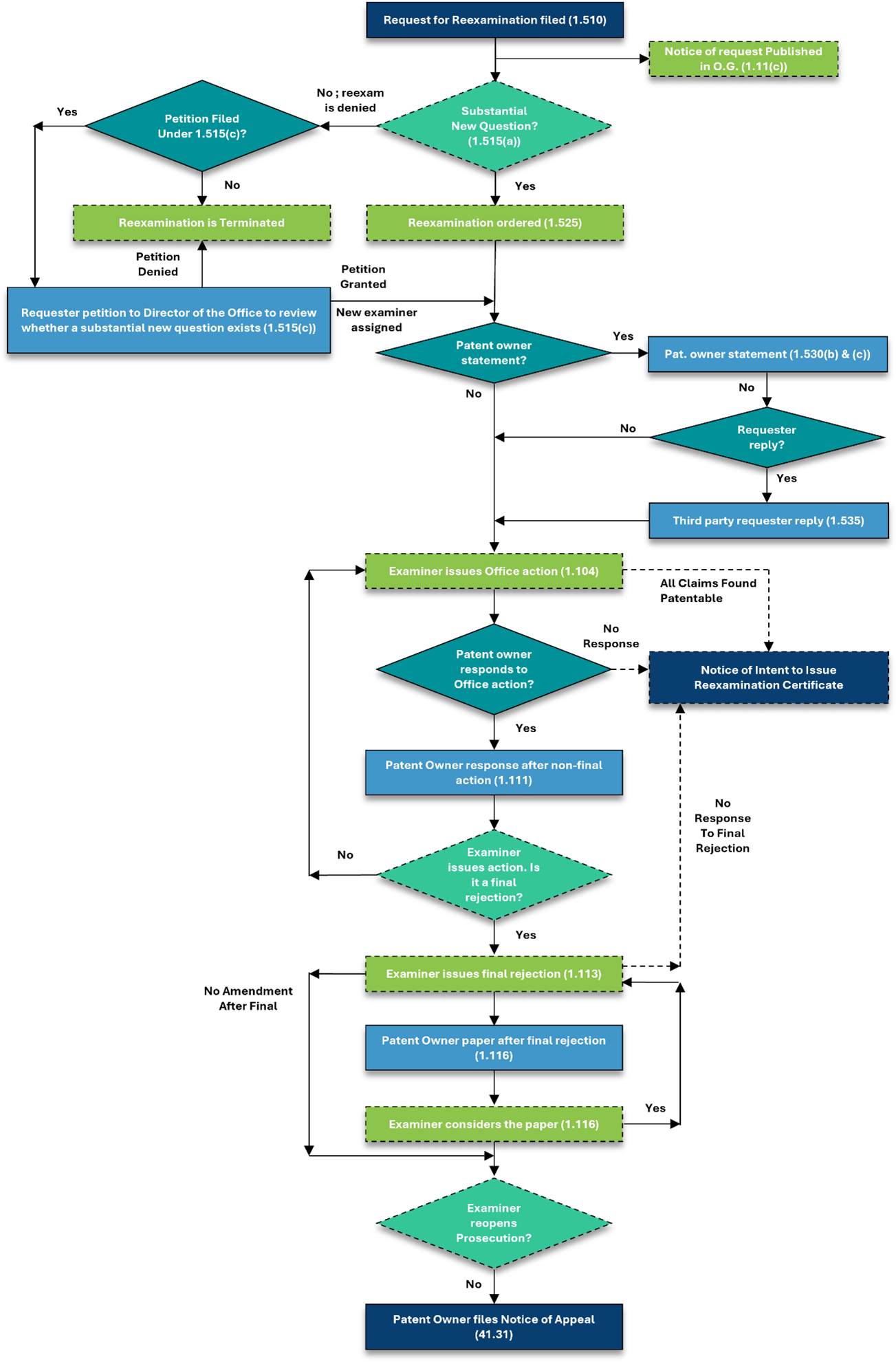
Figure 1: A flow chart detailing the EPR process, from the filing of a request to the filing of a notice of appeal. (Fig. 1 Alt. Text: A blue and green themed flow chart depicting the steps that go into EPR. The chart begins with the filing of a request for reexamination, proceeds to the determination of SNQP, then turns to the patent owner and requester statements, before showing the first and second office action and response steps. The flow chart culminates with the issuance of a reexamination certificate and optionally starting the appeals process.)
Broadly, the EPR process unfolds across three main stages:
- Filing Stage - Preparing and submitting an EPR request.
- Reexamination Stage – Examination of the claims, including office actions and responses.
- Appeal Stage – Optional, and to be discussed in the next EPR Academy installment.
This article addresses the filing and reexamination stages in detail.
The Filing Stage

Figure 2: The segments from the flow chart in Figure 1 pertaining to the Filing Stage. (Fig. 2 Alt. Text: A truncated version of the blue and green themed flow chart from Figure 1 depicting the “Request for Reexamination filed” and “Notice of request Published in O.G.” steps from the flow chart.)
The filing stage culminates in submitting a complete request for reexamination.[1] However, significant preparation is required leading up to submission, and it varies depending on whether the requester is a third party or the patent owner.
A complete EPR request generally consists of three categories of information:
- The “What” – The documents and records relating to the patent and prior art.
- The “Why” – The reasoning and evidence supporting a substantial new question of patentability.
- Administrative Requirements – Certifications, service requirements, and procedural compliance.
Each category is discussed below.
1. The “What”: Required Patent and Prior Art Documents
This section refers to the records related to the target patent of the EPR request, including:
-
- A complete copy of the patent at issue;[2]
- Any disclaimers, certificates of correction, or past reexamination certificates;[3]
- Copies of every prior art patent or printed publication cited in the request;[4] and
- A citation form listing each prior art patent and printed publication relied on in the request references.[5]
As in information disclosure statement (IDS) practice, U.S. patents and printed publications typically do not need to be submitted unless specifically required.[6]
Further, any complaint in a pending civil action, decision by a federal court, or interference or derivation decision involving the patent to be reexamined should also be included.[7]
2. The “Why”: Establishing a Substantial New Question of Patentability
The “why” category includes documents supporting the argument that at least one substantial new question of patentability (SNQP) exists. These include:
-
- A clear and detailed statement of any proposed SNQPs;[8]
- Identification of the claims-in-question;[9]
- An explanation linking the cited art to the challenged claims;[10]
- Optional expert declarations or affidavits;[11] and
- Optional proposed amendments (if the patent owner files the request).[12]
Because the SNQP determination is the threshold issue for ordering reexamination, the request must clearly articulate why the cited prior art raises a substantial and new question of patentability.[13]
The proposed SNQP must be “based on prior patents and printed publications.”[14] As such, questions of patentability based upon public use, on sale, or conduct by the parties are not appropriate grounds for establishing SNQP.[15] Further, even where prior patents or printed publications are relied upon, they must be applied directly to grounds under 35 U.S.C. §§ 102 & 103.[16]Using them as evidence of public use, on sale, etc. is insufficient.[17]
The request for reexamination must both identify the specific claim(s) for which reexamination is sought and provide an explanation linking the previous statement identifying SNQP and the identified claim(s).[18]Simply listing the claims to be reexamined and patents/publications, along with the statement identifying SNQP is insufficient.[19]Rather, there must be a complete explanation linking the claims, patents/publications, and the SNQP.[20]
The USPTO’s preferred format for the explanation is a claim chart breaking down each claim limitation and mapping it to corresponding disclosures in the cited patents/publications.[21]An example of this is seen below in Figure 3.
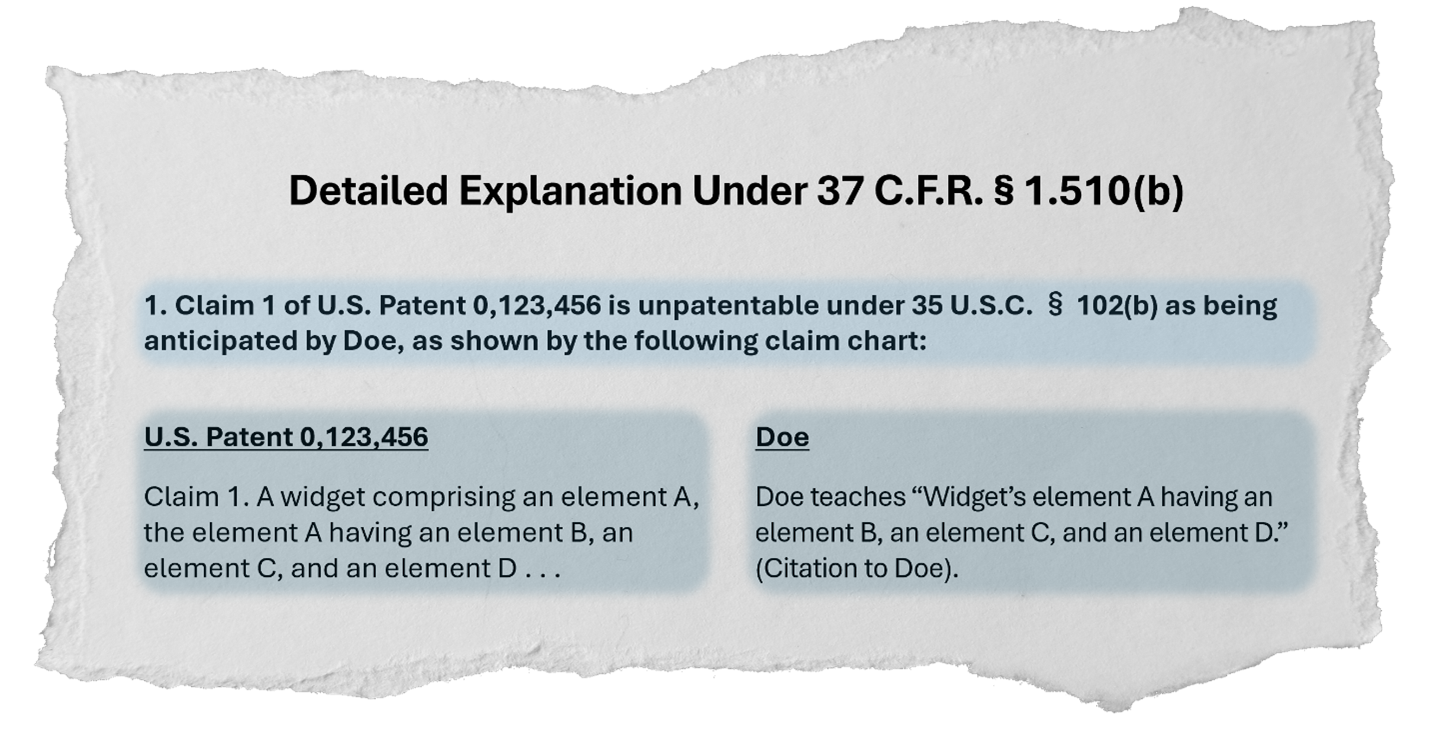
Figure 3: Example claim chart as the preferred format for the explanation linking SNQP to the claims to be challenged. (Fig. 3 Alt. Text: A claim chart graphic depicted as a torn piece of paper with the heading “Detailed Explanation Under 37 C.F.R. § 1.510(b).” The claim chart identifies “Claim 1” of U.S. Patent 0,123,456 as being unpatentable under 35 U.S.C. § 102(b) for anticipation by “Doe.” It then compares the language of the claim to the teachings of Doe to show that the claimed limitations are all taught by the Doe reference.)
There are also some optional aspects which may be included in support of or supplement to the reasoning in the request. First, a request may include proposed amendments if the requester is the patent owner.[22]This is an exception to the general rule that the patent owner cannot file a statement, response, or amendment until an EPR has been ordered.[23]Amendments are discussed further in the “Patent Owner’s Statement & Requester’s Reply” section below.
In addition to amendments, an EPR request may also optionally include affidavits, expert declarations, and other written evidence.[24]These often bolster the patents or printed publications used to establish a SNQP by explaining the contents or pertinent dates of those pieces of prior art in more detail.[25]
3. Administrative Requirements
A complete request must also include:
-
- Proof of service on the patent owner (for third-party requesters);[26]
- Certification the estoppel provisions of 35 U.S.C. §§ 315(e)(1) and 325(e)(1) do not apply;[27]and
- A cover letter explaining unsuccessful service attempts (if applicable).[28]
The Reexamination Stage
Phase I: SNQP Determination, Patent Owner’s Statement, and Requester’s Reply
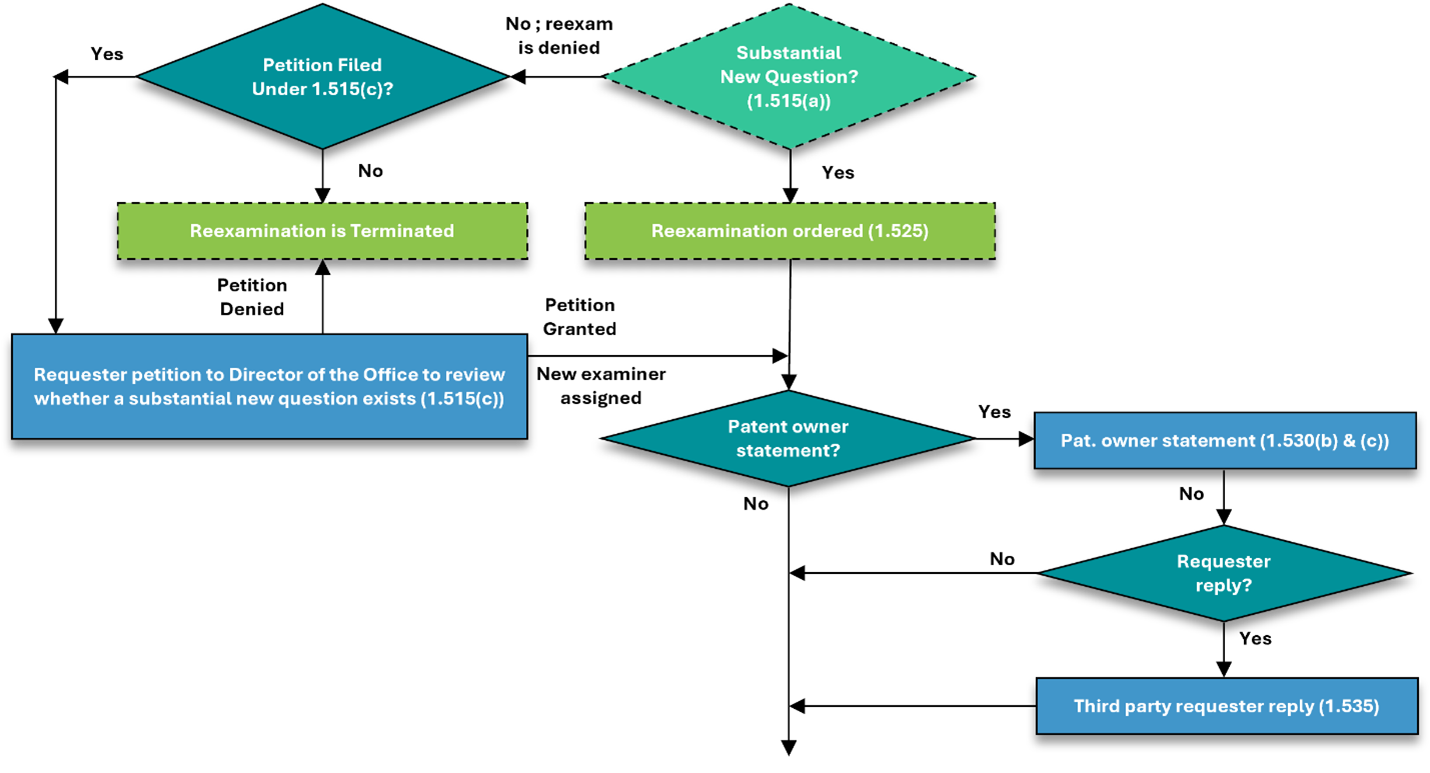
Figure 4: The segments from the flow chart in Figure 1 pertaining to Phase I of the Reexamination Stage, from the SNQP determination to the third-party requester’s reply. (Fig. 4 Alt. Text: A truncated version of the blue and green themed flow chart from Figure 1 depicting the steps from the flow chart involved in the SNQP determination, patent owner’s statement, and third-party requester’s reply.)
SNQP Determination
Once filed, the USPTO publishes the request in the Official Gazette the USPTO’s official journal.[29]The Examiner then has three months to determine whether an SNQP exists.[30]As of late 2025, though, determinations took only one month from filing on average.[31]
The standard for showing an SNQP is “a substantial likelihood that a reasonable examiner would consider the prior art patent or printed publication important in deciding whether or not the claim is patentable.”[32]Finding an SNQP does not require finding a prima facie case of unpatentability; that determination is reserved for the actual reexamination.[33]
Additionally, the SNQP must raise a new question of patentability, meaning one not previously decided by or currently pending before the USPTO.[34]The question cannot have been decided in a federal court’s final invalidity holding on the merits, either.[35]A determination that a SNQP exists leads to the granting of an order for reexamination.[36]
SNQP is a relatively low threshold compared to IPR or PGR institution. Between 2020 and 2024, EPR requests were granted at an average rate of 95%, compared with 63% for IPR and PGR petitions.[37]The contrast in institution rates has become even starker in 2025, with a year-to-date institution rate of only 50% for IPRs and PGRs, and a 98% grant rate for EPRs.[38]
Where the order for reexamination is denied for lack of an SNQP, the requester may petition for review.[39] These petitions are made to the Director of the Central Reexamination Unit (“CRU”) and must be filed within one month of the date the denial was ordered.[40]Failure to file a petition within that period means the determination is final and nonappealable.[41]Where a petition is filed, the CRU Director reviews under a de novo standard of review.[42]
Patent Owner’s Statement & Requester’s Reply
If reexamination is ordered:
- The patent owner has at least two months to file a statement.[43]
- A copy of the statement must be served on the requester.[44]
- The patent owner can waive their right to file a statement and expedite the reexamination process.[45]
- This will not be desirable in all cases but can be a useful means of speeding things up, particularly where the request is filed by the patent owner themself.
- The patent owner may submit amendments with their statement.[46]
- Regardless of when they are introduced, amendments during EPR cannot enlarge the scope of any claim or introduce any new matters to the patent.[47]
- After a patent owner’s timely filed statement, a third-party requester may file a reply.[48]
- The period for doing so is two months from the date the third-party requester is served with the patent owner’s statement.[49]The substance of the reply is not constrained by the substance of the statement, and can even introduce additional sources of prior art.[50]
After the reply, the process truly becomes ex parte and any involvement of third-party requesters is no longer permitted.[51]
Phase II: Examination and Office Actions
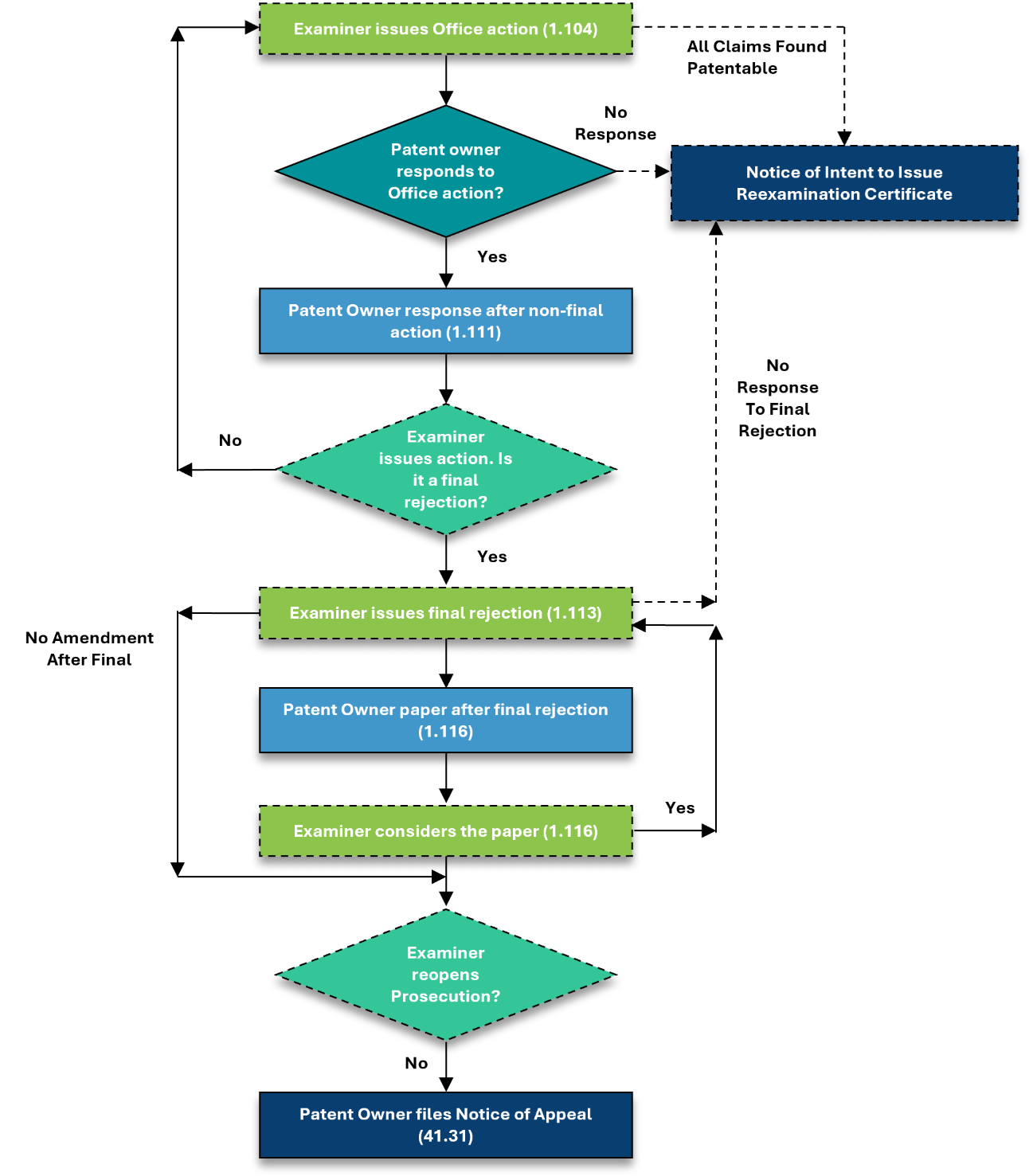
Figure 5: The segments from the flow chart in Figure 1 pertaining to Phase II of the Reexamination Stage, from the first office action to filing a notice of appeal. (Fig. 5 Alt. Text: A truncated version of the blue and green themed flow chart from Figure 1 depicting the steps from the flow chart involved in the actual reexamination and the Examiner’s resulting office actions.)
With the third party no longer permitted to participate, the examination phase of EPR becomes ex parte in nature, much like a normal examination, but with its own characteristics.
Reexamination & First Office Action
After the patent owner’s statement and third-party requester’s reply, the Examiner conducts their reexamination.
The Examiner conducts the reexamination with “special dispatch,” meaning these proceedings have priority over other proceedings.[52]Further, the reexamination focuses only on the SNQP and issues arising under 35 U.S.C. §§ 102 & 103.[53]
After conducting their reexamination, the Examiner issues a first office action, either confirming the claims, rejecting them, or a combination of both.[54]This is depicted below in Figure 6 through a representation of part of an office action cover sheet.
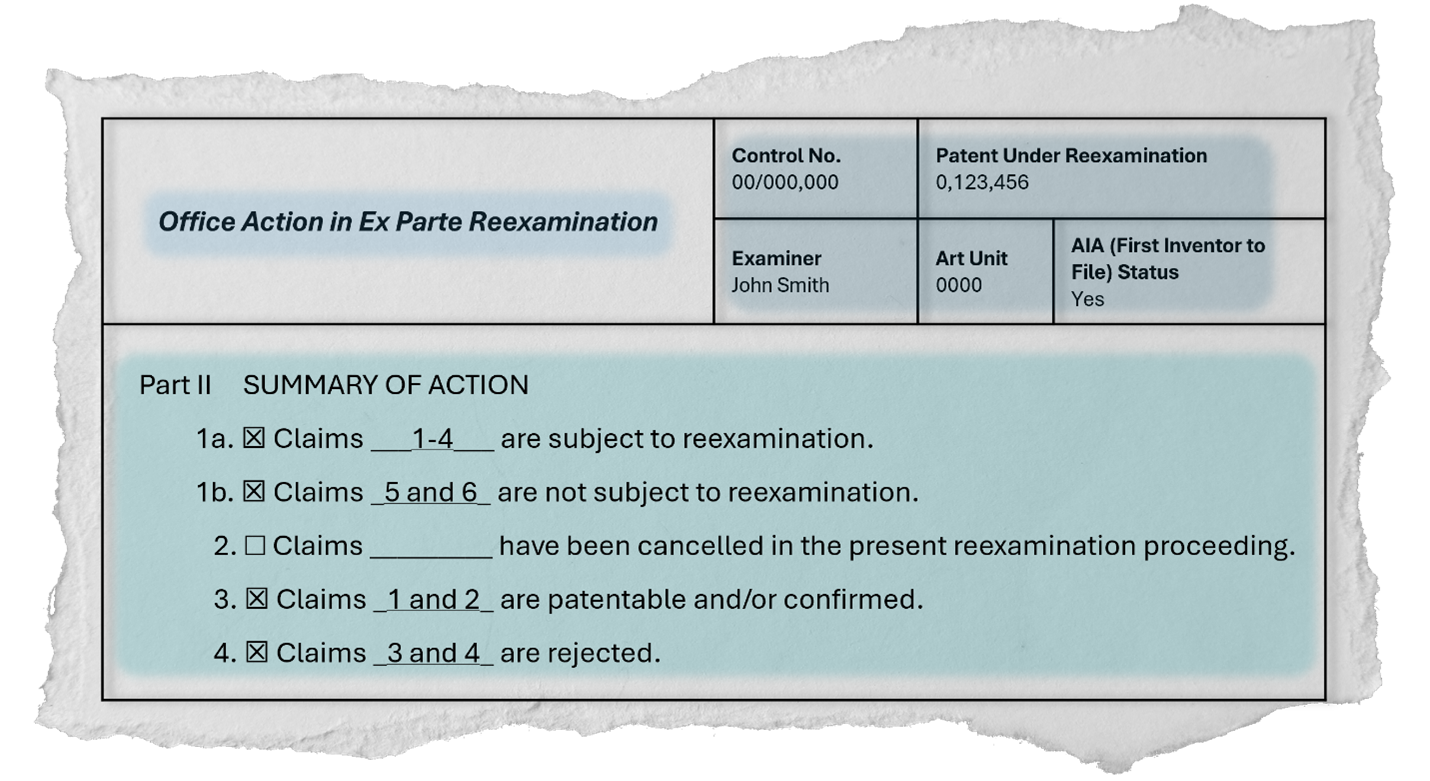
Figure 6: Table depicting the section of an office action cover sheet summarizing the action’s rejection and confirmation of claims. (Fig. 6 Alt. Text: An office action cover sheet graphic depicted as a torn piece of paper presenting the cover sheet’s header and “Part II Summary of Action” section. The “Summary of Action” includes a numbered list explaining that hypothetical claims 1-4 are subject to reexamination, while claims 5 and 6 are not. Furthermore, it explains that claims 1 and 2 are confirmed to be patentable, while claims 3 and 4 are rejected.)
If all claims are found patentable, the Examiner will file a Notice of Intent to Issue Reexamination Certificate (NIRC) and publish a reexamination certificate.[55]Where there are rejected claims, however, the patent owner then has the opportunity to respond.[56]Failure to reply results in termination of the proceeding, also leading to an NIRC and publishing of a reexamination certificate.[57]
Patent Owner’s Response to First Office Action
The patent owner generally has two months to file a response to the Examiner’s first office action.[58]Responses must address all grounds for rejection distinctly and specifically, and provide arguments for why the claims are patentable.[59]Amendments may be presented as well to overcome the Examiner’s rejections.[60]Extensions to the two month filing period can be requested, subject to additional fees, showing cause, or considerations of reasonableness.[61]
Final Office Action
The second office action is typically a final action.[62]
After a final action, the patent owner may:
- Petition to reopen prosecution, if they believe the final rejection or refusal to enter an amendment after final rejection was improper;[63]or
- Proceed toward appeal, which will be discussed in a future installment of Finnegan’s EPR Academy series.[64]
Final Steps: NIRC and Reexamination Certificate
Once reexamination concludes:
- The Examiner issues a Notice of Intent to Issue Reexamination Certificate (NIRC).[65]
- Any appeals must be pursued within 2 months or will become time-barred.[66]
- The USPTO publishes the reexamination certificate, which may:
- Cancel claims,
- Confirm claims, or
- Incorporate amended or new claims.[67]
Publication in the Official Gazette concludes the EPR proceeding.[68]
From Request to Resolution: Final Thoughts
From filing an EPR request to issuance of a reexamination certificate, the process can seem intimidating. This installment aims to demystify that journey and provide a clear roadmap for practitioners and patent owners alike.
Stay tuned for the next EPR Academy article, where we address special considerations in EPR, including appeals, interactions with parallel proceedings, and comparisons to other proceedings such as IPR, PGR, and reissue.
Endnotes
[1]37 C.F.R. § 1.510(a).
[2]37 C.F.R. § 1.510(b)(4).
[3]37 C.F.R. § 1.510(b)(4).
[4]37 C.F.R. § 1.510(b)(3).
[5]MPEP § 2217(I) (9th ed. Rev., Jan. 2024).
[6]MPEP § 2218 (9th ed. Rev., Jan. 2024).
[7] MPEP § 2219 (9th ed. Rev., Jan. 2024).
[8]37 C.F.R. § 1.510(b)(1).
[9]37 C.F.R. § 1.510(b)(2).
[10]37 C.F.R. § 1.510(b)(2).
[11]MPEP § 2214(II) (9th ed. Rev., Jan. 2024).
[12]MPEP § 2214(I) (9th ed. Rev., Jan. 2024).
[13]MPEP § 2216 (9th ed. Rev., Jan. 2024).
[14]37 C.F.R. § 1.510(b)(1).
[15]MPEP § 2216 (9th ed. Rev., Jan. 2024).
[16]MPEP § 2217(I) (9th ed. Rev., Jan. 2024).
[17]MPEP § 2217 (9th ed. Rev., Jan. 2024).
[18]37 C.F.R. § 1.510(b)(2).
[19]MPEP § 2217(I) (9th ed. Rev., Jan. 2024).
[20]MPEP § 2217(I) (9th ed. Rev., Jan. 2024).
[21]MPEP § 2217(I) (9th ed. Rev., Jan. 2024).
[22]37 C.F.R. § 1.510(e).
[23]37 C.F.R. § 1.530(a).
[24]MPEP § 2217(II) (9th ed. Rev., Jan. 2024).
[25]MPEP § 2217(II) (9th ed. Rev., Jan. 2024).
[26]37 C.F.R. § 1.510(b)(5).
[27]37 C.F.R. § 1.510(b)(6).
[28]MPEP § 2220 (9th ed. Rev., Jan. 2024).
[29]MPEP § 2229 (9th ed. Rev., Jan. 2024).
[30]37 C.F.R. § 1.515(a).
[31]U.S. Pat. & Trademark Office, Reexaminations – FY 2025 (2025).
[32]MPEP § 2242 (9th ed. Rev., Jan. 2024).
[33]MPEP § 2242 (9th ed. Rev., Jan. 2024).
[34]MPEP § 2242 (9th ed. Rev., Jan. 2024).
[35]MPEP § 2242 (9th ed. Rev., Jan. 2024).
[36]MPEP § 2240 (9th ed. Rev., Jan. 2024).
[37]U.S. Pat. & Trademark Office, Fiscal Year (FY) 2024 Workload Tables (2024); U.S. Pat. & Trademark Office, PTAB Trial Statistics FY24 End of Year Outcome Roundup IPR, PGR (2024).
[38]U.S. Pat. & Trademark Office, PTAB Trial Statistics 2025 End of Year Outcome Roundup (2025); U.S. Pat. & Trademark Office, Reexaminations – FY 2025 (2025).
[39]37 C.F.R. § 1.515(c).
[40]37 C.F.R. § 1.515(c).
[41]37 C.F.R. § 1.515(c).
[42]MPEP § 2248 (9th ed. Rev., Jan. 2024).
[43]37 C.F.R. § 1.530(b).
[44]MPEP § 2249 (9th ed. Rev., Jan. 2024).
[45]MPEP § 2249 (9th ed. Rev., Jan. 2024).
[46]MPEP § 2250 (9th ed. Rev., Jan. 2024).
[47]35 U.S.C. § 305.
[48]37 C.F.R. § 1.535.
[49]MPEP § 2251 (9th ed. Rev., Jan. 2024).
[50]MPEP § 2251 (9th ed. Rev., Jan. 2024).
[51]MPEP § 2251 (9th ed. Rev., Jan. 2024).
[52]MPEP § 2261 (9th ed. Rev., Jan. 2024); 35 U.S.C. § 304.
[53]MPEP § 2258 (9th ed. Rev., Jan. 2024).
[54]MPEP § 2260 (9th ed. Rev., Jan. 2024).
[55]MPEP § 2262 (9th ed. Rev., Jan. 2024).
[56]MPEP § 2266 (9th ed. Rev., Jan. 2024).
[57]MPEP § 2266 (9th ed. Rev., Jan. 2024).
[58]MPEP § 2263 (9th ed. Rev., Jan. 2024).
[59]37 C.F.R. § 1.111(b).
[60]37 C.F.R. § 1.111(c).
[61]37 C.F.R. § 1.550(c).
[62]MPEP § 2269 (9th ed. Rev., Jan. 2024).
[63]MPEP § 2272 (9th ed. Rev., Jan. 2024).
[64]MPEP § 2273 (9th ed. Rev., Jan. 2024).
[65]MPEP §§ 2262, 2266, and 2272 (9th ed. Rev., Jan. 2024).
[66]MPEP § 2273 (9th ed. Rev., Jan. 2024).
[67]35 U.S.C. § 307(a).
[68]35 U.S.C. § 307; MPEP § 2291(9th ed. Rev., Jan. 2024).
Related Offices
Related Professionals


- Dara M. Emami
- Associate
- Reston, VA
- +1 571 678 8856

- Guanshi Li, P.E.
- Associate
- Boston, MA
- +1 617 646 1653


- Caitlin T. Coverstone
- Patent Agent
- Washington, DC
- +1 202 408 4129
Copyright © Finnegan, Henderson, Farabow, Garrett & Dunner, LLP. This article is for informational purposes, is not intended to constitute legal advice, and may be considered advertising under applicable state laws. This article is only the opinion of the authors and is not attributable to Finnegan, Henderson, Farabow, Garrett & Dunner, LLP, or the firm’s clients.