
A Tale of Widows and (Sparkling) Wine: TTAB Cancels VEUVE OLIVIER Registration for Likelihood of Confusion with VEUVE CLICQUOT
April 12, 2024
Authored and Edited by Maxime I. Jarquin; Patrick J. Rodgers; Jenevieve J. Maerker
MHCS brought an action at the Trademark Trial and Appeal Board (TTAB) seeking to cancel Les Grand Chais de France’s registered mark VEUVE OLIVIER for “sparkling wines,” arguing that it creates a likelihood of confusion with, and dilutes, MHCS’s VEUVE CLICQUOT mark for “champagne.” Although MHCS asserted numerous registrations in its petition for cancellation, all for champagne or sparkling wines—including VEUVE CLICQUOT PONSARDIN, VEUVE CLICQUOT, LA VEUVE (“the widow” in French), THE WIDOW, and LA VIUDA (“the widow” in Spanish)—the TTAB focused on VEUVE CLICQUOT only. Given the strength of MHCS’s mark, the overlap of VEUVE, and the legally identical goods, the TTAB found that VEUVE OLIVIER creates a likelihood of confusion with VEUVE CLICQUOT, and therefore granted MHCS’s petition for cancellation. Having cancelled the registration on likelihood of confusion grounds, the TTAB did not reach MHCS’s dilution claim.
To prevail on a claim for likelihood of confusion, a petitioner must first establish priority. MHCS’s VEUVE CLICQUOT registration dates back to June 22, 1999 (when it filed the application); Les Grand Chais de France didn’t file its VEUVE OLIVIER application until January 16, 2015, and it submitted no evidence that it had used the mark before then. The TTAB thus easily concluded that MHCS had priority over the VEUVE OLIVIER application based on its VEUVE CLICQUOT registration.
Turning to the DuPont factors, the TTAB first considered the similarity of the parties’ goods—“champagne” for MHCS and “sparkling wine” for Les Grand Chais de France. While not precisely the same, the TTAB noted that champagne is a type of sparkling wine, specifically, “[a] sparkling white wine made from a blend of grapes, especially Chardonnay and Pinot, produced in Champagne.” Because Les Grand Chais de France’s identification of “sparkling wine” in its VEUVE OLIVIER registration was unrestricted, the TTAB presumed it encompassed all types of sparkling wine, including champagne. The TTAB thus concluded the goods were legally identical. And having found the goods legally identical, the TTAB also found that the channels of trade and classes of purchasers were the same. These factors all weighed heavily in favor of a likelihood of confusion.
Looking next to the strength of MHCS’s VEUVE CLICQUOT mark, the TTAB considered both its conceptual strength (distinctiveness) and its marketplace strength (secondary meaning or public recognition as a mark). VEUVE CLICQUOT is registered without a claim of acquired distinctiveness, so the TTAB presumed it to be inherently distinctive. Further, it found that the term VEUVE, which means “widow” in French, is arbitrary as applied to champagne, thus making it conceptually strong. Although the TTAB faulted MHCS for failing to identify how much of the total sales or advertising amounts it presented were attributable to champagne sold under the VEUVE CLICQUOT mark, the TTAB was nonetheless persuaded by MHCS’s considerable evidence of commercial strength, which included: the brand’s over 250-year history (since its founding in 1772 by Barbe Clicquot, the original widow at the company’s helm); its considerable sales of a wide array of champagne products in the United States (with the VEUVE CLICQUOT mark prominently displayed on the bottles, as shown in the examples below) for almost 175 years; its extensive advertising both in print and on the internet; and its high-profile events attracting celebrities and press attention (such as the Veuve Clicquot Polo Classic). The TTAB thus found the VEUVE CLICQUOT mark both conceptually and commercially strong, weighing in favor of likelihood of confusion.
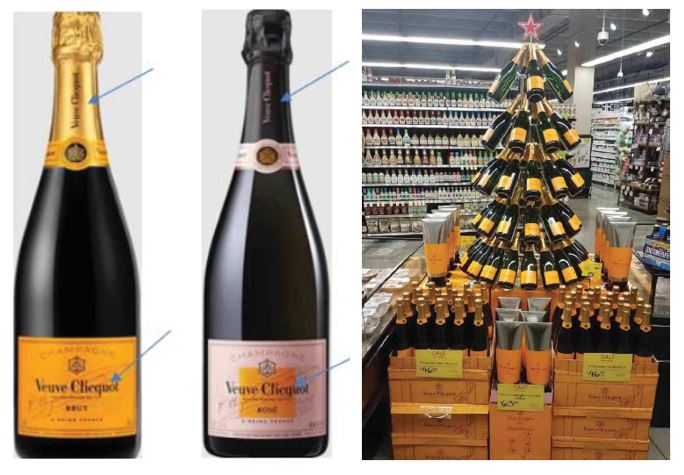
Finally, as to the similarity of the marks themselves, the TTAB found that—taken as a whole—VEUVE OLIVIER and VEUVE CLICQUOT look and sound different and have two different meanings if translated from French (“Widow Olivier” and “Widow Clicquot”). But the inquiry didn’t end there. The TTAB went on to find that, despite these differences, the word VEUVE is identical in both marks, and because it is the first word in both marks, it is the dominant term in each party’s mark. Moreover, the TTAB found that an “appreciable number of purchasers are unlikely to be aware that VEUVE means ‘widow’ and are unlikely to translate the marks into English.” As a result, the TTAB found that the differences in meaning between the marks would be lost on the purchasers and would therefore not aid them in distinguishing the marks. In the words of the TTAB “[t]hey will perceive only that the same French-looking and French-sounding word, VEUVE, appears as the first term in both marks.”
Having found that all of the DuPont factors weighed in favor of a likelihood of confusion, the TTAB granted MHCS’s petition to cancel Les Grands Chais de France’s VEUVE OLIVIER registration.
The case is MHCS v. Les Grands Chais De France, No. 92075021 (TTAB Mar. 8, 2024).
Related Practices
Related Industries
Related Offices
Contacts

- Maxime I. Jarquin
- Associate
- Washington, DC
- +1 202 408 4004

- Patrick J. Rodgers
- Associate
- Washington, DC
- +1 202 408 4374

- Jenevieve J. Maerker
- Of Counsel
- Boston, MA
- +1 617 646 1655
Copyright © 2024 Finnegan, Henderson, Farabow, Garrett & Dunner, LLP.
DISCLAIMER: Although we wish to hear from you, information exchanged in this blog cannot and does not create an attorney-client relationship. Please do not post any information that you consider to be personal or confidential. If you wish for Finnegan, Henderson, Farabow, Garrett & Dunner, LLP to consider representing you, in order to establish an attorney-client relationship you must first enter a written representation agreement with Finnegan. Contact us for additional information. One of our lawyers will be happy to discuss the possibility of representation with you. Additional disclaimer information.