
NantWorks, LLC v. Niantic, Inc.
September 18, 2020
By Zachery D. Olah; Karthik Kumar, Ph.D.; Rajeev Gupta, Ph.D.
This is our next thread of articles in our Augmented Reality/Virtual Reality Litigation Update series. In this series, we shine the spotlight on legal proceedings involving AR/VR technology. As we follow the proceedings in a continuously updated thread of articles, we discuss the AR/VR technologies involved, the intellectual properties at issue, and the litigation strategies and tactical maneuvers of the parties in litigation.
NantWorks LLC’s Complaints
In this installment, we highlight a recent case filed in the Northern District of California. On September 3, 2020, NantWorks, LLC sued Niantic, Inc. alleging that it infringed U.S. Patent Nos. 10,403,051 (the ’051 patent), 10,614,477 (the ’477 patent), and 10,664,518 (the ’518 patent). The case is captioned NantWorks, LLC v. Niantic, Inc., 3-20-cv-06262 (N.D. Cal. 2020).
By May 24, 2019, NantWorks and its associated business entities acquired ownership of the asserted patents by assignment from their original inventors. NantWorks owns all the rights associated with the asserted patents. In the complaint, NantWorks alleged that Niantic is accountable for direct and indirect infringement of each of the ’051 patent, the ’477 patent, and the ’518 patent through its Pokémon Go and Harry Potter mobile applications available on Android and iOS devices. According to NantWorks, Niantic infringed the asserted patents because each of the Niantic applications include superimposed AR objects over digital representations of the user’s real-world environment. Additionally, NantWorks alleged that each of Niantic’s applications infringe the asserted patents because they employ a “Dynamic Weather feature” that displays different AR images in the virtual environment as the real-world weather in the vicinity of the user changes. NantWorks’ indirect infringement allegations include claims that Niantic induces infringement by making its applications available to end users. Also, NantWork alleged that Niantic advertised its applications and encouraged its customers to infringe the asserted patents. The complaint concludes by asking the Court to find infringement, both direct and induced, and award monetary damages, including attorneys’ fees.
The ’051 Patent and ’518 Patent
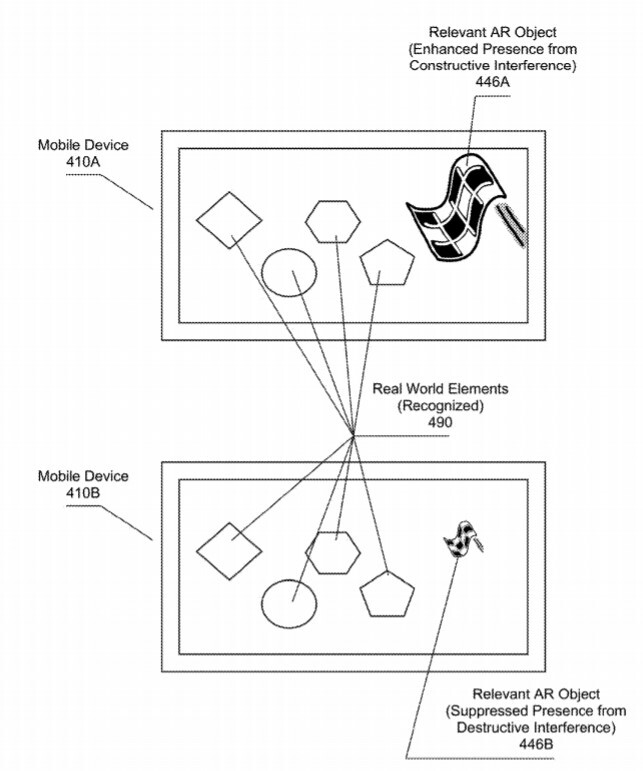
This article focuses on the ’051 and ’518 patents. The ’051 patent is titled “Interference based augmented reality hosting platforms.” According to NantWorks, the ’051 patent claims improvements in delivering realistic AR experiences that include AR objects that interact with each other in the virtual environment. Specifically, the ’051 patent claims using device location information, among other things, to identify AR objects available based on location of the device and to determine whether to alter the occurrence of the AR objects based on location information. This system of enhancing or including AR objects based at least on the device location is shown in Figure 4 of the ’051 patent.
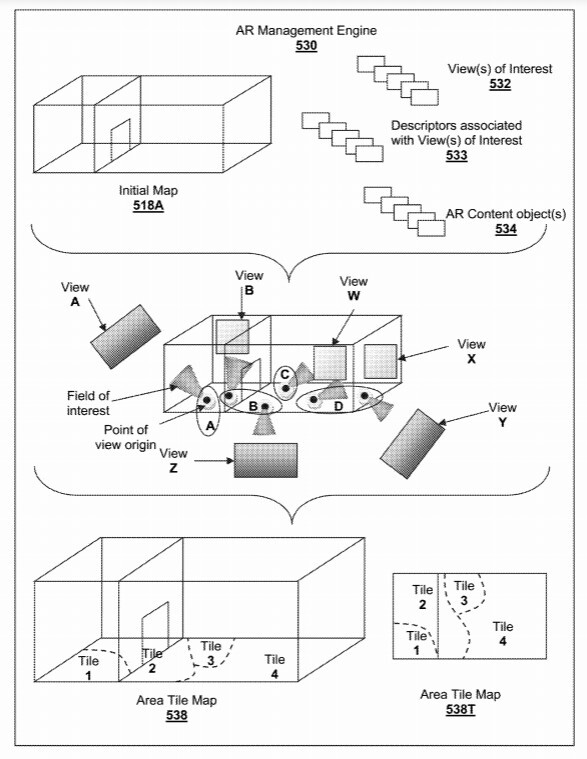
Additionally, the ’518 is titled “Wide Area Augmented Reality Location - Based Services.” According to ’518 patent, its disclosure provides an improvement to AR service technologies, especially those services based on location. In particular, the ’518 patent states that it improves on the prior art’s failure to consider that relevant AR areas have “various views of interest” and failure to differentiate between sub-areas in the AR image based on “AR content densities.” As such, the ’518 patent claims an AR device that is configured to include a map made up of multiple sub-areas. Further, the device uses location-based information to determine where the device is located within the map. The device’s location in a specific sub-area of the map can then trigger the display of an AR object on the device’s display. This system is best shown in Figure 5 of the ’518 patent.
The Accused AR/VR Products
As mentioned previously, the complaint alleges that Niantic directly and indirectly infringed the asserted patents via its Pokémon Go and Harry Potter mobile applications, which allow users to interact with the real-world while using AR technology. NantWorks’s complaint alleged that each of the accused applications display map views that depict real-world locations near the device running the application. NantWorks included screenshots of gameplay identifying how each application depicts a real-world location on the virtual map. According to the complaint, the technology included in Niantic’s applications place avatars at the location of the device within the virtual map based on location information provided by the device. Additionally, the location of the device allegedly leads to the user’s ability to see or interact with different AR content within the virtual map.
Next Steps
If this case does not settle, we may see the defendant answer the complaint, or perhaps move to dismiss the complaint as deficient in some respect. Niantic may choose to take other action against the asserted patents, including filing a petition for inter partes review challenging the patentability of the asserted patents. We will keep you posted of future developments in this AR/VR litigation.
Related Practices
Related Offices
Related Professionals


Copyright © Finnegan, Henderson, Farabow, Garrett & Dunner, LLP. This article is for informational purposes, is not intended to constitute legal advice, and may be considered advertising under applicable state laws. This article is only the opinion of the authors and is not attributable to Finnegan, Henderson, Farabow, Garrett & Dunner, LLP, or the firm's clients.


