FORUM IP Talks: Kara Specht on Patent Litigation in the U.S.
October 7, 2025
FORUM IP Talks
Finnegan partner Kara Specht was interviewed by FORUM IP Talks on patent litigation in the U.S. She is scheduled to speak at the 3rd edition of the Global Patent Litigation FORUM in Munich on October 23.
Kara, let's talk about a PTAB recent decision involving the new USPTO director before we delve into some issues of patent litigation in the U.S.. What are some guidelines for determining patentability for AI and software inventions, particularly in view of recent decisions by the USPTO, like Ex Parte Desjardins (Appeal 2024-000567)?
The framework for determining whether AI and software meets the patent eligibility requires is constantly evolving. In Ex Parte Desjardins, the U.S. Patent and Trademark Office has taken the position that "categorically excluding AI innovations from patent protection” could lead to negative consequences, suggesting that the Office will be more receptive to applications on software and AI innovations going forward. Applicants should focus on describing the "genuine technological improvement" in how the machine learning model operates in their applications. The Office seems to be most receptive to technological improvement that were concrete. In Ex Parte Desjardins, those improvements included reduced storage, enhanced efficiency, and the ability to preserve knowledge across training tasks. Importantly, these improvements should not only be reflected in the specification of the application but in the claims being examined as well. Looking forward to future applications under examination, the decision in Ex Parte Desjardins explained that “§§ 102, 103 and 112 are the traditional and appropriate tools to limit patent protection to its proper scope. These statutory provisions should be the focus of examination.” Applicants, therefore, should continue to be prepared to address those statutes during examination. We expect to see further guidance from the Office and the Courts on how the patentability standards will apply to AI and software innovations and expect the jurisprudence to continue to refine the legal framework and analysis applied.
Where do appellants most often misjudge the standard (de novo vs. abuse of discretion vs. substantial evidence), and how should that reshape issue selection and briefing?
Determining and addressing the standard of review for the issue presented is, in my opinion, the most important portion of the appeals process. Especially for appeals coming from the PTAB. Appellants often stretch to argue that the de novo standard applies to gain a fresh review by the Federal Circuit, even when the true dispute lies in the factual underpinnings of a legal conclusion – which would merit a substantial evidence or abuse of discretion standard of review. Especially in areas like obviousness law, where the conclusion of whether a claim is rendered obvious is a legal determination, disputes raised sometimes truly lie in the factual determinations underlying the legal conclusion. When selecting issues to raise on appeal, legal issues that receive a de novo review are generally seen as highest priority. Thus, to the extent an issue can be framed such that it is rooted in a legal conclusion, it should be raised in the appeal. But, for mixed questions, appellants should also consider and address in briefing the substantial evidence or abuse of discretion standards head on any underlying factual disputes to bolster the primary legal argument.
Which single case-management move (claim narrowing, early damages contentions, phased discovery, ESI discipline) most changes bargaining power in NPE cases right now?
While it is difficult to note just a single case-management move, claim narrowing has been most effective recently. We are seeing an increasing number of NPEs assert many patents with large numbers of claims. Because trials are usually limited to a week or two, both parties know all the patents and claims cannot be asserted effectively at trial. But raising allegations on a large number of patents and claims provides significant leverage to the plaintiff early in the case for several reasons. First, it makes it difficult to challenge the validity of the patents, particularly if the claims cover a broad scope of features. To effectively challenge the validity of every claim in a large, broad batch requires extensive (and expensive) prior art searching, complicated contentions, and likely multiple petitions for inter partes review. Second, it complicates non-infringement, particularly if a large number of independent claims are asserted. A defendant must then investigate all claims as compared to accused products, possibly developing many non-infringement positions based on the difference in scope between the claims, while maintaining consistency. Third, damages analysis also becomes complicated, particularly when apportionment is at issue and the claims related to a large swath of different features.
To streamline the issues, target the strongest defenses, and prepare a cohesive defense strategy, narrowing the asserted patents and claims early in the case helps to put a defendant on stronger ground. Narrowing is often done in stages, with the court’s guidance and precedent, often taking place either before or after claim construction, before expert reports, and then again before trial. As a defendant, the sooner you can narrow the scope of the case, the better. Developing creative approaches, and researching your particular court’s standard narrowing procedures, can greatly increase leverage in the case.
What timing and facts most reliably win (or defeat) a stay pending IPR/PGR, and how should parties choreograph petitions and claim elections?
Of the factors considered for a stay, simplification of the issues before the court often weighs most heavily. That is, a defendant seeking a stay should present clear and tangible explanations of what issues before the court will be simplified during the IPR proceeding, should the stay be granted, and why those issues will be simplified and make the court’s job easier if the stay is ever lifted and the case resumes. To present this persuasively, defendants should bring a motion to stay as early as feasible. The earlier the stay motion is brought, the more probable it is that issues will be simplified and the burden on the court reduced by avoiding duplication. A good example is claim construction. If constructions are proposed and disputed in an IPR, that could simplify that issue before the court, assuming the court has not already conducted claim construction proceedings. Additionally, to a party considering challenging a patent in IPR, the potential for simplification is greatly reduced if all asserted claims are not challenged at the PTAB. As general guidance, challenging all claims in the patent (or at minimum all asserted claims) and doing so quickly, provides the best potential for stay of the district court litigaiton.
What’s your rule of thumb for aligning invalidity theories, claim construction, and expert work so the case “travels” cleanly across PTAB and district court without estoppel traps?
Under the current PTAB guidance, this is an important consideration for petitioners. Entering into Sotera stipulations has become standard practice for petitioners, which essentially triggers estoppel upon institution of the petition rather than upon a final written decision. Without a stipulation, petitioners were free to raise the same prior art and grounds before the district court as they raised in their IPR petitions. But with a stipulation, petitioners must now prepare from an early stage to be estopped, likely relying on only system art and other non-publication-based invalidity positions at the district court. A petitioner will want to ensure they have strong system prior art and other defenses before entering into a Sotera stipulation because they will likely be facing estoppel much sooner than they would absent the stipulation. This reuqires building complementary invalidity positions between the PTAB and the district court, rather than relying on a single position in both forums.
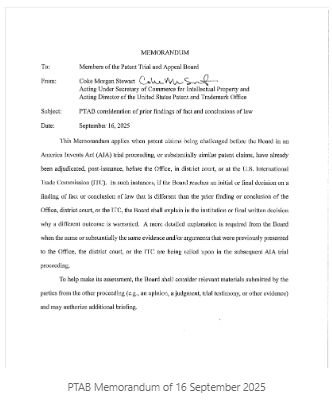
Moreover, the Board’s latest guidance memorandum, issued on September 16, 2025, requires that ‘“if the Board reaches an initial or final decision on a finding of fact or conclusion of law that is different than the prior finding or conclusion of the Office, district court, or the ITC, the Board shall explain in the institution or final written decision why a different outcome is warranted.” The memorandum requires petitioners to ensure that they are carefully considering the theories, constructions, and testimony being submitted both before the district court and at the Board to avoid inconsistencies.
Before committing to PTAB, which data points (parallel-proceeding posture, petitioner profile, art strength, scheduling) genuinely move the denial needle?
The latest guidance from the Board suggests there are four strong positions to avoid discretionary denial: 1) identifying material error in the original prosecution of the patent; 2) demonstrating that the patent owner has never commercialized a product for its patent; 3) showing that the patent is “new” (issued within the last six years); and 4) demonstrating that the PTAB proceeding will conclude before or around the time of the district court’s conclusion. The first two materially impact the way a petitioner may build its case.
For position 1, the Board has indicated that material error in prosecution rises above an examiner simply overlooking or failing to identify a reference. Instead, it requires that the examiner misapplied a reference or misunderstood its teachings, and if the examiner had properly applied and understood the reference, the patentability calculus may have come out differently in the first instance. Often, petitioners look to identify prior art that had not been previously identified. Armed with this guidance from the Board, however, a petitioner might begin its assessment with the patent’s own file history, looking to identify any errors that may have occurred during prosecution and building its challenge around that error.
For position 2, the Board has indicated that arguing for non-commercialization requires more than just a conclusory statement. Instead, petitioners should build the evidence showing how long the patent has been in force, track the assignment history of the patent to show what entities have had rights to it, and explain clearly how the evidence shows that the patent has not been commercialized over its enforcement period. Importantly, the petitioner should also provide evidence of how it has commercialized a product in the relevant space, often done by citing infringement contentions from a parallel litigation and providing some background on the products at issue. With the right facts, this can be an effective way to combat a patent owner’s settled expectations, particularly if the patent has been in force for more than six years.