
‘Designed’ to Scale? Design Application Pendency Down Despite Increased Filings
May 13, 2016
Authored and Edited by Justin N Mullen; Elizabeth D. Ferrill
On May 5, the U.S. Patent and Trademark Office and the Patent Public Advisory Committee held their quarterly meeting at the USPTO’s Alexandria headquarters. Of a number of topics, the meeting included a patent operations update. Particularly, their slides (reproduced below) highlighted a few trends in design patent application filings.
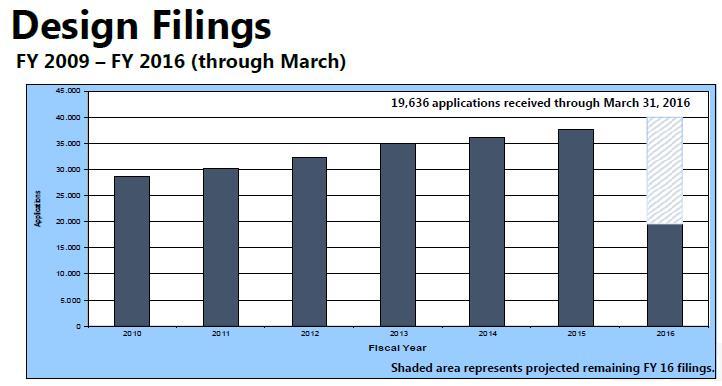
At the halfway mark in the USPTO’s fiscal year, almost 20,000 design applications have been filed for 2016. Moreover, as shown in the chart, the Office forecasts that the total number of design application filed this year will exceed 40,000 applications for the first time. For comparison, the year-over-year increase in design application filings amounted to 3.4% and 1.8% in 2014 and 2015, respectively. A total of 40,000 filings would surge to an 8.4% increase for 2016.
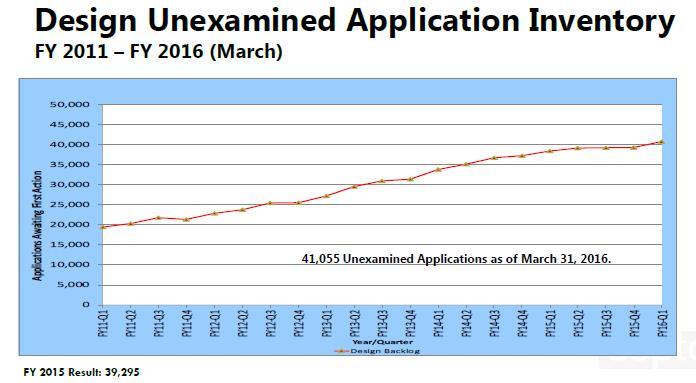
As one could likely foresee, such a surge has caused a parallel uptick in the USPTO’s unexamined design application inventory, as shown below. While inventory appeared to flat-line throughout FY2015, the first quarter of 2016 has brought the unexamined application inventory to a high mark, crossing the 40,000 application line for the first time in recent history.
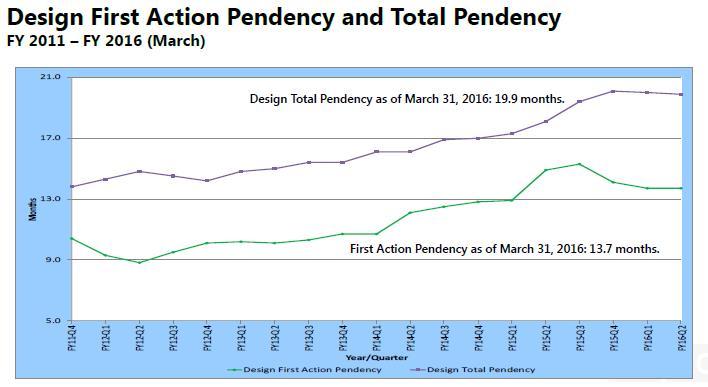
However, despite the potential record number of filings and increased inventory, both first action pendency and total pendency for design applications has decreased slightly in FY2016 Quarter 2 to 13.7 months and 19.9 months, respectively. While still historically high for design application, this pendency is well below average pendency for non-design applications (i.e., utility, reissue, and plant applications), which was 26.6 months in FY 2015.
As we reported back in March, this pendency for design applications remains historically high, despite the large increases in the workforce at TC2900, the technology center that examines design patent applications. But this dip in pendency in Q2 suggests that perhaps the pendency will trend downward as the new examiners finish their training and come up to speed. The new examiners are quite welcome given the potential record number of application filings this year.
As with other events, the USPTO has provided the presentation materials to the public, selections from which were incorporated into this post.
Related Practices
Contacts

Copyright © 2016 Finnegan, Henderson, Farabow, Garrett & Dunner, LLP.
DISCLAIMER: Although we wish to hear from you, information exchanged in this blog cannot and does not create an attorney-client relationship. Please do not post any information that you consider to be personal or confidential. If you wish for Finnegan, Henderson, Farabow, Garrett & Dunner, LLP to consider representing you, in order to establish an attorney-client relationship you must first enter a written representation agreement with Finnegan. Contact us for additional information. One of our lawyers will be happy to discuss the possibility of representation with you. Additional disclaimer information.

