
TTAB Affirms Trademark Rejection Based On Functionality
November 02, 2015
Authored and Edited by Jonathan D. Uffelman; Naresh Kilaru; Julia Anne Matheson
On September 29, 2015, the TTAB affirmed an Examining Attorney’s refusal to register product configuration trade dress on the Supplemental Register on functionality grounds. The case underscores the difficulty of securing registration of product configuration trade dress (on any register) when functionality issues are in play.
Applicant Heatcon, Inc. sought to register the three-dimensional configuration shown below for industrial equipment that fabricates bonded composite materials:

The Board applied the traditional four-factor test under In re Morton-Norwich Prods., Inc., 671 F.2d 1332, 1340-1341 (CCPA 1982) to determine whether the design is functional. That test considers (1) the existence of a utility patent disclosing the utilitarian advantages of the design; (2) whether advertising materials tout the design’s utilitarian advantages; (3) the availability to competitors of functionally equivalent designs; and (4) whether the design results from a comparatively simple or inexpensive method of manufacturing the product.
As to the first factor, the Examining Attorney noted the existence of a third-party patent for a portable curing system for repairing vacuum bags:
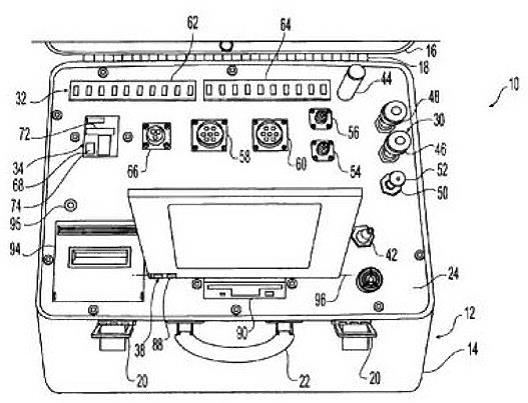
The Board noted a number of similarities between Heatcon’s product and the patented device. Significantly, the patent disclosed that the specific arrangement of various functional features would lead to utilitarian advantages such as allowing the air input line to be easily connected to the port, easily discharging air or other fluid into the environment, and easily plugging the vacuum sensor lines into the connectors. Given the weight accorded utility patent evidence in the functionality analysis, the Board found that this patent was prima facie evidence that Heatcon’s design was functional.
Regarding the second factor, the Board found that Heatcon’s own advertising materials promoted specific utilitarian advantages of the applied-for configuration, including the device’s ergonomic design. Additionally, there were third-party references touting the utilitarian advantages of Heatcon’scentral display, and competitors’ advertising materials for products with similar features promoted the functional advantages of those features.
As to the third factor, the Examining Attorney rejected the alternative designs Heatcon submitted because they did not show alternative configurations that provided the same utilitarian benefit. The Board also noted that once functionality is found based on other considerations, there is “no need to consider the availability of alternative designs because the feature cannot be given trade dress protection merely because there are alternative designs available.”
Finally, on the fourth factor, the Board found that Heatcon did not submit sufficient evidence for any determination to be made on whether Heatcon’s product was comparatively simple or inexpensive to manufacture.
On balance, the Board found that the arrangement of the product’s features was directed by utilitarian concerns. Each part was essential to the function of the device and placed in such a way as to make the operation easier, safer, and more efficient.
The case is In re Heatcon, Inc., Ser. No. 85281360.
Contacts

- Jonathan D. Uffelman
- Domain Name Specialist / Attorney
- Washington, DC
- +1 202 408 4328

Copyright © 2015 Finnegan, Henderson, Farabow, Garrett & Dunner, LLP.
DISCLAIMER: Although we wish to hear from you, information exchanged in this blog cannot and does not create an attorney-client relationship. Please do not post any information that you consider to be personal or confidential. If you wish for Finnegan, Henderson, Farabow, Garrett & Dunner, LLP to consider representing you, in order to establish an attorney-client relationship you must first enter a written representation agreement with Finnegan. Contact us for additional information. One of our lawyers will be happy to discuss the possibility of representation with you. Additional disclaimer information.