
Counterfeiting Claim Muffled by Lack of “Spurious” Intent to Trick Consumers
July 15, 2020
Authored and Edited by Rosie Norwood-Kelly; Margaret A. Esquenet
The “substantially indistinguishable” appearance of a senior and junior mark is not enough to seal the deal on a trademark counterfeiting claim according to the District Court of Connecticut. The junior user’s mark must also be indistinguishable in a way that tricks the consumer into thinking she is getting the product associated with the senior user’s registered mark.
Illinois Tool Works, Inc. (ITW) has used the mark MUFFLER WELD for its muffler and tailpipe sealer since 1977. The sealer is contained in a small black tub and packaged in the middle of a bright orange flame motif with the MUFFLER WELD mark in capital white letters at the top of the packaging, as pictured below. The house brand, VersaChem, under which ITW sells the sealer, appears on the lid of the black tub.
In 2018, J-B Weld Co. began to sell its own muffler sealer under the product name MufflerWeld. The J-B Weld MufflerWeld sealer is dispensed from a white squeezable tube with alternating red and black bands onto which the J-B Weld logo is superimposed, as pictured below. The MufflerWeld product name appears directly beneath the logo.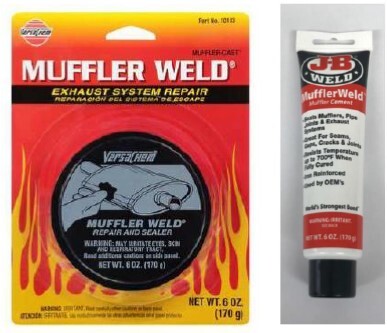
Based on this branding, ITW filed a complaint against J-B Weld alleging it infringed and counterfeited its MUFFLER WELD mark.
While litigation was pending, the court granted ITW’s motion for preliminary injunction to prevent J-B Weld from continuing to market its product using the MufflerWeld name. In doing so, it concluded ITW was likely to prevail on its trademark infringement claim. The court compared the parties’ products side-by-side and determined that while there were “obvious” differences in the products’ packaging, the products displayed nearly identical names. Therefore, ITW had succeeded in showing the likelihood of confusion necessary for a preliminary injunction. J-B Weld then moved to dismiss ITW’s claim that it had engaged in counterfeiting, arguing the facts as pleaded in the complaint were inconsistent with such an allegation.
Citing Second Circuit case law to establish the standard for determining whether trademark counterfeiting had occurred, the court concluded the allegedly counterfeit product must be examined “from the standpoint of an average consumer” and be compared the “with the registered mark imprinted on actual merchandise.” ITW argued that because J-B Weld’s mark was identical ITW’s mark, it pleaded facts sufficient for finding the mark was counterfeit. The court, however, determined this argument “read out an important word in the Lanham Act’s definition of a counterfeit mark: “spurious.”” Therefore, the court held it is not enough that the mark be “substantially indistinguishable,” the mark must actually trick consumers into believing they are purchasing the senior product. This determination cannot be done by simply looking at the marks in the abstract. Rather, a court must look at the appearance of the mark on the “actual merchandise.”
In viewing the products as a whole, the court found the differences in the products’ packaging–i.e. color schemes, distinct house marks, sizes, and dispensing mechanisms–distinguished the products in a way that would make it highly unlikely a “customer experiencing the marks in commerce would believe that the infringing product was the senior product.” Further, the court determined this analysis holds true even in an online context where the probability of confusion is higher than would occur in a retail setting. Without this “trick” confusion fundamental to a counterfeit, the court granted J-B Weld’s motion to dismiss ITW’s counterfeiting claim with prejudice.
The case is Ill. Tool Works Inc. v. J-B Weld Co., No. 3:19-cv-01434 (JAM) (D. Conn. Dec. 20, 2019).
Related Practices
Related Industries
Related Offices
Copyright © 2020 Finnegan, Henderson, Farabow, Garrett & Dunner, LLP.
DISCLAIMER: Although we wish to hear from you, information exchanged in this blog cannot and does not create an attorney-client relationship. Please do not post any information that you consider to be personal or confidential. If you wish for Finnegan, Henderson, Farabow, Garrett & Dunner, LLP to consider representing you, in order to establish an attorney-client relationship you must first enter a written representation agreement with Finnegan. Contact us for additional information. One of our lawyers will be happy to discuss the possibility of representation with you. Additional disclaimer information.
