
Section 101 Patent Subject Matter Eligibility Requirements
October 4, 2024
Aerospace Manufacturing and Design
As the pace of innovation in the aerospace industry continues to skyrocket, innovators are looking to patents to protect their new developments.[1] As one example, Textron Aviation (which includes Beechcraft, Cessna, and Hawker) has worked to “empower innovation and creativity” through patent protection and ended 2023 with a historic number of patent filings.[2]
Many new aerospace innovations go beyond developing new physical components and instead improve aircraft sensing and control. These innovations rely on new ways to gather, analyze, and/or respond to data gathered in or around the aircraft. For example, innovations in autonomous flight control, electric power distribution, and emergency response all rely on some form of data analysis process.
The patent subject matter eligibility requirements of 35 U.S.C. § 101 continue to pose an obstacle for many aerospace innovators seeking to patent inventions relying on a data analysis process. These inventions are often considered an abstract idea of either a mental process or mathematical concept and thus ineligible for patent protection.[3]
This article explains the § 101 patent subject matter eligibility requirements, explores examples of inventions confronted with § 101 challenges, and provides recommendations to overcome § 101 challenges.
Overview of Section 101
Under 35 U.S.C. § 101 an invention is eligible for a patent if it is a “new and useful process, machine, manufacture, or composition of matter, or any new and useful improvement thereof.”[4] To avoid monopolization of the “basic tools of scientific and technological work,” courts have developed exceptions to these broad categories. In particular, courts prohibit the patenting of laws of nature, physical phenomena, and abstract ideas.[5] Abstract ideas include mathematical concepts, mental processes, and methods of organizing human activity.[6]
The U.S. Patent and Trademark Office (USPTO) and courts review the claims and specification to determine whether § 101 eligibility requirements are met. The claims define the scope of intellectual property rights. The specification describes the invention and provides support for the claims. A patent application may be denied or a patent invalidated if the claims, when read in view of the specification, are directed to an abstract idea.
When § 101 Challenges Are Not Overcome
Aerospace innovators are often not able to overcome § 101 challenges when their claims focus heavily on a data analysis process without sufficiently incorporating other claim elements. When determining the claims do not overcome a § 101 challenge, the court or USPTO often notes that the claimed invention does not provide a technical improvement to a physical device.
In Ex Parte Cassio Wallner, for example, the USPTO rejected a patent application directed to “analyzing and assessing structural damage to an aircraft during operation of the aircraft”[7] as a process that “can be performed in the human mind.”[8]
The claims compared “sensed aircraft structural damage data with at least one predetermined limit specified in [a] structural repair manual associated with the aircraft” and “automatically determine[ed], in response to the comparing and results of the specific structural analysis, a damage disposition.”[9] The USPTO considered both analysis steps abstract ideas that could be performed in the human mind by simply comparing damage limits to the aircraft’s AFM/POH.[10]
While the claims recited additional elements, including a “sensor” that gathered the data and “generating a report,” the USPTO considered these elements to be recited in “general terms” that would not protect from preemption of the abstract idea.[11] Instead, the USPTO found the claimed invention simply automated a known manual process using a computer, which is not permitted.[12] To survive a challenge under § 101, the claims needed to “recite how the result is achieved,” not just “state that the intention … is to accomplish the desired result.”[13] The USPTO distinguished the claimed invention from a system that controlled a physical process or provided another improvement to technology, which can overcome § 101 challenges.[14]
Similarly, in Wisk Aero LLC v. Archer Aviation Inc., the U.S. District Court for the Northern District of California invalidated patents directed to flight controllers that calculate the distribution of rotor power in a multi-rotor aircraft as “mathematical techniques.”[15]
The claims determined “a combination of the actuators and associated actuator parameters” to achieve force and moment inputs by “minimizing a weighted set of costs” or by determining “a solution space based on current capabilities of the actuators.” The Court considered these analysis steps to simply recite an abstract idea of “a new mathematical step in [a known] computational technique.”[16]
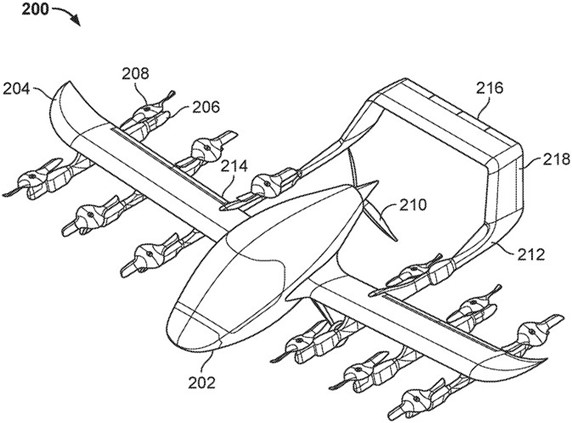
U.S. Patent Nos. 10,364,036 and 11,034,441, Fig. 2A
While the claims recited additional physical elements, like an aircraft, actuators, and flight controllers, the Court found that the claimed inventions did not improve the technical functioning of those physical elements or explain how the flight controller redistributes rotor power.[17] In fact, the Court found that the recited physical elements of “an aircraft” and a “flight controller” were “generic.”[18] These physical elements did not advance over known aircrafts or flight controllers which can overcome § 101 challenges.[19]
When § 101 Challenges Are Overcome
Despite the hurdle provided by § 101, some aerospace innovators have had success protecting their ideas through patents even when they include a data analysis process. Successful innovators often draft claims with specific elements that integrate the data analysis into a way to physically improve a device and provide support for the physical improvement in their specification.
In Ex Parte Howard P. Austerlit, the claims included the data analysis steps of “calculating the fluid height in the fixed tank” and “obtaining a scale factor by dividing a known vertical spacing between the first and second pressure sensors by a difference in the pressure sensed between the first and second pressure sensors.”[20] The USPTO considered both analysis steps abstract ideas of a mathematical concept.[21]
However, the USPTO noted that the additional elements of a “first sensor” and a “second sensor” and the relative placements integrated the claims into a practical application. The USPTO found that the claimed invention provided “a specific improvement in a practical application, namely a system for measuring fuel levels which limits the presence of electrical wires in the field tank and lowers the overall weight of components needed to measure fuel levels.”[22]
Likewise, in Ex Parte Jose Luis Lemus Martin, the USPTO considered assigning priorities to electrical loads based on mission parameters and available energy from a power source to be a mental process.[23]
However, the USPTO noted that the additional claim elements of a power management system that optimizes power usage by performing the data collection and analysis steps “repetitively during performance of the mission” integrated the abstract process into a practical application. The USPTO therefore found that the claimed invention provided an improvement to “the operation of an aerial vehicle by managing and optimizing its power usage.”[24]
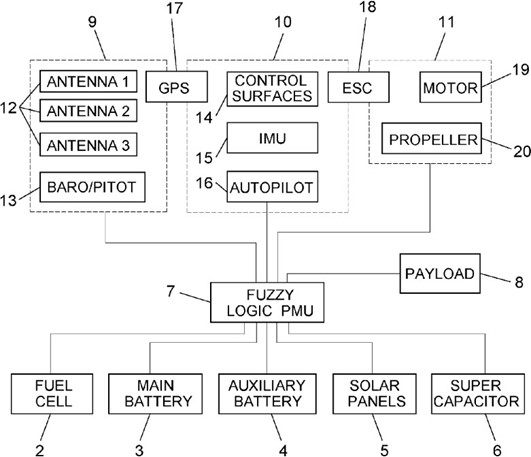
U.S. Patent Application Publication No. US 2017/0313419, Fig. 1
Recommendations to Overcome § 101 Challenges
As detailed above, patents or patent applications that include specific additional elements that tie a data analysis process to a device’s physical improvements are more likely to overcome § 101 challenges. Aerospace innovators can follow the below steps to improve their chances of obtaining a patent and avoiding invalidation.
First, innovators should consider the physical implementation of their invention and what improvements might result. For example, innovators can highlight improvements to physical devices used to gather data, such as those provided by the sensor arrangement in Ex Parte Howard P. Austerlitz. Innovators can also consider whether the response to data analysis improves the functioning of a physical device, as it did in the for the in-flight power transfer process of Ex Parte Jose Luis Lemus Martin.
Technical advancements over known systems may be the clearest way to overcome § 101 challenges like those in Ex Parte Cassio Wallner and Wisk v. Archer. For example, improvements in sensors and methods of drawing data,25 measuring devices or techniques generating new data,[26] improvements to component control,[27] and dynamic user interfaces that automatically move and prioritize icons[28] have all been considered sufficient to overcome § 101 challenges. Emphasizing improvements like these will raise aerospace innovators’ chances of obtaining strong patent protection.
Second, the specification should fully explain any identified physical improvements or applications of an abstract idea. The USPTO requires the specification to explain how to implement the invention with sufficient technical detail that a skilled engineer can recognize the patent’s improvement.[29] Explaining how to accomplish a stated goal may avoid challenges like those in Ex Parte Cassio Wallner and Wisk v. Archer.
Third, claims that tie a data analysis process to its practical application may help aerospace innovators obtain strong patent protection. In Ex Parte Jose Luis Lemus Martin, the USPTO found that tying power management activities to the performance of the mission practically integrated the abstract idea and overcame the § 101 challenge.[30] Abstract ideas cannot be patented due to concerns they may hinder innovation by limiting access to mathematical concepts and mental processes.[31] So, linking a patent back to a practical improvement can open a path to strong patent protection.
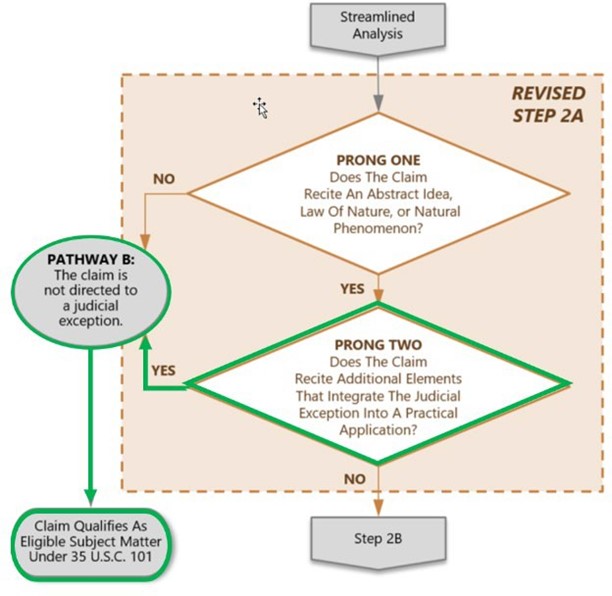
USPTO Training Materials on Subject Matter Eligibility (green emphasis added)
Hope for Aerospace Patent Protection
Aerospace innovators will continue to create new and ground-breaking innovations that rely on data analysis processes. For example, aviation innovations have led to such amazing results as Garmin’s Autoland technology, winner of the 2020 Robert J. Collier Trophy. But even the most cutting-edge inventions may be found abstract without physical implementations or practical improvements. By clearly explaining the ties between mathematical concepts and physical components, aerospace innovators can continue to develop and rely on strong patents to protect their creations.
Endnotes
- See Lionel M. Lavenue, Joseph M. Myles, Andrew N. Schneider, Exploring Patent Trends in Aerospace Electrification, Finnegan Articles, https://finnegan.com/en/insights/articles/exploring-patent-trends-in- aerospace- electrification.html#:~:text=General%20Trends,PLC%20filing%20the%20most%20applications.
- See Established Patent Culture leads to Historic Year for Textron Aviation Inventors, Journey – Business Aviation Insights, Resources, and Stories, https://txtav.com/en/journey/articles/articles/established-patent-culture-leads-to-historic-year
- See Ex Parte Cassio Wallner, Paulo Anchieta Da Silva, Ricardo Rogulski, Ricardo Pinheiro Rulli, & Tomaz Lazanha, No. APPEAL 2020-001152, 2020 WL 3483953, at *2 and 15 (P.T.A.B. June 16, 2020).
- 35 U.S.C. § 101
- MPEP 2106.4 (e9 r10. 2022).
- Id.
- Wallner, 2020 WL 3483953, at *2.
- Id. at *15.
- Id. at *2–3.
- Id. at *14.
- Id. at *17.
- Id. at *18.
- Id.
- Id.
- Wisk Aero LLC v. Archer Aviation Inc., No. 3:21-CV-02450-WHO, 2022 WL 1157489, at *4–6 (N.D. Cal. Apr. 19, 2022).
- Id.
- Id. at *7.
- Id.
- Id.
- Ex Parte Howard P. Austerlitz, Ronald W. Bueter, Stanley Wood, & Lewis J. Boyd, No. APPEAL 2019- 000693, 2020 WL 2572591, at *4 (P.T.A.B. May 18, 2020).
- Id.
- Id. at *5.
- Ex Parte Jose Luis Lemus Martin, Sergio Pereira Mayan, & Eduardo Gabriel Ferreyra, No. APPEAL 2021-000844, 2021 WL 4130016, at *4 (P.T.A.B. Sept. 9, 2021).
- Id.
- See Thales Visionix, Inc. v. United States, 850 F.3d 1343, 1348-49, 121 USPQ2d 1898, 1902 (Fed. Cir. 2017).
- See Electric Power Group, LLC v. Alstom, S.A., 830 F.3d 1350, 1355, 119 USPQ2d 1739, 1742 (Fed. Cir. 2016).
- See Jaguar Land Rover Ltd. v. Bentley Motors Ltd., 388 F. Supp. 3d 665, 678 (E.D. Va. 2019).
- See MPEP 2106.4(a)(1) (e9 r10. 2022).
- MPEP 2106.05(a) (e9 r10. 2022).
- Martin, 2021 WL 4130016, at *4.
- See MPEP 2106.05(e)
Related Practices
Related Offices
Related Professionals


- Joseph M. Myles
- Associate
- Washington, DC
- +1 202 408 4372

Originally printed in Aerospace Manufacturing and Design on October 4, 2024. This article is for informational purposes, is not intended to constitute legal advice, and may be considered advertising under applicable state laws. This article is only the opinion of the authors and is not attributable to Finnegan, Henderson, Farabow, Garrett & Dunner, LLP, or the firm’s clients.