
Cedar Lane Technologies Inc. v. Corel, Inc.
April 29, 2020
By Zachery D. Olah; Karthik Kumar, Ph.D.; Rajeev Gupta, Ph.D.
In our Augmented Reality/Virtual Reality Litigation Update series, we shine the spotlight on legal proceedings involving AR/VR technology. As we follow the proceedings in a continuously updated thread of articles, we discuss the AR/VR technologies involved, the intellectual properties at issue, and the litigation strategies and tactical maneuvers of the parties in litigation.
Cedar Lane’s Complaints
In this installment, we highlight a recent case filed in the Western District of Texas. On April 2, 2020, Cedar Lane Technologies Inc. sued Corel, Inc., alleging that it infringes six of its U.S. patents, specifically, U.S. Patent Nos. 6,700,999 (the ’999 patent), 6,972,774 (the ’774 patent), 7,292,261 (the ’261 patent), 7,733,368 (the ’368 patent), 8,031,223 (the ’223 patent), and RE44,087 (the ’087 patent). This article focuses on the ’261 patent, the ’368 patent, and the ’223 patent, each of which claims different aspects of a virtual reality camera. The case is captioned Cedar Lane Technologies Inc. v. Corel, Inc., 1-20-cv-00352 (W.D. Tex. 2020).
On May 13, 2019, Cedar Lane acquired ownership of the ’261 patent, the ’368 patent, and the ’223 patent by assignment from previous owners. Each patent had been previously assigned to parties other than the original inventors. The complaint alleges that Corel is responsible for direct and indirect infringement of the patents at issue through Corel’s Roxio Creator NXT program and its Panorama Assistant feature because it directs its employees to test the Roxio Creator NXT platform and sells the platform to its customers so that they can use the product in an infringing manner. The complaint further alleges that Corel distributes and sells this product to customers for their own use in a manner that infringes the claims of the patents at issue. This sale and distribution are the basis for Cedar Lane’s indirect infringement claims, specifically induced and contributory infringement. Cedar Lanes’ complaint concludes by asking the Court to find each of its patents enforceable, to reach a judgment of infringement by Corel, and to award money damages, including reasonable attorney’s fees.
The ’261, ’368, and ’223 Patents
The ’261, ’368, and ’223 patents (the patents) are all titled “Virtual reality camera.” They claim systems, apparatuses, and methods for capturing images, overlaying them on top of one another, and facilitating the creation of a panoramic image. One application of the patented technology is to utilize it in an augmented reality application. When applied in this manner, the patented technology is directed to taking a first image and displaying a portion of that first image such that the user can orient the field of view in the camera to ensure that a second image matches with the portion of the first image that is displayed. This technology is portrayed in Figure 1 of each of the patents.
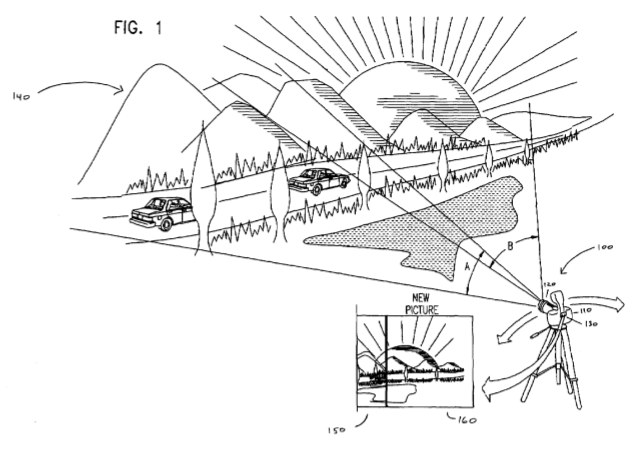
The claims of the patents that are asserted in this case are directed to methods of creating a panoramic image that involves taking multiple images, converting those images, and aligning overlapping portions of the converted images to create a final panoramic photograph.
The Accused AR/VR Products
As mentioned above, the complaint accuses Corel, Inc. of direct and indirect infringement of the patents for their role in developing and selling their Roxio Creator NXT platform, including the Panorama Assistant feature. The Roxio Creator NXT platform allows users to input images that the platform can then convert from “a rectilinear-based view to a cylindrical-based view.” This conversion makes the images appear curved so the user can orient the images in the desired order. Screenshots of the Roxio Creator NXT platform included in exhibits of the complaint show that the Panorama Assistant can then “work its magic” to “automatically align[]” the images so that they can be merged into a panoramic photograph. To support its claims, Cedar Lane includes additional screenshots of the Roxio Creator platform interface in exhibits attached to the complaint. The screenshots show the instructions and steps required to take single images to create a panoramic image.
Next Steps
If this case doesn’t settle, we may see the defendants answer the complaints, or perhaps move to dismiss the complaints as deficient in some respect. Other actions they may take include filing petitions for inter partes review challenging the patentability of the patents and claims at issue in this case. We will keep you posted of future developments in this AR/VR litigation.
Related Practices
Related Offices
Related Professionals


Copyright © Finnegan, Henderson, Farabow, Garrett & Dunner, LLP. This article is for informational purposes, is not intended to constitute legal advice, and may be considered advertising under applicable state laws. This article is only the opinion of the authors and is not attributable to Finnegan, Henderson, Farabow, Garrett & Dunner, LLP, or the firm’s clients.