
Streamlining Appeals for Small Entities
January 22, 2016
Authored and Edited by Leslie A. McDonell
On September 18, 2015, the Patent Trial and Appeal Board (PTAB) launched a Streamlined, Expedited Patent Appeal Pilot (S-EPAP) program for Small Entities. As with the Expedited Patent Appeal Pilot (EPAP) program, the S-EPAP program for Small Entities is intended to reduce the overall number of appeals pending before the Board.
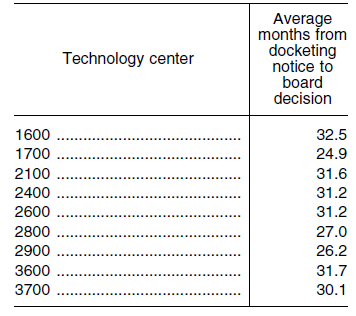
Typically, patent appeals are taken up by the Board in the order in which they are docketed; the current average pendency of an ex parte appeal is around 30 months. The current pendency of decided appeals in applications for each Technology Center decided this fiscal year is shown in the following table:
Under the S-EPAP program for Small Entities, a small or micro entity appellant who has only a single appeal pending before the Board, and agrees to streamline the appeal may file a request to have the appeal granted special status and advanced out of turn for a Board decision. The goal of the pilot program is for the Board to render a decision on the appeal granted special status no later than six months from the date of filing of the petition. As a result, the streamlining of an appeal could potentially expedite the time it takes for the invention to be patented and brought to the marketplace.
To participate in S-EPAP program for Small Entities, an appellant need only make a certification and file a petition to make special under 37 C.F.R. 41.3 (Form PTO/SB/438) to the Chief Administrative Patent Judge. The USPTO provides a form-fillable PDF (Form PTO/SB/441) for use in the certification and petition, and waives the petition to make special fee in this instance. The petition under 37 CFR 41.3 must be signed by a registered practitioner who has a power of attorney under 37 CFR 1.32, or has authority to act under 37 CFR 1.34, for the application involved in the appeal to be made special.
In the petition, appellant must:
- Certify that the appeal to make special is the appellant’s only appeal pending before the Board as of September 18, 2015, and was docketed with the Board on or before September 18, 2015;
- Certify that status as a small entity or micro entity has been established and is still appropriate in the application underlying the appeal to be made special;
- Agree that for each ground of rejection applying to two or more claims, the Board may select a single claim from the claims subject to each ground of rejection and decide the appeal to be made special with respect to every claim subject to that ground of rejection on the basis of the selected claim alone;
- Certify that the appeal to be made special does not involve any claim subject to a rejection under 35 U.S.C. 112; and
- Agree to waive any oral hearing in the appeal to be made special, and acknowledge that any oral hearing fees paid in connection with the appeal to be made special will not be refunded.
The Board’s goal for handling an S-EPAP application is to:
- Render a decision on the petition to make the appeal special no later than 2 months from the filing date of the petition; and
- Render a decision on the appeal made special no later than 4 months from the date a petition to make an appeal special is granted.
The USPTO adopted S-EPAP for Small Entities on a temporary basis, i.e., until two thousand (2,000) appeals have been accorded special status under the program, or until September 16, 2016, whichever occurs earlier. As with other pilot programs, the USPTO may extend the pilot program, depending upon its results.
Currently, the USPTO has not published any statistics on S-EPAP for Small Entities.
For more information on the S-EPAP program for Small Entities, visit their FAQs page on the USPTO website.
Copyright © 2016 Finnegan, Henderson, Farabow, Garrett & Dunner, LLP.
DISCLAIMER: Although we wish to hear from you, information exchanged in this blog cannot and does not create an attorney-client relationship. Please do not post any information that you consider to be personal or confidential. If you wish for Finnegan, Henderson, Farabow, Garrett & Dunner, LLP to consider representing you, in order to establish an attorney-client relationship you must first enter a written representation agreement with Finnegan. Contact us for additional information. One of our lawyers will be happy to discuss the possibility of representation with you. Additional disclaimer information.

