
Applicants These Days: Who are they? And, How Can they be Changed?
January 12, 2016
Authored and Edited by Adriana L. Burgy; Stephanie M. Sanders
What’s the situation?
For applications having an actual filing date on or after September 16, 2012, a party applying for a patent has the option of naming the inventor or joint inventors of the invention as the applicant or naming the assignee, an obligated assignee, or a person who otherwise shows sufficient proprietary interest in the application as the applicant. To File or Not to File as an Applicant-Assignee: That is the Question, a post on the Finnegan AIA Blog, provides insight into the strategy behind determining which entity to list as the applicant.
How will the USPTO recognize the assignee as the applicant?
For the USPTO to recognize an assignee (or other party as described above) as the applicant in an application, assignee information must be included in the Applicant Information section of the Application Data Sheet (ADS) (PTO/AIA/14). The USPTO will not accept an attempted designation of the assignee as the applicant in any other fashion. When naming the assignee as the applicant in the first instance, i.e., on the same day the application is filed, proof that an assignment has been executed and recorded is not required at that time (although it is best practice to record such an assignment well in advance of paying the issue fee). If the Applicant Information section is left blank, the USPTO will recognize the inventor or joint inventors as the applicant.
Can the applicant be changed during prosecution?
Once an applicant—the inventor(s) or the assignee—is accepted by the USPTO, it can be changed; however, a number of steps are required to do so. In particular, in order to change the applicant from the inventor(s) to the assignee, the USPTO requires the following documentation:
1. Request to Update Applicant Under 37 C.F.R. § 1.46(c) - Be sure to include a request for an Updated Filing Receipt.
2. Corrected ADS – A Corrected ADS in compliance with 37 C.F.R. § 1.76(c) must be filed in order to change the applicant to the assignee. To prepare a Corrected ADS, strikethroughs must be applied to deleted or changed information and new or updated information must be underlined. Be sure to add the application number (underlined) in the appropriate field and the text “Corrected ADS” to the top of each sheet. For more information on correcting an ADS in applications filed on or after September 16, 2012, see MPEP 601.05(a).
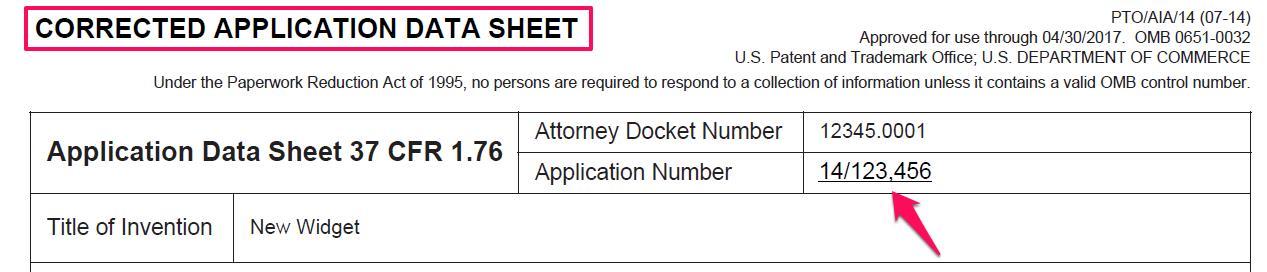
Add “Corrected Application Data Sheet” to the top of each sheet.
Add the application number (underlined) in the appropriate field on each sheet.
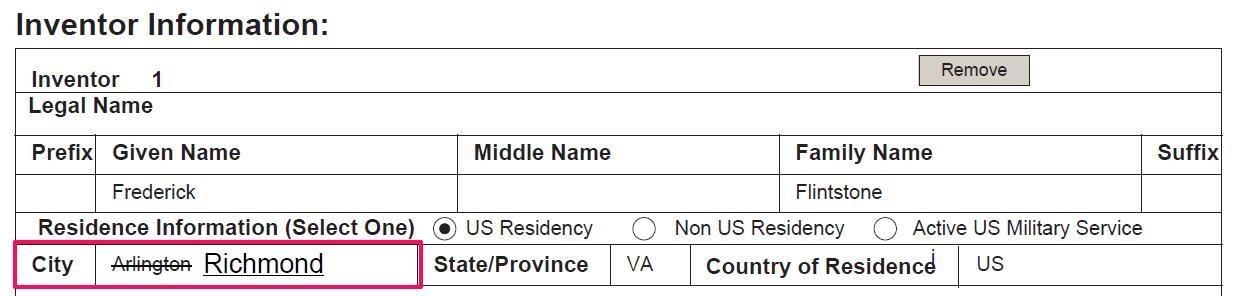
Strikethrough information to be deleted and underline information to be added.
3. Statement under 37 C.F.R. § 3.73(c) – A Statement under 37 C.F.R. § 3.73(c) (PTO/AIA/96 ) is required when changing the applicant to the assignee anytime after the original filing.
4. Power of Attorney from New Applicant - Because the applicant always signs a Power of Attorney (e.g., PTO/AIA/82) in an application filed on or after September 16, 2012, if the applicant changes, a new Power of Attorney is required. For more information on Powers of Attorney in applications filed on or after September 16, 2012, please see "Who Has the Power? Granting Power of Attorney in AIA Applications."
Tags
patent application, Assignee-Applicant, assignment, Power of Attorney, United States Patent and Trademark Office (USPTO)
Contacts

Copyright © 2016 Finnegan, Henderson, Farabow, Garrett & Dunner, LLP.
DISCLAIMER: Although we wish to hear from you, information exchanged in this blog cannot and does not create an attorney-client relationship. Please do not post any information that you consider to be personal or confidential. If you wish for Finnegan, Henderson, Farabow, Garrett & Dunner, LLP to consider representing you, in order to establish an attorney-client relationship you must first enter a written representation agreement with Finnegan. Contact us for additional information. One of our lawyers will be happy to discuss the possibility of representation with you. Additional disclaimer information.

