
Anticipation Law Does Not Permit Finding Missing Claim Elements Based Only on Artisans “Immediately Envisioning Them”
April 13, 2017
Authored and Edited by J. Derek McCorquindale; Eric P. Raciti

The recent Federal Circuit decision, Nidec Motor Corp. v. Zhongshan Broad Ocean Motor Co. Ltd. et al., No. 2016-1900 (Fed. Cir. Mar. 14, 2017), explained the anticipation teachings of earlier precedent and unanimously reversed the invalidity determination of the Patent Trial and Appeal Board (“PTAB”). In the March 14, 2017, panel opinion by Circuit Judge Moore, alongside Circuit Judges Lourie and Taranto, the court rejected the PTAB’s anticipation analysis and corrected a misapplication of 35 U.S.C. § 102 used to invalidate a claim.
In inter partes review No. IPR2014-01122, the petitioners Zhongshan Broad Ocean Motor Co. Ltd., Broad Ocean Motor LLC, and Broad Ocean Technologies, LLC (collectively “Broad Ocean”) alleged that claim 21 of Nidec Motor Corp.’s (“Nidec”) U.S. Patent No. 7,208,895 (the “’895 patent”) was invalid as anticipated by U.S. Patent No. 5,569,995 (“Kusaka”). Nidec’s ’895 patent discloses a system for controlling the torque of an electromagnetic motor. Slip op. at 2. The motor control values are expressed from two different frames of reference: the stationary frame of reference and the rotating frame of reference. Id. at 3.
According to the court, “[t]he dispute in this case centers on the vectorize block 212.” Id. It further explained, using Fig. 2, that
The inputs to the vectorize block are reference currents IQr demand 208 and Idr demand 209. The IQr and Idr demand signals are “concatenated” in vectorize block 212 to produce IQdr demand signal 214. Id. at 3:3–13.
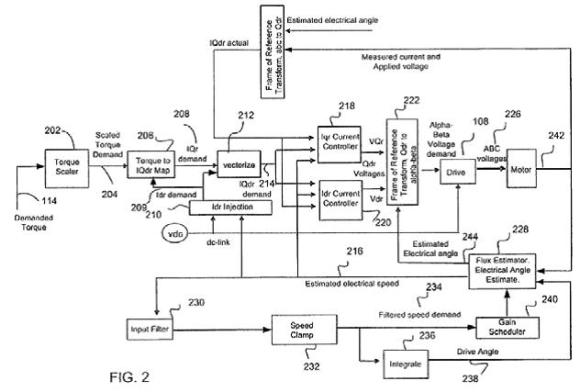
Id. at Fig. 2. Claim 12, from which challenged claim 21 depends, requires “combining the IQr demand and the dr- axis injection current [Idr] demand to produce an IQdr demand.” Id. at 10:1–16.
Slip op. at 3. The Board interpreted: (1) “IQr demand” as “Q-axis demand current;” (2) “dr-axis injection current demand” as “d-axis injection current;” and (3) “IQdr demand” as “a current demand that includes Q and d-axis current demands.” Id. at 4. While the last of these elements was the focus of the eventual appeal, none of these constructions was challenged as incorrect.
Based on the foregoing constructions, the PTAB determined that Kusaka anticipates claim 21 of the ’895 patent, finding that the prior art’s reference currents Iq and Id disclosed the “IQr demand” and “dr-axis injection current demand” limitations, respectively, and that “the set of Iu*, Iv*, and Iw* is an IQdr demand.” Id. The PTAB thus found every element of the subject claim disclosed in Kusaka, and invalidated it under § 102 in a final written decision.
Nidec appealed, arguing that Kusaka cannot anticipate claim 21 of the ’895 patent as a matter of law because it does not disclose “produc[ing] an IQdr demand.” Id. at 5 (citing Appellant’s Brief for the argument that “Kusaka discloses three separate phase currents in the stationary frame of reference, rather than an IQdr demand, which must be in the rotating frame of reference”). The Federal Circuit agreed with Nidec on appeal, holding that the PTAB incorrectly found every claim element in a single prior art reference. The court reversed the PTAB’s decision that Kusaka anticipates claim 21 because the PTAB’s findings were not deemed supported by substantial evidence, as “Kusaka fails to disclose an IQdr demand.” Id. at 6.
The court noted that “[t]hroughout the IPR proceedings, both Nidec and Broad Ocean took the position that the IQdr demand must be a signal in the rotating frame of reference,” a shared position based on the specification. Id. (citing ’895 patent at 3:14–25 and finding that “[a]fter leaving the vectorize block, the IQdr demand signal is converted to a vector of motor voltages in the rotating frame of reference. This vector is then converted into three reference voltages in the stationary frame of reference, which are applied to the motor”). Thus, according to the court, “the IQdr demand signal itself must be in the rotating frame of reference.” Id. at 6.
The court explained that the PTAB incorrectly “identified Kusaka’s set of reference currents Iu, Iv, and Iw as disclosing an IQdr demand, but those signals are not in the rotating frame of reference.” Id. The PTAB had suggested that, despite the fact that Kusaka does not disclose a signal in the rotating frame of reference, it could disclose an IQdr demand nonetheless based on its reading of Kennametal, Inc. v. Ingersoll Cutting Tool Co., 780 F.3d 1376, 1381 (Fed. Cir. 2015). According to the Board, anticipation could be found even when a prior art reference fails to disclose a claim element so long as a skilled artisan reading the reference would “at once envisage” the claimed arrangement. Slip op. at 6. But the “Board’s misapplication of Kennametal improperly assumed disclosure of a claim element.” Id.
The court elaborated that in Kennametal,
the challenged claim required a ruthenium binding agent and a PVD coating to be used together. The prior art reference disclosed five binding agents (one of which was ruthenium) and three coating techniques (one of which was PVD). The reference never disclosed the specific combination of ruthenium and PVD, but it taught that any of the five binding agents could be used with any of the three coating techniques. We held that substantial evidence supported the Board’s finding that the reference effectively taught fifteen combinations, one of which anticipated the challenged claim.
Id. at 6-7 (citing Kennametal, 780 F.3d at 1382–83). According to the court, Kennametal only addresses whether the disclosure of a limited number of combination possibilities actually discloses one of the possible combinations. Id. at 7.
Thus, the court forcefully held that Kennametal had not changed decades of anticipation jurisprudence, and “does not stand for the proposition that a reference missing a limitation can anticipate a claim if a skilled artisan viewing the reference would ‘at once envisage’ the missing limitation.” Id. at 7. Quite simply, “Kennametal does not permit the Board to fill in missing limitations simply because a skilled artisan would immediately envision them.” Id. The court reversed the PTAB’s departure from the proper anticipation analysis, because the finding that Kusaka anticipates claim 21 of the ’895 patent was not supported by substantial evidence.
This opinion is a restatement of black letter anticipation law, resulting in a full reversal. While somewhat rare to see an opinion entirely devoted to discussing the application of long-established § 102 doctrines, the court in this case was wary of the PTAB’s shift away from bedrock principles.
Related Practices
Contacts


- Eric P. Raciti
- Partner
- Boston, MA
- +1 617 646 1675
Copyright © 2017 Finnegan, Henderson, Farabow, Garrett & Dunner, LLP.
DISCLAIMER: Although we wish to hear from you, information exchanged in this blog cannot and does not create an attorney-client relationship. Please do not post any information that you consider to be personal or confidential. If you wish for Finnegan, Henderson, Farabow, Garrett & Dunner, LLP to consider representing you, in order to establish an attorney-client relationship you must first enter a written representation agreement with Finnegan. Contact us for additional information. One of our lawyers will be happy to discuss the possibility of representation with you. Additional disclaimer information.