
Trademark Application for Fruity Pebbles’ Colors—“Yabba-Dabba-Delicious” but Not Protectable
March 8, 2024
Authored and Edited by Troy V Viger; Jenevieve J. Maerker
In a precedential decision, the Trademark Trial and Appeal Board (“TTAB”) affirmed refusal of Post Foods, LLC’s application to register a color mark, consisting of “the colors of yellow, green, light blue, purple, orange, red and pink applied to the entire surface of crisp cereal pieces,” depicted below, on the Principal Register for “breakfast cereals”:
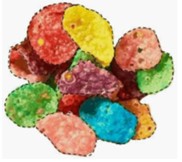
Post originally sought registration of trade dress comprising both the seven colors and the shape of its Fruity Pebbles cereal, a timeless classic. The examining attorney refused registration on the ground that the proposed trade dress failed to function as a mark because it consisted of a nondistinctive product design that is not registrable on the Principal Register without proof of acquired distinctiveness. Although Post had submitted evidence to support its claim of acquired distinctiveness—including evidence of long use, extensive advertising, unsolicited media coverage, and significant sales—the examining attorney found the evidence insufficient to demonstrate acquired distinctiveness. In response, Post submitted additional evidence of the mark’s acquired distinctiveness, including a survey and consumer statements. The examining attorney still found the evidence insufficient and maintained the non-distinctiveness refusal. In addition, the examining attorney required Post to disclaim rights in the cereal shape, on the ground that the cereal shape was nondistinctive and incapable of acquiring distinctiveness that would enable it to function as an indicator of source. Post complied by amending the mark description to remove reference to the shape of the cereal. Left with only the claimed colors as the mark, and still unconvinced by Post’s evidence of acquired distinctiveness, the examining attorney issued a final refusal.
Color, a type of trade dress, is registrable as a mark, but when used on a product itself (as opposed to product packaging), it is never inherently distinctive and can only be registered upon proof of acquired distinctiveness. The TTAB noted that Post’s burden to prove that its color mark had acquired distinctiveness was “substantial.”
Reviewing the factual record, the TTAB found the examining attorney’s evidence sufficient to establish that consumers encounter “numerous examples of multicolored breakfast cereals in a variety of shapes,” which contradicted Post’s claim that its use of the claimed colors was substantially exclusive. The examining attorney’s evidence included cereal boxes that showed similar multicolor combinations for cereals such as Cap’n Crunch’s OOPS! All Berries, Froot Loops, and Trix Fruity Shapes. The evidence also included articles and recipes discussing “rainbow” colored cereals, including a “Rainbow Fish” crusted-fish recipe incorporating “rainbow-colored cereal,” an ice cream parlor review noting that a store sells seasonal ice cream flavors like “rainbow cereal,” and an article discussing the use of food dyes in “rainbow-hued cereal.”
The TTAB discredited much of Post’s evidence because the application identified the goods broadly as “breakfast cereals,” rather than “crisp rice breakfast cereals,” and Post could not claim exclusivity of its color mark among all breakfast cereals. The TTAB also criticized Post’s two surveys because they measured a much narrower mark, i.e., the claimed colors as applied to only one type of breakfast cereal, and not the actual mark, i.e., a color mark applied to all types of breakfast cereals. While consumers might recognize Post’s cereal’s color, shape, and texture combined as an indicator of source, the evidence was insufficient to show that consumers associate just the colors with Post alone “for any and all ‘breakfast cereals.’” Indeed, Post’s survey itself showed that consumers correctly associated multicolored ring-shaped cereal with a different brand, demonstrating that consumers do not believe that all rainbow-colored cereals emanate from Post. Accordingly, the TTAB concluded that Post had failed to show that multicolored cereal exclusively identified its Fruity Pebbles, and therefore affirmed the refusal to register Post’s purported product trade dress.
The case is In re Post Foods, LLC, Serial No. 88857834 (TTAB Jan. 4, 2024) (precedential).
Related Practices
Related Industries
Related Offices
Contacts

- Jenevieve J. Maerker
- Of Counsel
- Boston, MA
- +1 617 646 1655
Copyright © 2024 Finnegan, Henderson, Farabow, Garrett & Dunner, LLP.
DISCLAIMER: Although we wish to hear from you, information exchanged in this blog cannot and does not create an attorney-client relationship. Please do not post any information that you consider to be personal or confidential. If you wish for Finnegan, Henderson, Farabow, Garrett & Dunner, LLP to consider representing you, in order to establish an attorney-client relationship you must first enter a written representation agreement with Finnegan. Contact us for additional information. One of our lawyers will be happy to discuss the possibility of representation with you. Additional disclaimer information.
