
Supreme Court Holds Cheerleader Uniform Designs Are Copyrightable
March 23, 2017
Authored and Edited by Margaret A. Esquenet; Naresh Kilaru; Julia Anne Matheson
On March 22, 2017, the Supreme Court held that decorative designs affixed to cheerleader uniforms may be entitled to copyright protection under the Copyright Act of 1976. The decision determined the proper approach to analyzing whether and how pictorial, graphic, or sculptural features can be identified separately from the utilitarian aspects of a useful article, potentially making such features eligible for copyright protection.
Varsity Brands, Inc., Varsity Spirit Corporation, and Varsity Spirit Fashions & Supplies, Inc. (together, “Varsity Brands”) design, manufacture, and sell cheerleading uniforms. Varsity Brands holds numerous U.S. copyright registrations for uniform designs, including the following:
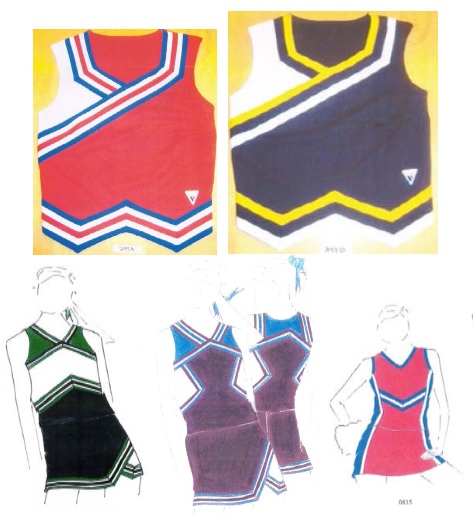
Alleging copyright infringement, Varsity Brands sued Star Athletica, LLC after seeing Star Athletica’s advertisements for cheerleading uniforms that allegedly imitated Varsity Brands’ five registered designs. The U.S. District Court for the District of Tennessee granted summary judgment to Star Athletica, finding that the aesthetic features of a cheerleading uniform merge with its functional purpose, and therefore were not physically or conceptually separable.
The Sixth Circuit reversed. It held that the designs were separable because they could be incorporated onto the surface of a variety of garments; they could also appear side by side with a blank cheerleading uniform—one viewed as a graphic design, one as a cheerleading uniform. In reaching its decision, the Sixth Circuit discussed the numerous approaches used by different circuits to analyze the separability question, and developed a hybrid approach of its own.
The Supreme Court granted certiorari to resolve the “widespread disagreement” over the proper test for implementing the Copyright Act’s separate-identification and independent-existence requirements. Writing for the majority, Justice Thomas announced a new separability test, holding:
[A] feature incorporated into the design of a useful article is eligible for copyright protection only if the feature (1) can be perceived as a two- or three-dimensional work of art separate from the useful article and (2) would qualify as a protectable pictorial, graphic, or sculptural work—either on its own or fixed in some other tangible medium of expression—if it were imagined separately from the useful article into which it is incorporated.
According the Court, the first prong of the test is easily satisfied if a useful article contains “some two-or three-dimensional element that appears to have pictorial, graphic, or sculptural qualities.” To satisfy the second prong, however, the feature must be able to exist as its own pictorial, graphic, or sculptural work once it is imagined apart from the useful article. “The ultimate separability question, then, is whether the feature for which copyright protection is claimed would have been eligible for copyright protection as a pictorial, graphic, or sculptural work had it originally been fixed in some tangible medium other than a useful article before being applied to a useful article.” Additionally, because separability is a conceptual undertaking, the physical-conceptual distinction is unnecessary. Accordingly, the Court stated: “[W]e necessarily abandon the distinction between ‘physical’ and ‘conceptual’ separability, which some courts and commentators have adopted based on the Copyright Act’s legislative history.”
Applying the new test to Varsity Brands’ uniforms, the court found the uniform designs to be protectable. First, the designs have pictorial, graphic, or sculptural qualities. Second, if these designs were separated from the cheerleading uniforms and applied in another medium, such as a painter’s canvas, they would qualify as works of art. Doing so would not replicate the uniform itself. The designs are therefore separable from the uniforms and eligible for copyright protection. The Court noted, however, that the shape, cut, and dimensions of the uniforms on which the designs appear are not subject to copyright protection.
Justice Ginsburg (who concurred in the judgment, but not in the opinion) argued that a separability analysis was unnecessary here because these graphic designs appear on useful articles, but are not designs of useful articles. The Court rejected that argument, stating that the Copyright Act requires the separability analysis for any pictorial, graphic, or sculptural features incorporated into the design of a useful article. The design of a useful article can include two-dimensional “pictorial” and “graphic” features.
Justice Breyer, writing in dissent, argued that the designs are not separable because removing the designs from the uniforms and placing them on a painter’s canvas would create “pictures of cheerleader uniforms.” But the majority rejected this position, holding that “[j]ust as two-dimensional fine art corresponds to the shape of the canvas on which it is painted, two-dimensional applied art correlates to the contours of the article on which it is applied.” Failing to protect that art would, according to the Court, create an anomaly by “extend[ing] protection to two-dimensional designs that cover part of a useful article but would not protect the same design if it covered the entire article.”
The case is Star Athletica, LLC v. Varsity Brands, Inc., Case No 15-866, 580 U.S. __ (2017).
Related Practices
Contacts

Copyright © 2017 Finnegan, Henderson, Farabow, Garrett & Dunner, LLP.
DISCLAIMER: Although we wish to hear from you, information exchanged in this blog cannot and does not create an attorney-client relationship. Please do not post any information that you consider to be personal or confidential. If you wish for Finnegan, Henderson, Farabow, Garrett & Dunner, LLP to consider representing you, in order to establish an attorney-client relationship you must first enter a written representation agreement with Finnegan. Contact us for additional information. One of our lawyers will be happy to discuss the possibility of representation with you. Additional disclaimer information.


