
Southern District of Texas Says Yes to Trade Dress for Dressing Rooms
September 28, 2023
Authored and Edited by Patrick J. Rodgers; Morgan E. Smith; Maxime I. Jarquin
Most people think of trademarks as words or logos. But trademark protection can be far more expansive. For instance, when one business copies another’s distinctive interior design, the injured party can seek relief by claiming trade dress infringement. That’s exactly what Pengu—a Houston-area swim school—did when it sued Blue Legend—another swim school with two locations in Texas, one near Houston—claiming that Blue Legend infringed the distinctive look and feel of Pengu’s school. At trial, the jury found that Blue Legend had willfully infringed Pengu’s trade dress and awarded Pengu Blue Legend’s profits. After receiving the jury’s verdict, Blue Legend moved for judgment as a matter of law. The court denied the motion, concluding: (1) there was sufficient evidence for the jury to find that Pengu’s trade dress acquired secondary meaning; (2) there was sufficient evidence for the jury to find a likelihood of confusion; and (3) Pengu was entitled to its attorneys’ fees and Blue Legend’s profits.
Trade dress is the total image and overall appearance of a product that often includes features such as size, shape, color, color combinations, textures, graphics, and even sales techniques defining a particular product. To protect trade dress, it must acquire secondary meaning, which happens when the public perceives the trade dress’s primary significance as identifying the source of the product. Here, Pengu characterized its trade dress as:
- A red, blue, green, and yellow color scheme on the dressing room doors, door trim, and roof trim of its swimming pools;
- A-frame roof style dressing rooms;
- A decorative design surrounding its swimming pools comprising several shades of blue arranged to resemble waves;
- Pool lane dividers with alternating blue and red colored segments; and
- A beach sand floor color and surface in their lobby and pool area.
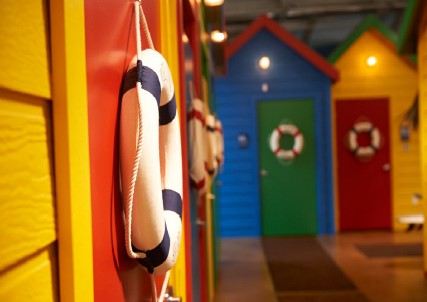
Pengu’s dressing rooms
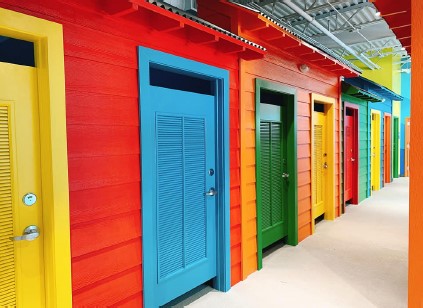
Blue Legend’s dressing rooms in Sugar Land, TX
The Southern District of Texas found that Pengu offered enough evidence to support a finding of secondary meaning for its trade dress because: Pengu used its trade dress for seven years before Blue Legend entered the market; Pengu presented evidence of significant sales during that period; and Pengu spent hundreds of thousands of dollars on advertising that depicted its trade dress. The court also found that there was substantial evidence that Blue Legend deliberately copied Pengu’s blueprints and drawings when it designed its facilities. For example, Blue Legend took photos of Pengu’s trade dress as “help for [Blue Legend’s] design” and specifically asked its architects to base the design of its dressing rooms on pictures of Pengu’s. The court noted that the jury could have inferred from this evidence “that the copying was done with the intention of taking advantage of Pengu’s reputation and the perceived secondary meaning of its trade dress.” The court therefore found that the jury was entitled to find Pengu’s trade dress had acquired secondary meaning.
The court also concluded the jury had more than sufficient evidence to find that Blue Legend’s interior design created a likelihood of confusion with Pengu’s trade dress. The court particularly emphasized the substantial similarities between Pengu’s and Blue Legend’s swimming pools, as shown in photos from Pengu’s complaint:
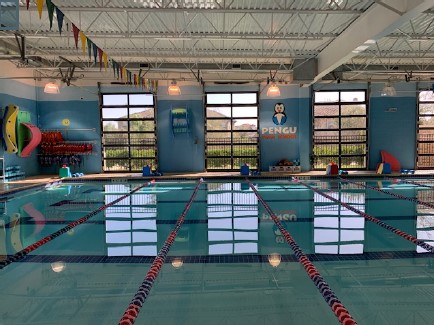
Pengu’s interior
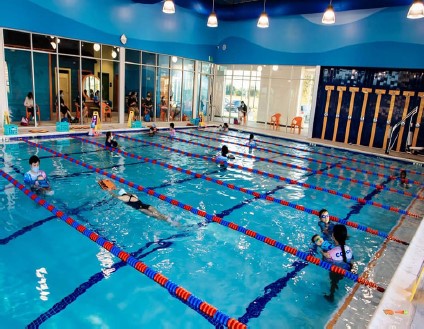
Blue Legend’s interior in Sugar Land, TX
The court emphasized that Pengu and Blue Legend “both offer swimming lessons in the greater Houston area” and that Blue Legend opened both of its facilities within a short distance of Pengu’s existing facilities. In addition, the evidence of Blue Legend’s intentional copying weighed in favor of a likelihood of confusion.
Finally, there was sufficient evidence for the jury to award Blue Legend’s profits to Pengu. Given Blue Legend’s willful infringement, the court reasoned that Blue Legend intended to confuse and deceive consumers by copying Pengu’s trade dress, particularly because Blue Legend’s owner specifically instructed his architects to consult the photos he took of Pengu when designing Blue Legend, which resulted in Blue Legend’s facilities looking “nearly indistinguishable from Pengu’s.” Additionally, even though there was no direct evidence of diverted sales, the court concluded that circumstantial evidence offered by Pengu was sufficient to support an award of profits, namely, that Blue Legend grew rapidly after opening its pools in the same market as Pengu. Weighing the additional factors for an award of profits (adequacy of other remedies, whether Pengu delayed, and the public’s interest in the disgorgement of profits) the court upheld the jury’s award of profits to Pengu.
The court also granted Pengu’s motion for attorneys’ fees, denied its motion for enhanced damages, and granted its motion for a permanent injunction.
This case serves as a powerful illustration not only of the difficulty of overturning a jury verdict, but of the possible trademark protection available beyond the mere protection of words, particularly where a plaintiff can make a robust showing of secondary meaning and a strong case for infringement, as Pengu did here.
The case is Pengu Swim Sch., LLC v. Blue Legend, LLC, No. 4:21-CV-1525, 2023 WL 5598996 (S.D. Tex. Aug. 29, 2023).
Related Practices
Related Industries
Related Offices
Contacts

- Patrick J. Rodgers
- Associate
- Washington, DC
- +1 202 408 4374


- Maxime I. Jarquin
- Associate
- Washington, DC
- +1 202 408 4004
Copyright © 2023 Finnegan, Henderson, Farabow, Garrett & Dunner, LLP.
DISCLAIMER: Although we wish to hear from you, information exchanged in this blog cannot and does not create an attorney-client relationship. Please do not post any information that you consider to be personal or confidential. If you wish for Finnegan, Henderson, Farabow, Garrett & Dunner, LLP to consider representing you, in order to establish an attorney-client relationship you must first enter a written representation agreement with Finnegan. Contact us for additional information. One of our lawyers will be happy to discuss the possibility of representation with you. Additional disclaimer information.