
LEGO Piece Might Infringe Jacket Designer’s Copyright and Trade Dress
August 31, 2023
Authored and Edited by Anthony D. Del Monaco; Morgan E. Smith
We previously discussed an amended complaint filed by artist James Concannon against LEGO alleging copyright and trade dress infringement. Concannon alleged he created a custom leather jacket as a gift for Antoni Porowski, star of Netflix’s Queer Eye series, and that LEGO’s “Queer‑Eye” toy set includes a jacket that infringes his design:
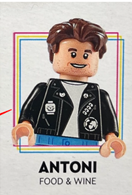
Since then, LEGO moved to dismiss the copyright infringement claims, arguing implied license and fair use. LEGO also moved to dismiss the trade dress infringement claims.
At this early stage of the case, LEGO could only rely on the facts pled in Concannon’s amended complaint to support its positions. Further, the Court was required to “accept as true all factual allegations” from the amended complaint “and draw from them all reasonable inferences.”
Implied License Defense
LEGO argued for dismissal of the copyright infringement claims on the theory that Concannon granted Porowski an implied license by gifting the jacket to Porowski without restrictions. It supported these allegations by noting Concannon had not authorized each appearance of the jacket on Netflix, had not protested unauthorized appearances, and had not asked Porowski to limit display of the jacket. Accordingly, LEGO argued, Concannon had granted both Porowski and the producers of Queer Eye an implied license that each was free to sublicense. In response, Concannon argued an implied license exists only if Concannon knew and intended that his jacket would be used for another specific purpose.
An implied license requires a meeting of the minds. That is, the parties must have agreed to permit the specific use at issue. Because of this requirement, the Court found that Concannon’s failure to take further action to protect his designs after their appearances on Queer Eye did not show that he intended the jacket to be distributed or that he, Porowski, or the producers had a common understanding of how to use the jacket. Therefore, the Court denied LEGO’s motion to dismiss based on implied license.
Fair Use Defense
LEGO also argued that Concannon’s copyright claims were barred by fair use. To determine whether LEGO’s use of the jacket would qualify as fair use, a court must consider four factors, including the “purpose and character of the use.”
In analyzing this factor, the Court considered whether the new work was “transformative.” LEGO likened its use of the jacket to the depiction of basketball player’s tattoos in a video game, citing Solid Oak Sketches, LLC v. 2K Games, Inc., 449 F. Supp. 3d 333, 346 (S.D.N.Y. 2020). In Solid Oaks, the court found the player’s tattoos in a video game transformative because the tattoo’s purpose in the video game was to accurately depict the basketball players versus the original purpose of the creation of the tattoos that allowed players to express themselves.
Concannon argued that LEGO’s use was not just to accurately portray Porowski, but to benefit from Concannon’s brand.
The Court concluded it could not determine LEGO’s purpose at this early stage of the case, and came to the same conclusion on the other three factors. Therefore, the Court did not dismiss the copyright claims under LEGO’s fair use defense.
Trade Dress Infringement Claim
LEGO then moved to dismiss the trade dress infringement claim as inadequately pled. To establish trade dress infringement, Concannon must describe the design with specificity and show that his design is non-functional, that it has secondary meaning, and that there is a likelihood of confusion. LEGO challenged each prong.
In the amended complaint, Concannon described three separate features of the jacket. The Court accepted Concannon’s description, allowing it to determine by “visual inspection whether each item of clothing falls within the proposed definition,” noting the inclusion of pictures in the complaint conveys the “overall image” of trade dress:
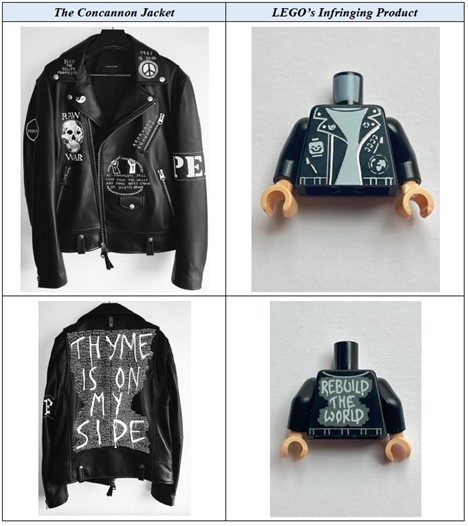
Therefore, the Court found Concannon adequately defined the trade dress.
In determining whether the trade dress has secondary meaning, the Court considered six non‑exclusive factors. LEGO argued that Concannon failed to satisfy several of the factors. Concannon countered that, as a solo artist, it would be improper for the Court to have him establish every non‑exclusive factor at the pleading stage; that he pled necessary details to satisfy some of the factors, such as his online presence and social media; and that his products have a “certain popularity within celebrity circles” that help sell his products. As part of this showing, the amended complaint included several images of celebrities wearing Concannon clothing:
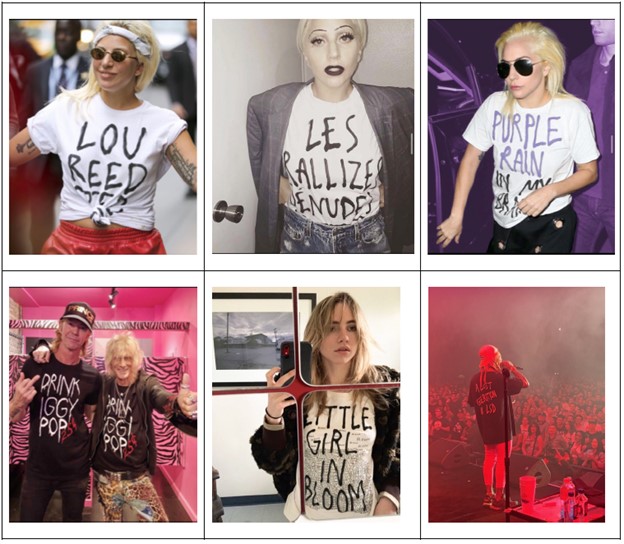
The Court sided with Concannon, finding that Concannon pled enough information to satisfy at least some of the non‑exclusive factors for secondary meaning.
The Court next applied the eight Polaroid factors to determine whether a likelihood of confusion exists. Regarding the strength of the mark, the Court agreed with Concannon that the same elements that can give his trade dress secondary meaning also makes it a source identifier and found this factor weighs in his favor. Regarding the similarity of the marks, the Court sided with Concannon because a visual comparison revealed similarity in the designs. Regarding the proximity of the products, because Concannon does not compete in the global toy market like LEGO, the Court determined this factor weighed in favor of LEGO. Regarding actual confusion, the Court held that determining confusion at this stage is difficult without further discovery and gave this factor limited weight. And as for bad faith, based on Concannon’s argument that LEGO conspired to copy his jacket, coupled with the degree of similarity between the jackets, the Court determined that there was a plausible inference of bad faith. Concannon did not make any allegations about the remaining three factors, so the Court determined that those factors do not weigh in Concannon’s favor.
Ultimately, because the Court determined that three of the factors fall in Concannon’s favor, and that other factors require further evidence, there is a plausible inference that consumers will likely be confused. Therefore, the Court denied LEGO’s motion to dismiss the trade dress claims.
At this early stage in the case, the Court reasoned it requires additional evidence to rule on any of the proposed claims and defenses. Only time will tell whether Concannon can ultimately prove its claims and whether LEGO can provide evidence to support its defenses.
The case is Concannon v. Lego Systems, Inc. et al, Civ. No. 3:21-cv-061678, Ruling on Motion to Dismiss and Motion to Seal (D. Conn. Mar. 15, 2023).
Related Practices
Related Industries
Related Offices
Contacts

Copyright © 2023 Finnegan, Henderson, Farabow, Garrett & Dunner, LLP.
DISCLAIMER: Although we wish to hear from you, information exchanged in this blog cannot and does not create an attorney-client relationship. Please do not post any information that you consider to be personal or confidential. If you wish for Finnegan, Henderson, Farabow, Garrett & Dunner, LLP to consider representing you, in order to establish an attorney-client relationship you must first enter a written representation agreement with Finnegan. Contact us for additional information. One of our lawyers will be happy to discuss the possibility of representation with you. Additional disclaimer information.

