
Finding a Lack of Bona Fide Use, TTAB Affirms Cancellation of Everwise Credit Union Registration Under the Lanham Act’s Reexamination Procedure
September 24, 2026
Authored and Edited by Daniel S. Stringer; Jenevieve J. Maerker
Trademark reexamination is an ex parte post‑registration proceeding created by the Trademark Modernization Act of 2020 and codified in Lanham Act § 16B, 15 U.S.C. § 1066B(b). Reexamination determines whether a registration was supported by actual use in United States commerce as of the relevant date to show such use. In the precedential decision In re Everwise Credit Union, Reexam. No. 2023-100533R for Reg. No. 7068783 (April 29, 2026), the Trademark Trial and Appeal Board affirmed the USPTO’s reexamination determination that Everwise’s overall showing reflected token use of EVERWISE CREDIT UNION designed to reserve rights in the mark, rather than bona fide use of the mark as of the deadline to file its Statement of Use, and ordered the registration cancelled.
Any person, or the USPTO on its own initiative, may file a petition for reexamination of a registration within five years after the registration date. The petition must identify the goods and/or services challenged, include a verified statement describing the reasonable non-use investigation undertaken by the petitioner, with supporting evidence, and be accompanied by payment of the required reexamination fee. The USPTO then decides whether the petition establishes a prima facie case of nonuse and, if so, institutes the proceeding. Once the proceeding is instituted, the USPTO issues an Office Action requiring the registrant to submit evidence rebutting nonuse as of the relevant date. The relevant date for purposes of an application filed based on use is the application filing date. For an application filed based on a bona fide intent to use, the relevant date is the date applicant filed an Amendment to Allege Use or Statement of Use, or the deadline for filing the Statement of Use, including all approved extensions, as applicable.
If the Office concludes that the mark should not have been registered as to particular goods and/or services, or all of them, the USPTO will order partial or total cancellation of the registration. The cancellation decision is appealable to the TTAB, and, thereafter, to the Court of Appeals for the Federal Circuit, or by way of a civil action in federal district court.
Following registration of the EVERWISE CREDIT UNION mark, a third party filed a petition for reexamination alleging that the mark was not in use in commerce with any of the identified services as of the deadline to file the Statement of Use. The petitioner alleged that the specimen filed with the Statement of Use showed that Everwise intended to rebrand from Teachers Credit Union to Everwise Credit Union, indicating that the rebrand had not occurred as of the deadline to file the Statement of Use. Petitioner also alleged that it had conducted searches of the USPTO and TTAB databases, app stores, as well as the Internet archive using the Wayback Machine website, and did not locate any evidence of use of the mark EVERWISE CREDIT UNION prior to the Statement of Use deadline.
Based on the evidence submitted with the petition, the USPTO examiner issued an Office Action finding that petitioner had established a prima facie case that EVERWISE CREDIT UNION had not been in use as of the Statement of Use deadline. Everwise responded to the Office Action with evidence, including a declaration from a company officer with accompanying exhibits, attesting to Everwise’s use of the mark in commerce as of the deadline to file the Statement of Use. The examiner subsequently issued a final Office Action finding Everwise’s evidence insufficient to rebut the prima facie case of nonuse. Everwise then appealed to the TTAB.
In determining whether Everwise had made bona fide use of EVERWISE CREDIT UNION, the TTAB first looked to the specimen filed with the Statement of Use. The webpage specimen showed use of the mark in three places: once as a tagline, and two other times in all lowercase letters, buried in the text of a paragraph.
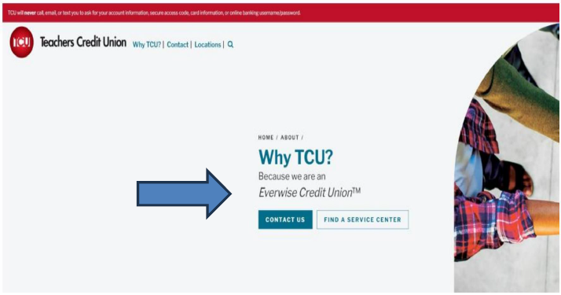
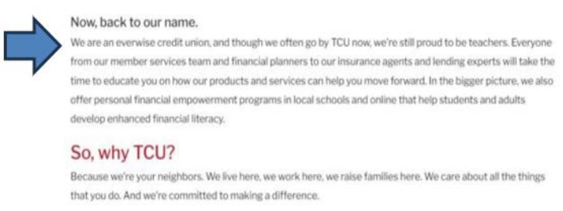
The TTAB determined that the mark contained in the body of the paragraph was not prominently displayed and therefore would not be viewed by consumers as indicating source. As for the tagline usage, the TTAB found that the record evidence supported its conclusion that displaying the mark in this manner merely served as a placeholder for future use once Everwise transitioned from Teachers Credit Union to Everwise Credit Union.
The TTAB first noted that record evidence showed Everwise changed its name from Teachers Credit Union to Everwise Credit union two months after it filed its Statement of Use with the above webpage specimen, suggesting that it added the tagline to its website to reserve rights in the future use of the EVERWISE CREDIT UNION mark. In assessing whether Everwise’s use of its mark was consistent with customary practices in the credit union industry, the TTAB referenced the types of uses it would expect a credit union to be able to produce (i.e., signage, check images, business cards, brochures, etc.) and found it notable that Everwise was unable to produce additional documentation evidencing use of EVERWISE CREDIT UNION on or before the Statement of Use filing deadline. The TTAB also discounted the declaration provided by Everwise to rebut the Office’s non-use finding, determining that it consisted of legal conclusions and observing that its exhibits showed use of TCU or TEACHERS CREDIT UNION serving as the source for Everwise’s financial services, rather than EVERWISE CREDIT UNION.
Additional evidence from the Wayback Machine further supported the TTAB’s conclusion that Everwise had not made bona fide use of EVERWISE CREDIT UNION. These website screen captures showed Teachers Credit Union was transitioning to Everwise Credit Union approximately two months after the deadline to file the Statement of Use, while a business article corroborated the post-Statement of Use filing deadline rebrand to Everwise Credit Union.
In a footnote, the TTAB underscored that an applicant that cannot establish use in commerce by the Statement of Use filing deadline may refile for the same mark on an intent-to-use basis. The TTAB then noted that Everwise did exactly that, reapplying to register the EVERWISE CREDIT UNION mark for the same financial services with claimed first-use dates consistent with the record evidence showing its rebrand occurred two months after the original deadline to file the Statement of Use.
The TTAB, therefore, affirmed cancellation under Section 16B(g), finding that Everwise failed to prove use of EVERWISE CREDIT UNION by the deadline to file the Statement of Use and ordered the registration cancelled.
Tags
Lanham Act, Trademark Modernization Act, United States Patent and Trademark Office (USPTO), Trademark Trial and Appeal Board (TTAB)
Related Practices
Related Industries
Related Offices
Contacts

- Daniel S. Stringer
- Associate
- Washington, DC
- +1 202 408 4322

- Jenevieve J. Maerker
- Of Counsel
- Boston, MA
- +1 617 646 1655
Copyright © 2026 Finnegan, Henderson, Farabow, Garrett & Dunner, LLP.
DISCLAIMER: Although we wish to hear from you, information exchanged in this blog cannot and does not create an attorney-client relationship. Please do not post any information that you consider to be personal or confidential. If you wish for Finnegan, Henderson, Farabow, Garrett & Dunner, LLP to consider representing you, in order to establish an attorney-client relationship you must first enter a written representation agreement with Finnegan. Contact us for additional information. One of our lawyers will be happy to discuss the possibility of representation with you. Additional disclaimer information.