
Added Subject-Matter in the IP5 Countries: A Comparative Analysis
July 16, 2025
Authored and Edited by K. Victoria Barker, Ph.D.; Sarah J. Rodriguez
U.S. attorneys frequently encounter concerns from European counsel that proposed claim amendments may “add matter” at the European Patent Office (EPO), despite such claims being permissible under USPTO standards. This discrepancy highlights the fundamental differences between the USPTO and the EPO in their assessment of added subject-matter. In this article, we examine these contrasting perspectives and explore how the remaining IP5 countries—China, Japan, and Korea—interpret these issues.
Differences in Assessing Added Subject-Matter
Most patent offices prohibit the inclusion of new subject-matter during prosecution. However, the EPO's stance is notably strict—arguably becoming even stricter over time. According to Article 123(2) EPC:
"The European patent application or European patent may not be amended in such a way that it contains subject-matter which extends beyond the content of the application as filed."
This appears similar to the USPTO’s MPEP guideline[1]:
No new matter may be introduced into an application after its filing date.
The divergence arises in how each office assesses what constitutes added subject-matter. The EPO applies its “Gold Standard” from G 2/10, which states that any amendments must fall within the limits of what a skilled person would derive directly and unambiguously from the original application using common general knowledge.
Meanwhile, the USPTO adopts a test[2] that evaluates whether:
- The original description allowed skilled persons in the field to recognize that the applicant invented the newly claimed subject-matter.
- The description conveyed with reasonable clarity that, at the time of filing, the applicant possessed the invention as claimed.
- The disclosure reasonably demonstrated the inventor’s possession of the later claimed subject-matter.
On paper, these approaches seem harmonized, yet their practical application differs due to each office's definition of a skilled person.
The Skilled Person: EPO vs. USPTO Perspectives
The EPO considers the skilled person to be an individual (or team) with average knowledge and access to the full prior art, but without inventive capability. [3] In contrast, the USPTO defines skill level based on the technological field of the invention, assessing what professionals in that field would reasonably understand. This disparity explains many differences in how added subject-matter is evaluated.
A notable distinction appears in how claim amendments introducing combinations of features are handled. In a simple example, the claims as originally filed are as follows:
- A device comprising: A; and B
- The device of claim 1, further comprising: C
- The device of claim 2, further comprising: D; and E
The specification additionally discloses: a device comprising A+B and further comprising G+H
When amending the claims at the USPTO, any combination of A, B, C, D, E, G and H may be permissible:
|
A+B+C |
A+B+C+D |
A+B+C+E |
|
A+B+C+D+E |
A+B+G |
A+B+H |
|
A+B+G+H |
A+B+E |
A+B+D+E |
|
A+B+D |
|
|
However, at the EPO, the only allowable amendments are the combinations that are expressly described in the application as originally filed:
|
A+B+C |
|
A+B+C+D+E |
|
A+B+G+H |
Thus, the EPO enforces a literal interpretation of the application, whereas the USPTO permits the skilled person to infer reasonable combinations.
Figures, Examples, and Global Patent Prosecution
Similar limitations arise in extracting features from figures and examples. The EPO considers features within examples to be inextricably linked, meaning isolated extraction—such as isolating a temperature from a synthetic example—is generally impermissible. The USPTO, however, permits such extractions, recognizing the expertise of the skilled person in combining features that are not explicitly described together.
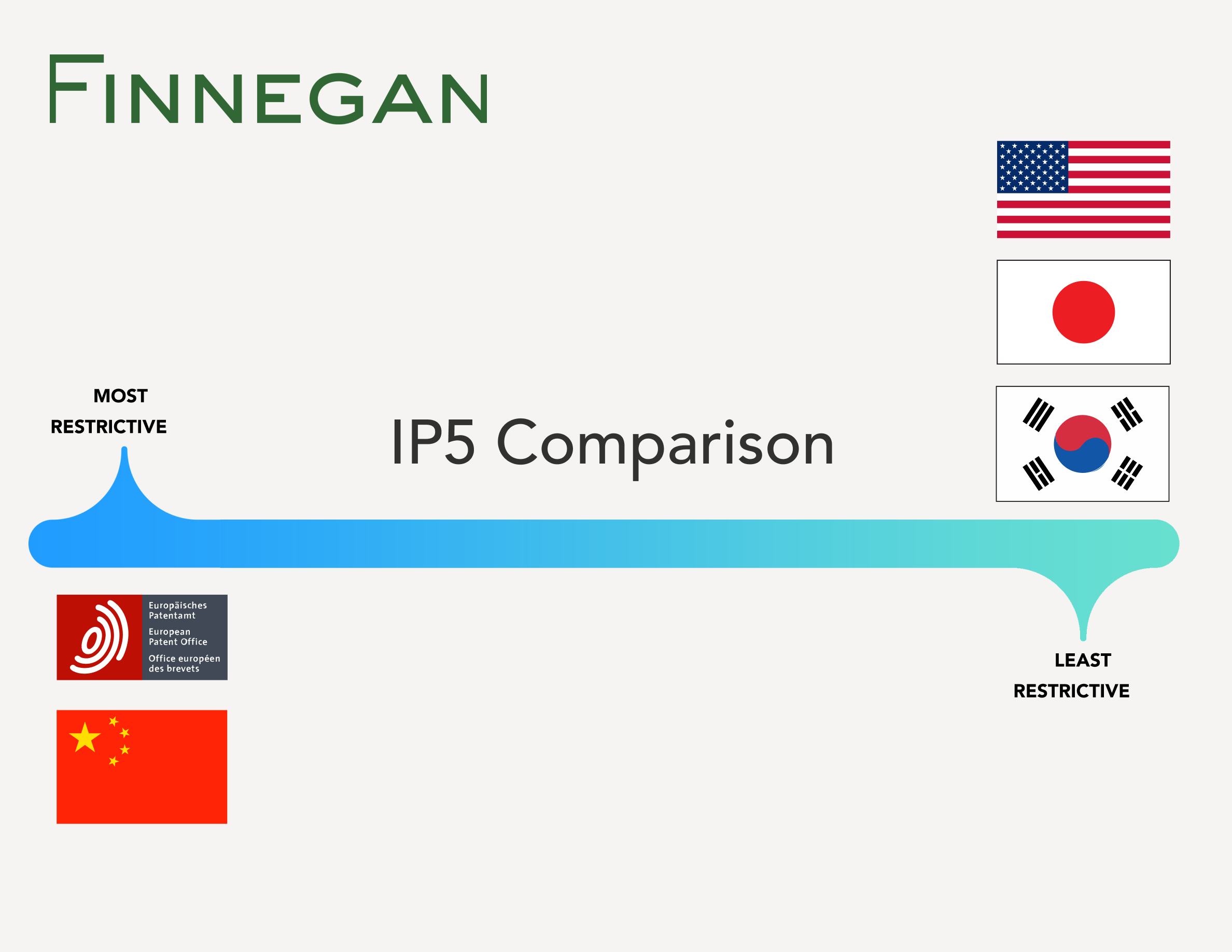
The remaining IP5 countries follow two distinct approaches:
- CNIPA (China) largely aligns with the EPO’s strict interpretation;
- JPO (Japan) and KIPO (Korea) are closer to the USPTO’s approach, although not as flexible on amendment practice as the USPTO.
There are, of course, nuances that are specific to local practice. For example, in China, redating of an application is permissible if new matter is added during the international phase of a PCT application. This is not permitted at the EPO. It is, however, a fairly limited tool since it will almost always result in the loss of priority.
These variations in the approach to added subject-matter across the IP5 countries impact upon strategies for global prosecution, particularly when rapid grant is required. For example, all the IP5 countries have mutual agreements under the Patent Prosecution Highway (PPH) program. However, it is clear that allowed claims in Japan may be deemed to add matter under Chinese practice, while EPO-allowed claims may be narrower than desirable for Korean filings.
Further Information
For more information on this topic, please see our webinar, available here[4].
Endnotes
[1] https://www.uspto.gov/web/offices/pac/mpep/s608.html
[2] 35 U.S.C. §112(a)
[3] https://www.epo.org/en/legal/case-law/2022/clr_i_d_8_1_1.html
[4] https://www.finnegan.com/en/insights/events/claim-amendments-a-global-perspective-04242025.html
Tags
United States Patent and Trademark Office (USPTO), European Patent Office (EPO), subject matter eligibility
Related Practices
Related Offices
Contacts


- Sarah J. Rodriguez
- Of Counsel
- London
- +44 (0)20 7864 2810
Copyright © 2025 Finnegan, Henderson, Farabow, Garrett & Dunner, LLP.
DISCLAIMER: Although we wish to hear from you, information exchanged in this blog cannot and does not create an attorney-client relationship. Please do not post any information that you consider to be personal or confidential. If you wish for Finnegan, Henderson, Farabow, Garrett & Dunner, LLP to consider representing you, in order to establish an attorney-client relationship you must first enter a written representation agreement with Finnegan. Contact us for additional information. One of our lawyers will be happy to discuss the possibility of representation with you. Additional disclaimer information