
Trends in PTAB Trials Involving Drug and Biologic Patents
June 26, 2024
Authored and Edited by Aïda Liman-Tinguiri; Mark J. Feldstein, Ph.D.
The USPTO recently released an updated “PTAB Orange Book patent/biologic patent study,” with data and statistics from AIA petitions beginning from Fiscal Year 2013—when these proceedings became available under the AIA—through March 31, 2024. This study builds upon its initial release in March 2018, with subsequent updates in 2019, 2021, and 2023.
The study data show that, cumulatively, only 3% of all AIA petitions are against Orange Book patents. Since FY2020, the number of these petitions ranged from 6-20 petitions, far down from peaks of well over 100 petitions in FY2015 and FY2016. They have decreased proportionally too, with Orange Book patents accounting for 7.5% in 2016 to about 1% in 2023 and this year. Nearly all of the proceedings (96%) were IPRs, with only 0 to 2 PGRs filed against Orange Book patents each year from FY2022 to date.
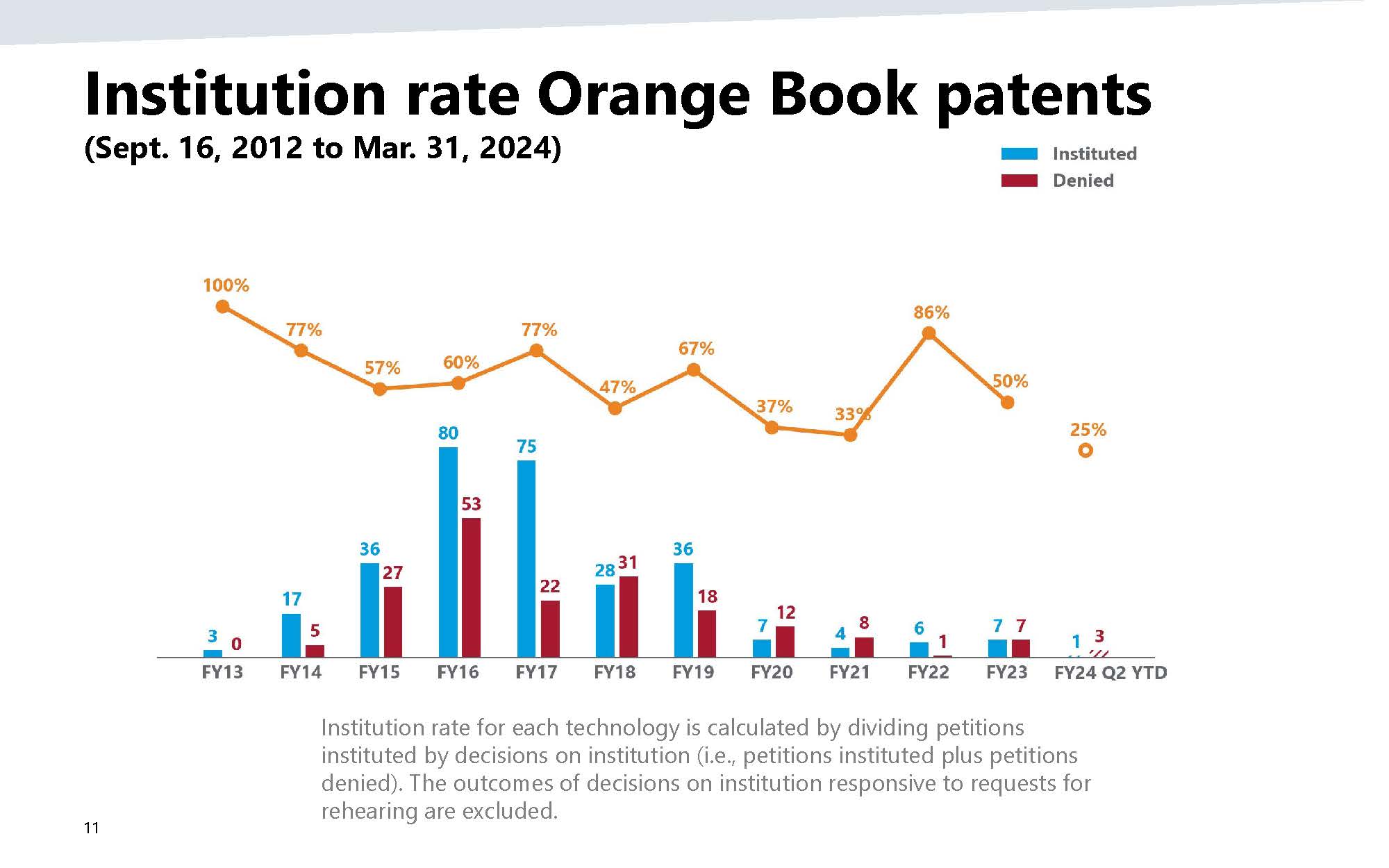
While the overall institution rate for Orange Book patents is 62%, as shown in the USPTO figure below, from FY2020 to present the annual has been lower with only 25% having been instituted so far this year. Accounting for all pre- and post-institution outcomes, denial of institution (41%) is the most likely outcome, followed by settlement (24%). Where FWD is entered, the PTAB is equally likely to find all claims patentable (15% of all petitions filed) as it is to find them unpatentable (15% of all petitions filed). Only a small percentage of all petitions filed result in a mixed FWD (2%), a request for adverse judgment (also 2%) or a dismissal (3%). Considered on a claim-by-claim basis, the PTAB found that 17% of all Orange Book patent claims challenged and 33% of all such claims instated were unpatentable.
Trends are somewhat different with biologic patents, which have accounted for about 2% of all AIA petitions to date. Since FY2020 the number of AIA petitions challenging biologic patents has increased steadily, from 8 petitions in FY2020 to 38 petitions in FY2023. Their proportion of the total has risen from 0.5% in FY2020 to 3.1% in FY2023, though only 2.35% for FY2024 to date. While FY2017 was a high point with 75 petitions against biologic patents accounting for 3.9% of all AIA petitions, the number and fraction of AIA petitions challenging biologic patents has been more consistent and surpassed challenges to Orange Book patents since FY2021. PGRs account for only a fraction of the petitions against patents, and have never exceeded more than 8 in a given year.
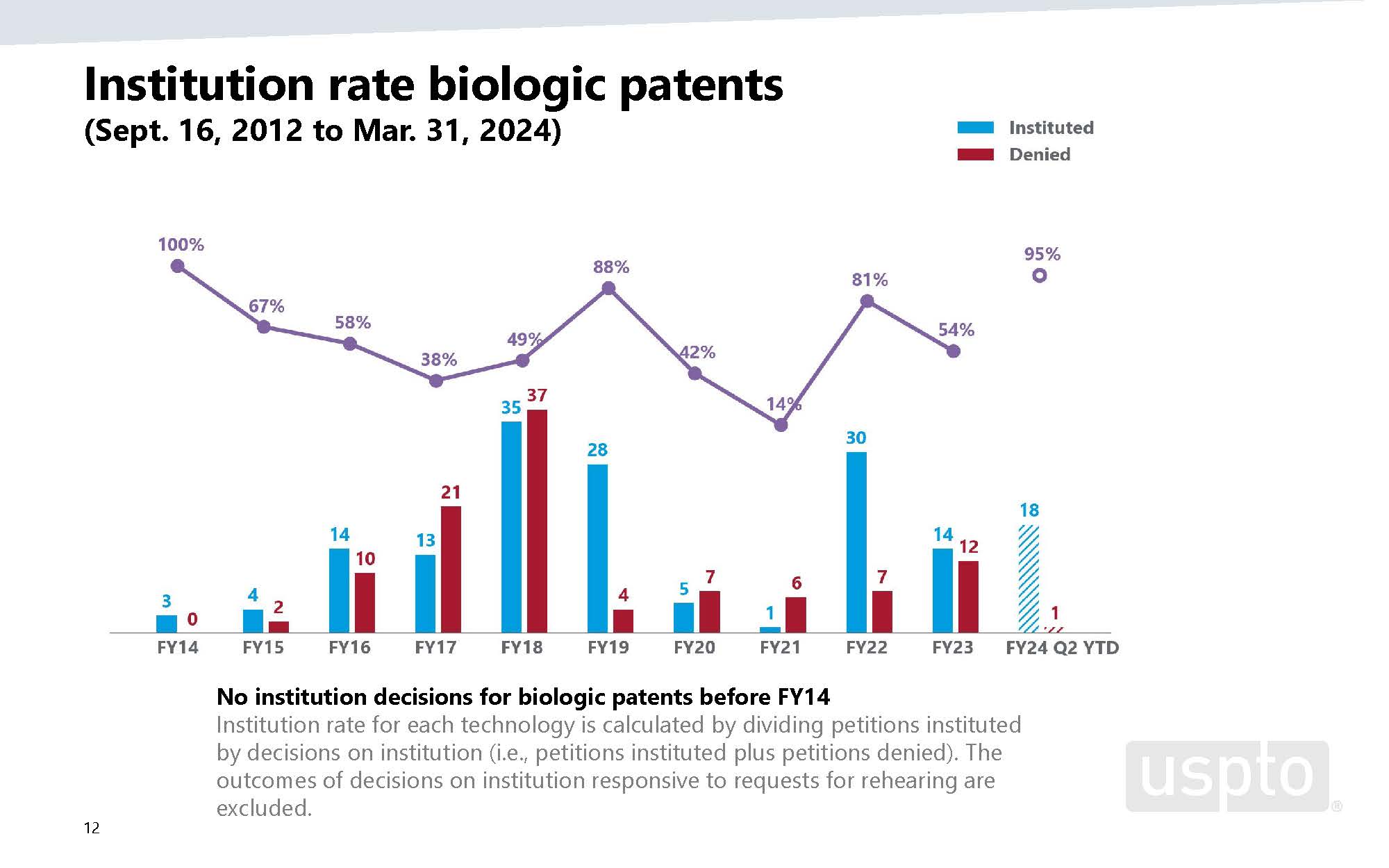
The overall institution rate for biologic patents is 61%, nearly identical to Orange Book patents. Annually from FY2020 to present, this rate has fluctuated from 15% in FY2021 to 95% so far in FY2024, as shown in the USPTO figure below. Also similar to Orange Book patents, the most likely outcome for biologic patent petition is a denial of institution (39%). When instituted, the PTAB is far more likely to find all claims unpatentable (22% of all petitions filed) than patentable (6% of all petitions filed) and even less likely to reach a mixed FWD (3%). While approximately 20% of patent disputes are settled, 6% are dismissed by the PTAB, and 5% end in a request for adverse judgment.
To access the original report, click here.
Acronyms
AIA = America Invents Act
FWD = Final Written Decision
IPR = Inter Partes Review
PGR = Post-Grant Review
PTAB = Patent Trial and Appeal Board
Related Industries
Related Offices
Contacts

Copyright © 2024 Finnegan, Henderson, Farabow, Garrett & Dunner, LLP.
DISCLAIMER: Although we wish to hear from you, information exchanged in this blog cannot and does not create an attorney-client relationship. Please do not post any information that you consider to be personal or confidential. If you wish for Finnegan, Henderson, Farabow, Garrett & Dunner, LLP to consider representing you, in order to establish an attorney-client relationship you must first enter a written representation agreement with Finnegan. Contact us for additional information. One of our lawyers will be happy to discuss the possibility of representation with you. Additional disclaimer information.