
Five Considerations Before Filing an IPR
May 01, 2013
Authored and Edited by Adriana L. Burgy; Jeffrey A. Berkowitz
The Basics: IPR is short for inter partes review. IPR is a new trial proceeding conducted by the USPTO’s Patent Trial and Appeal Board (PTAB). A third party can file an IPR petition challenging the patentability of one or more claims in a patent for novelty (35 U.S.C. § 102) or obviousness (35 U.S.C. § 103) in view of patents and/or printed publications. The petition can be filed 9 months after the grant of the patent or issuance of a reissue patent or, if a post grant review is instituted, following termination of the post grant review.
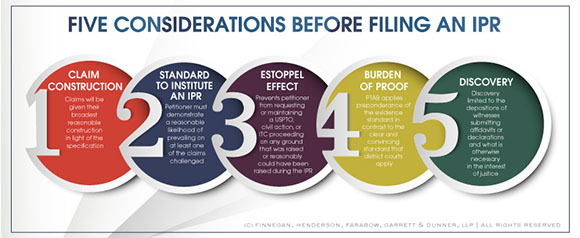
Five Considerations BEFORE Filing: Here are five considerations before filing an IPR:
- Claim Construction: Claims will be given their broadest reasonable construction in light of the specification.
- Standard to Institute an IPR: Petition must establish a reasonable likelihood of prevailing on the challenge to at least one of the claims.
- Estoppel Effect: A final written decision by the PTAB on an IPR is subject to an estoppel that prevents the petitioner from requesting or maintaining a further proceeding before the USPTO with respect to the claim(s) in the IPR on any ground that the petitioner raised or reasonably could have raised during the IPR. The same estoppel applies for civil actions and U.S. International Trade Commission (ITC) proceedings.
- Burden of Proof: PTAB applies preponderance of the evidence standard in contrast to the clear and convincing standard that district courts apply.
- Discovery: Discovery limited to the depositions of witnesses submitting affidavits or declarations and what is otherwise necessary in the interest of justice.
Contacts


Copyright © 2013 Finnegan, Henderson, Farabow, Garrett & Dunner, LLP.
DISCLAIMER: Although we wish to hear from you, information exchanged in this blog cannot and does not create an attorney-client relationship. Please do not post any information that you consider to be personal or confidential. If you wish for Finnegan, Henderson, Farabow, Garrett & Dunner, LLP to consider representing you, in order to establish an attorney-client relationship you must first enter a written representation agreement with Finnegan. Contact us for additional information. Additional disclaimer information.