
District Courts Continue to Grant Majority of Post-Grant-Related Motions to Stay
October 11, 2013
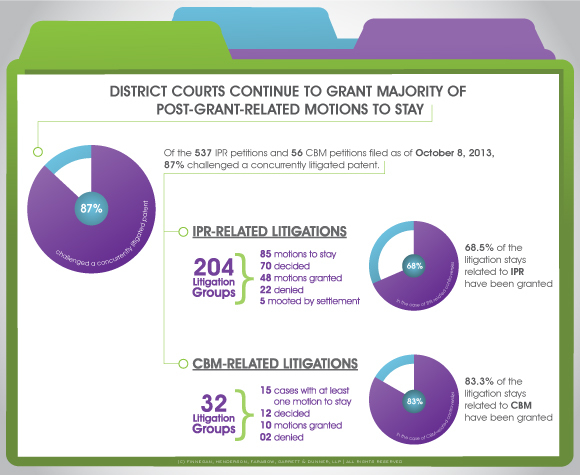
Of the 537 IPR petitions and 56 CBM petitions filed as of October 8, 2013, 87% challenged a concurrently litigated patent. These numbers, however, reflect a more complex reality. Petitioners have filed as many as eight IPRs or ten CBMs related to a single controversy. And a single controversy can spawn dozens co-pending litigations—particularly after the district courts implemented the non-joinder rules of the AIA, 35 U.S.C. § 299.
Recognizing that a single controversy can encompass multiple litigations, reexaminations, IPRs, reissues, and U.S. International Trade Commission (ITC) actions, we identified 204 unique litigation groups identified with at least one IPR. We then looked to the “lead” litigations for each and identified those with stay motions filed. Finally, we looked to see if the court had ruled on those motions, and then ran the numbers.
Petitioners have requested a stay in almost half of all IPR-related litigations. Specifically, of the 85 district court motions related to at least one IPR petition, 70 have been decided, with 48 stays granted and 22 denied. The remaining five have been mooted by settlement.
We also identified 32 different litigations related to at least one CBM petition. 15 cases involved at least one motion to stay. Stays have been granted in ten of these cases and denied in two.
The takeaways are clear. While less than half of the litigations related to IPR and CBM proceedings involve a motion to stay, a large majority of them have been granted—68.5% in the case of IPR-related controversies and 83.3% for CBM-related controversies. By way of comparison, the ITC has yet to grant a motion to stay based on a related IPR or CBM proceeding. Thus, while the number of IPR and CMB petitions has increased in the past six months, the statistics on stay have remained steady.
Note: All data was retrieved from the Patent Review Processing System (PRPS) from September 16, 2012, to October 8, 2013 (including those dates), and encompasses filings that have and have not been instituted or are pending.
Copyright © 2013 Finnegan, Henderson, Farabow, Garrett & Dunner, LLP.
DISCLAIMER: Although we wish to hear from you, information exchanged in this blog cannot and does not create an attorney-client relationship. Please do not post any information that you consider to be personal or confidential. If you wish for Finnegan, Henderson, Farabow, Garrett & Dunner, LLP to consider representing you, in order to establish an attorney-client relationship you must first enter a written representation agreement with Finnegan. Contact us for additional information. Additional disclaimer information.
