
Disclaimers Can Be Held Against the Patentee
March 30, 2023
Authored and Edited by Shannon M. Patrick; Amanda K. Murphy, Ph.D.; Stacy Lewis†
Holding
In Early Warning Services, LLC v. Wepay Global Payments LLC, PGR2022-00031, Paper 34, the Patent Trial and Appeal Board (“the PTAB”) granted Petitioner’s motion for adverse judgment and cancelled the challenged claim.[1]
Background
Early Warning Services, LLC (“EWS”) filed a post-grant review (“PGR”) petition challenging the sole design claim of Wepay’s U.S. Patent No. D930,702 S (“the ’702 patent”) on anticipation and obviousness grounds. The PTAB instituted. PGR2022-00031, Paper 22 (P.T.A.B. Oct. 7, 2022).
The ’702 patent “includes five figures that describe two embodiments of a graphical user interface (“GUI”) design.” Id. at *5. The first embodiment is identified by Figures 1 and 2 in the ’702 patent, and the second embodiment is identified by Figures 3-5:
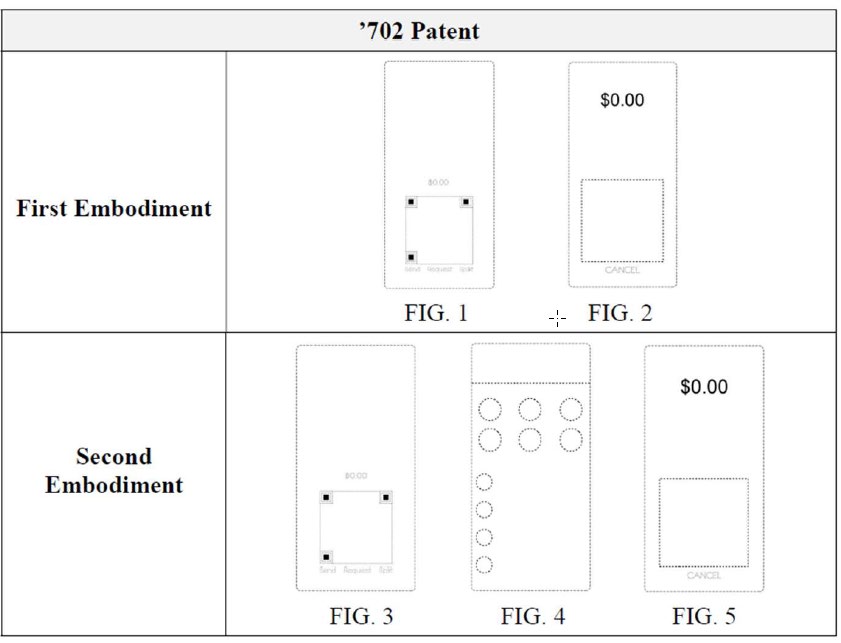
Id. at *6.
Wepay filed a statutory disclaimer of the first embodiment on October 5, 2022, and of the second embodiment on January 26, 2023. Id.
PTAB Decision
The PTAB granted Petitioner’s motion for adverse judgment.
The PTAB found that the statutory disclaimers, taken together, disclaimed all five figures and both embodiments described in the ’702 patent. Id. Therefore, the PTAB determined that adverse judgment was warranted based on the disclaimers. Id.
The PTAB also substantively addressed EWS’s patentability challenges to the challenged claim. It did this to preempt any discussion of whether the Patent Owner intended to disclaim the full scope of the subject matter claimed. Id. at *6.
The PTAB found that EWS proved “by a preponderance of the evidence that the challenged claim is unpatentable.” Id. at *6-7. The disclosure contained within a prior art reference, Reddy, rendered the sole claim of the ’702 patent anticipated or obvious. Id. at *7-8. Reddy disclosed “a design having substantially the same overall appearance as the claimed design.” Id. at *8. Both Reddy and the ’702 patent included “an image of a Three Square Arrangement followed by an image of a $0.00 in practically identical style and font.” Id. (omitting quotations).
The PTAB found that, to the extent that any slight differences in spacing of the squares is not de minimus, an ordinary designer “would have modified Reddy’s design to mirror the claimed design in order to increase the amount of data contained in the code.” Id. *9.
Because the PTAB concluded that Wepay forfeited arguments opposing the information advanced by EWS, the PTAB found that on the record, EWS demonstrated by a preponderance of the evidence that “the subject matter of the challenged claim would have been obvious based on the other grounds asserted in the Petition.” Id. at *9-10.
Takeaways
Patent Owners should be cautious when disclaiming embodiments claimed in patents. Not only can statutory disclaimers that effectively disclaim the entirety of claimed inventions lead to adverse judgments before the PTAB, but the PTAB may go further and issue a Final Written Decision finding the challenged claims unpatentable. That Final Written Decision will then have estoppel implications for the Patent Owner. See 37 C.F.R. §72.73.
Endnotes
[1] PGR2022-00045 was joined to this proceeding.
Related Industries
Related Offices
Contacts

- Shannon M. Patrick
- Associate
- Atlanta, GA
- +1 404 653 6558

†Stacy Lewis is a Law Clerk at Finnegan.
Copyright © 2023 Finnegan, Henderson, Farabow, Garrett & Dunner, LLP.
DISCLAIMER: Although we wish to hear from you, information exchanged in this blog cannot and does not create an attorney-client relationship. Please do not post any information that you consider to be personal or confidential. If you wish for Finnegan, Henderson, Farabow, Garrett & Dunner, LLP to consider representing you, in order to establish an attorney-client relationship you must first enter a written representation agreement with Finnegan. Contact us for additional information. One of our lawyers will be happy to discuss the possibility of representation with you. Additional disclaimer information.

