
Trending at the PTAB: Obviousness in Director Reviews
September 6, 2024
Law360
By Nicholas A. Cerulli; Hira Javed; Leith S. Shafi
A string of recent director review decisions has brought relief to petitioners in overcoming institution denials and final written decisions on obviousness issues. And while the director still denies the majority of director review requests, these cases indicate a willingness by the director to weigh in on substantive issues, such as obviousness, particularly in cases where the director believes the board provided incorrect or inadequate rationale to support its decisions.
Director Review Since Arthrex
The U.S. Supreme Court's 2021 decision in U.S. v. Arthrex held that the director of the U.S. Patent and Trademark Office has the authority to review PTAB decisions.[1] Since then, the USPTO has developed a process for the director to review board decisions involving (1) an abuse of discretion, (2) important issues of law or policy, (3) erroneous findings of material fact, and/or (4) erroneous conclusions of law.[2]
Many of the initial director reviews took place through sua sponte decisions by the director, but increasingly, director reviews are being granted in response to party-originated requests.[3] The cases below highlight three recent decisions where the petitioner was successful in persuading the director to grant director review and reverse board decisions on obviousness.
Recent Director Reviews on Obviousness
Nearmap US Inc. v. EagleView Technologies Inc.
In Nearmap, the petition asserted two alternative grounds of patentability against claims directed to a roof estimation system. The first ground relied on two references (Heller and Quam) and a claim construction that did not give patentable weight to a particular claim limitation, while the second ground was based on three references (Heller, Quam and Deaton) and gave full patentable weight to all claim limitations.[4]
During trial, the patent owner argued that the disputed claim language should be given full patentable weight, and that under the patent owner's proposed construction, none of the prior art combinations rendered the claims obvious.[5] The patent owner also offered evidence of secondary considerations of nonobviousness relating to commercial success and industry praise.[6]
In its final written decision last year, the board upheld the validity of the claims, finding it "unnecessary to address" the parties' arguments regarding the prior art because the secondary considerations evidence was "decisive as to obviousness."[7]
In response, the petitioner requested director review, arguing that the board had failed to resolve the parties' claim construction dispute, and this failure affected the board's secondary considerations analysis.[8] The petitioner also argued that the board's final written decision merely summarized the petitioner's arguments and the evidence presented, but never analyzed the petitioner's allegations of unpatentability based on the combination of prior art references.[9]
In a July 15 decision, the director agreed with the petitioner and found that the board did not provide adequate reasoning to support its conclusion of nonobviousness, nor did it adequately address the disputed issues.
The director explained that, although evidence of secondary considerations must be considered, it is not the only factor that controls the obviousness inquiry. According to the director, a proper Section 103 analysis requires consideration of all four Graham factors and "it is error to reach a conclusion of obviousness until all those factors are considered."[10]
The director also found the board's analysis insufficient because it did not make appropriate findings on the weight assigned to the secondary considerations, and it did not address the claim construction dispute within the obviousness analysis.[11] As a result, the director concluded that the board's decision was incomplete by crediting the patent owner's evidence of secondary considerations as outweighing the petitioner's obviousness contentions, without fully resolving the necessary and disputed underlying issues.[12] The director vacated the final written decision and remanded for further proceedings consistent with the director's decision.[13]
The Nearmap case emphasizes that the board must fully explain the reasoning behind its decision, and, in the case of obviousness, it must consider all of the Graham factors and reconcile any disputed claim construction issues. A decision that falls short of these expectations may be a strong candidate for director review.
Hesai Technology Co. Ltd. v. Ouster Inc.
In Hesai, the board denied institution where the prior art (Hall), cited for a disputed claim limitation, included an apparent typographical error.[14] The relevant limitation recited a "plurality of pixels [that] includes a first set of pixels arranged in a first column and a second set of pixels arranged in a second column horizontally and vertically offset from the first column."[15]
In its preliminary response, the patent owner argued the board was required to disregard Figure 22 of Hall (shown below)[16] due to an unexplained discrepancy where the specification described "32 detectors," but the figure depicted 36 detectors.[17]
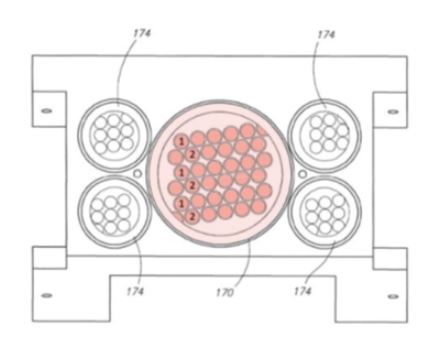
In its request for director review, the petitioner argued that the board had misapplied precedent from the U.S. Court of Appeals for the Federal Circuit and improperly discounted the petitioner's reliance on Hall's Figure 22 to teach the disputed claim limitation, due to an obvious typographical error.[18]
In a July 25 decision, the director found that this discrepancy in Hall was not material to the relevant claim limitation because it related to the number of detectors rather than the arrangement of the detectors.[19] Accordingly, the director found that the board erred by not considering the prior art to the extent it taught the claimed arrangement of detectors. The director vacated the board's denial of institution and remanded for further proceedings.[20]
While Hesai suggests what may already be obvious — even if there is a typographical error in the reference, the rest of the reference may still be used as prior art — it is yet another example of how the director is paying close attention to even the smallest perceived mistakes by the board.
Prime Time Toys LLC v. Spin Master Inc.
In Prime Time Toys, the board denied institution of three inter partes reviews challenging the patentability of patents involving "soft-projectile launching devices that launch super absorbent polymer projectiles."[21]
In each preliminary response, the patent owner argued that the board should deny institution because the petitioner allegedly failed to show a motivation to combine two prior art references (Peev and Spitballs).[22] In particular, the patent owner argued that the petitioner failed to show that a person of ordinary skill in the art would have considered risk of injury to be a known problem with airsoft guns.[23]
The board agreed with the patent owner in denying institution. Subsequently, the petitioner sought director review arguing the board abused its discretion by:
(1) completely failing to consider evidence of secondary considerations in the form of simultaneous invention, which evidence supports a finding of motivation to combine; (2) arbitrarily ignoring admissions made by Patent Owner's expert and other record evidence which are contradictory to the Board's finding; and (3) relying on the personal experience of Petitioners' expert without any evidence that such experience was known and practiced by the [person of ordinary skill in the art] defined by the Board.[24]
In a July 19 decision, the director found that the board over-credited the personal experience of the petitioner's expert rather than addressing material admissions by the patent owner's expert.[25] The director also concluded that the board failed to consider secondary considerations of obviousness, including evidence of simultaneous invention offered by the petitioner.[26]
Finally, the director disagreed with the board that a skilled artisan would desire to use an airsoft gun to mimic real firearms, leading such an artisan to mimic the injury caused by real firearms or to otherwise preserve an airsoft gun's ability to cause injury.[27]
The director criticized the board's decision as requiring the petitioner to establish an "absolute success" rather than merely an expectation of success to show obviousness.[28] Accordingly, the director reversed the institution denials and remanded to the board to institute trial and conduct further proceedings.[29]
The Prime Time Toys case shows that the director may even be inclined to review the weight given to certain evidence in the case. Thus, director review can still be a viable option in cases where the board has over-credited or not given proper weight to certain evidence.
Takeaways for Practitioners Considering Director Review
These three recent cases highlight the director's willingness to use director review to weigh in on substantive issues, such as obviousness, as opposed to strictly procedural issues or changes in law.
The director appears particularly interested in cases where a party can demonstrate that the board failed to consider certain evidence or otherwise provided insufficient analysis to support its decision.
Recent trends in these cases seem to favor petitioners. In theory, patent owners should also be able to take advantage of director review for substantive issues, but that may not be the case in reality, as the director may take the view that any substantive issues adverse to patent owners can get sorted out during trial, unlike institution denials for petitioners.
As such, practitioners, particularly those representing petitioners, should consider director review as a useful tool for seeking relief from an adverse board decision on substantive issues like obviousness. Practitioners should especially consider filing a request for director review when they believe the board has overlooked or not properly considered evidence in their case. With the right facts and a compelling argument, it may help them get a second bite at the apple.
Endnotes
[1] 141 S.Ct. 1970 (2021) (holding the unreviewable authority wielded by APJs during IPRs is incompatible with their status as inferior officers and requiring the Director of the USPTO to hold the ultimate authority to review the final outcome of IPR proceedings).
[2] USPTO, Patent Trial and Appeal Board, "Revised Interim Director Review Process," https://www.uspto.gov/patents/ptab/decisions/revised-interim-director-review-process, at No. 3.A (Apr. 16, 2024).
[3] The data was taken from the Director Review requests spreadsheet. See USPTO, Patent Trial and Appeal Board, "Status of Director Review Requests," https://www.uspto.gov/patents/patent-trial-and-appeal-board/status-director-review-requests (Aug. 15, 2024).
[4] Nearmap US, Inc. v. Eagle View Technologies, Inc., IPR2022-00734, Paper No. 43 at 4-5 (P.T.A.B. Feb. 20, 2024).
[5] Id.
[6] Id. at 6.
[7] Id.
[8] Id. at 2.
[9] Id.
[10] Id. at 7.
[11] Id. at 8.
[12] Id. at 8-9.
[13] Id. at 9-10.
[14] Hesai Technologies Co. Ltd. v. Ouster, Inc., IPR 2023-01458, Paper No. 14 (P.T.A.B. Jul. 25, 2024).
[15] Id. at 4.
[16] Id. at 5.
[17] Id. at 6.
[18] Id. at 2.
[19] Id. at 7-8.
[20] Id. at 9.
[21] Prime Time Toys LLC v. Spin Master, Inc., IPR2023-01339, -01348, -01461, Paper No. 12 at 3 (P.T.A.B. Jul. 9, 2024).
[22] Id. at 5.
[23] Id. at 5-6.
[24] Id. at 2-3.
[25] Id. at 3, 7.
[26] Id.
[27] Id. at 3, 7-8.
[28] Id. at 12-13.
[29] Id. at 21.
Tags
Patent Trial and Appeal Board (PTAB), Trending at the PTAB Series, United States Patent and Trademark Office (USPTO), claim construction, Obviousness (35 USC § 103)
Related Practices
Related Offices
Related Professionals


- Leith S. Shafi
- Associate
- Washington, DC
- +1 202 408 4231
Originally printed in Law360 on September 6, 2024. This article is for informational purposes, is not intended to constitute legal advice, and may be considered advertising under applicable state laws. This article is only the opinion of the authors and is not attributable to Finnegan, Henderson, Farabow, Garrett & Dunner, LLP, or the firm’s client.