
No Pain, No Gain
May 25, 2018
Intellectual Property Magazine
The fitness equipment industry today is not just dumbbells and treadmills. Market analysts project global sales of fitness equipment to reach more than $13bn by 2022, with an annual growth rate of approximately 3.6%.1
Product and design innovation have been key for fitness equipment companies to keep pace with this growth and the increasing demands of a rising health-conscious population. Consumers continue to desire more efficient and productive machines and features that engage the user. And other technological trends, such as improved biometric monitoring, performance metrics, and interconnectivity, have influenced recent product offerings. Naturally, as companies in the fitness equipment market innovate and develop new products to meet rapidly changing fitness fads and preferences, significant efforts have been, and continue to be made to protect and enforce the related IP. To provide a glimpse of these IP efforts, we highlight trends, technologies, and issues from recent U.S. patent disputes in the fitness equipment industry, and conclude with some takeaways from this snapshot.
The major product offerings in the fitness equipment industry include aerobic or cardiovascular equipment, such as treadmills, stationary bikes, stair climbers, rowing machines, elliptical trainers, and strength training equipment, such as weightlifting machines and traditional weightlifting devices, like free weights. Generally, U.S. patent documents related to the technical subject matter of these products fall under Class A63B of the Cooperative Patent Classification (CPC). Class A63B covers technologies for physical training, gymnastics, swimming, climbing, or fencing, training equipment, and ball games and includes various subclasses specifically directed to fitness equipment. Data relating to CPC Class A63B indicates that close to 400 US patent disputes involving fitness equipment technology have been initiated since 2013.2 These disputes have been filed in U.S. district courts, the Patent Trial and Appeal Board at the U.S. Patent and Trademark Office, and the U.S. International Trade Commission. Notably, the industry has experienced a recent spike in case filings within the past three years.
Not surprisingly, the underlying technologies for many of these disputes mirror the product features and fads that have been driving consumer demand in the fitness equipment industry. As shown below, one of the top technology subclasses for the U.S. patents subject to these disputes is directed to electronically controlling or monitoring exercises, training, or athletic performances (Subclass A63B 24 – Electric or electronic controls for exercising apparatus).3 This subclass includes patents directed to the interconnectivity of exercise equipment. For example, U.S. patent infringement disputes have been initiated involving exercise machines, such as treadmills, stationary bicycles, and elliptical trainers, with interconnectivity and interactive capabilities.4
Much litigation has also focused on strength and cardiovascular training technologies (Subclasses A63B 21/00 and 22/00). See table 1. For example, these U.S patent disputes relate to traditional exercise equipment, such as weightlifting machines, exercise bikes, and elliptical trainers,5 as well as trendier products, such as Pilates exercise machines, incline trainers, and natural stride cardiovascular trainers.6
Table 1: Number of Cases by Cooperative Patent Classification
|
CP Class |
U.S. Court Cases |
Patent Doc Court (Global) |
|
A63B 24/00: Electric or electronic controls for exercising apparatus of preceding groups |
50 |
2722 |
|
A63B 5/00: Apparatus for jumping mats for jumping A63B6/00 |
24 |
692 |
|
A63B 53/00: Golf clubs cleaning or maintenance A63B57/0087 |
23 |
3500 |
|
A63B 21/00: Exercising apparatus for developing or strengthening the muscles or joints of the body by working against a counterforce, with or without measuring devices electric or electronic controls therefor A63B24/00 |
20 |
2911 |
|
A63B 22/00: Exercising apparatus specially adapted for conditioning the cardiovascular system, for training agility or co-ordination of movements force resisting aspects A63B21/00 |
17 |
2615 |
|
A63B 69/00: Training appliances or apparatus for special sports training of parachutists B64D23/00 |
16 |
10351 |
|
A63B 23/00: Exercising apparatus specially adapted for particular parts of the body A63B22/00 takes precedence |
11 |
3914 |
|
A63B 59/00: Bats, rackets, or the like, for other games bats with a ball tethered thereto A63B67/20 |
9 |
2525 |
|
A63B 71/00: Games or sports accessories not covered in groups A63B1/00 to A63B69/00 starting appliances A63K3/02 |
8 |
6032 |
|
A63B 37/00: Balls solid balls |
5 |
2401 |
|
A63B 9/00: Climbing poles, frames, or stages climbing walls for mountaineering training A63B69/0048 |
3 |
1836 |
|
A63B 43/00: Balls with special arrangements |
3 |
1892 |
|
A63B 63/00: Targets or goals for ball games, golf cups A63B57/00 |
3 |
3577 |
|
A63B 2225/00: Other characteristics of sports equipment |
2 |
1 |
|
A63B 41/00: Hollow inflatable balls connecting valves to inflatable elastic bodies B60C29/00 |
2 |
1202 |
|
A63B 47/00: Devices for handling or treating balls |
2 |
1593 |
|
A63B 27/00: Climbing mountaineering apparatus for climbing poles, trees, or the like ropes A63B29/02 |
2 |
1009 |
|
A63B 2244/00: Sports with balls not used |
1 |
0 |
|
A63B 49/00: Rackets, bats, or other accessories for ball games, tennis, badminton, or like rackets |
1 |
1159 |
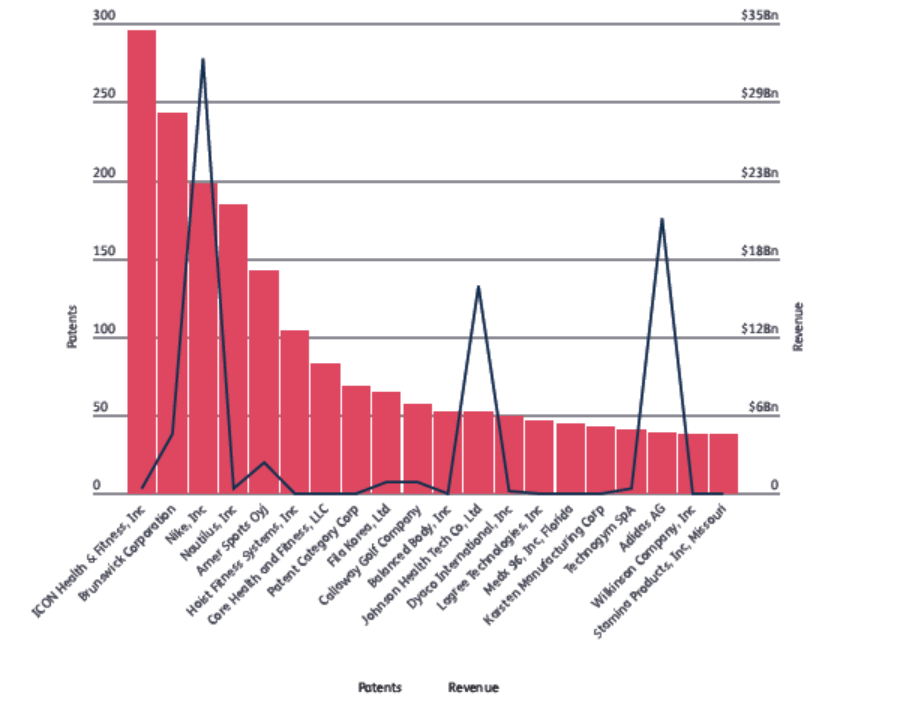
The fitness equipment industry comprises approximately 100 companies, some of the major players being Cybex International and Life Fitness (both owned by Brunswick Corp), ICON Health & Fitness, Nautilus, Peloton Interactive, Precor (owned by Amer Sports Oyj), Dyaco International, Technogym SpA, and Johnson Health Tech Co. Data indicates that, among these major players, ICON has filed the most U.S. patent disputes in the past five years, and thus, has been the industry player most actively enforcing its IP rights.7 Further, the data in the chart below shows that, among the major industry players, ICON has the largest US patent portfolio related to fitness equipment technology.8 This may indicate that ICON is also the most active industry player in pursuing IP protection. See chart 1.
Chart 1: Number of Patents for Top 20 Companies
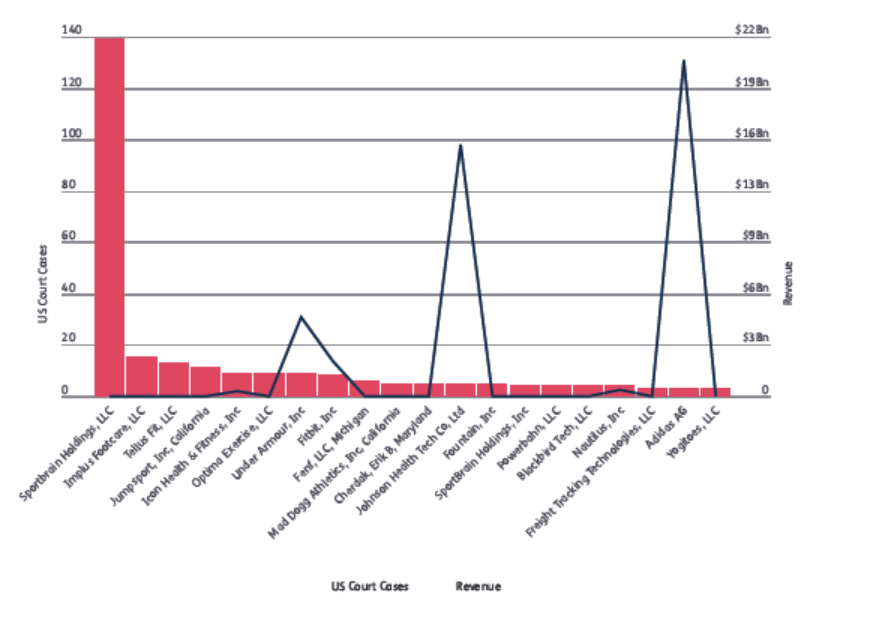
The major industry players, however, have not been the most litigious in terms of recent U.S. patent disputes. Instead, non-practising entities account for the highest volume of recently-filed U.S. patent cases (well over half of all cases) involving the fitness equipment industry.9 See chart 2. The majority of these cases also target the interconnectivity trend that has been influencing demand and growth in the fitness equipment industry.
Chart 2: Number of U.S. Court Cases for Top 20 Plaintiffs
This snapshot of the fitness equipment industry provides a number of IP takeaways to consider as equipment companies continue to feed the rising demand and market growth. Product innovation and differentiation are crucial in the fitness equipment industry to address rapidly shifting fitness trends and consumer boredom with exercise. Protecting these innovations appears to be more and more crucial, because a given exercise technology may experience significant success based on the popularity of a current exercise preference, especially in view of the rapidly growing health-conscious population. The recent popularity of connected exercise devices provides an intriguing example. Equipment manufactures may utilise their IP for offensive purposes, such as enforcing patents against alleged infringers, and for defensive purposes, such as countersuing for patent infringement or gaining leverage in an existing dispute. The trend of U.S. patent application filings related to fitness equipment technology (an average of more than 1,000 each of the past eight years) shows the significance of IP protection to the industry.10
This trend highlights the value of a freedom-to-operate analysis. With the growing number of U.S. patent disputes in the fitness equipment industry, identifying and navigating potential IP infringement risks in advance is imperative when developing and producing new fitness equipment products. Doing so reveals the level of risk and potential adversaries to assist with business and legal making decisions associated with the new products. Fitness equipment companies should also assess the potential for any non-traditional adversaries, eg, non-practising entities, in this analysis. As the recent data has shown, U.S. patent disputes initiated by non-practising entities significantly outnumber disputes between industry competitors. Depending on the circumstances and analysis, including the litigation habits of relevant non-traditional adversaries, companies should assess potential strategies for engaging these adversaries, including, for example, more aggressive tactics such as post-grant challenges at the patent office.11
IP due diligence and freedom-to-operate analyses should also be considered for other relevant contexts in the fitness equipment industry. Fitness equipment companies often acquire other companies to expand their market and product lines. An example of this is Brunswick, the parent company of Life Fitness, acquiring Cybex International to add to its fitness equipment line. For such deals, fitness equipment companies should analyse various IP issues to assist with the business and legal decision making process, such as the IP infringement risks of the acquired products and the value of any IP that may be secured with the purchase.
Current forecasts project healthy growth for the fitness equipment industry. This growth may be attributed to the development of innovative products to quench consumer demand for new fitness fads and rising health awareness. And as fitness equipment companies continue to innovate and produce new products, recent trends in the industry illustrate the importance of protecting their IP and guarding against other IP threats.
Endnotes
1 Fitness Equipment Manufacturing Report Summary, D&B Hoovers (5 Feb, 2018).
2 Based on an Innography search of litigations involving U.S. patents classified in A63B subclasses focused on exercise equipment: A63B 17, A63B 19, A63B 21, A63B 22, A63B 23, A63B 24, A63B 26, A63B 2207, A63B 2208, A63B 2213, A63B 2220, and A63B 2230.
3 Based on an Innography search of U.S. patent litigations filed per A63B subclass.
4 Eg, ICON Health & Fitness, Inc v. Peloton Interactive, Inc et al, Case No. 1:16-cv-08303; ICON Health & Fitness, Inc v. Johnson Health Tech North America, Inc, Case No. 1:13-cv-00112; ICON Health & Fitness, Inc v. Saris Cycling Group, Inc, Case No. 3:13-cv-00005.
5 Eg, Hoist Fitness Sys, Inc v. TuffStuff Fitness Int’l, Inc, Case No. 5:17-cv-01388; Health In Motion, LLC et al v. Torque Fitness, LLC, Case No. 8:13-cv-00827; WAYSS Inc v. ICON Health & Fitness, Inc, Case No. 1:15-cv-05023; Mad Dogg Athletics, Inc v. Fitness Master, Inc, Case No. 2:15-cv-02616; Johnson Health Tech Co, Ltd et al v. Spirit Manufacturing, Inc, Case No. 3:13-cv-00712.
6 Eg, ICON Health & Fitness, Inc v. TRUE Fitness Technology, Inc, Case No. 4:18-cv-00439; Nautilus, Inc v. ICON Health & Fitness, Inc, Case No. 1:17-cv-00154; Lagree Tech, Inc et al v. Spartacus 20th LP et al, Case No. 3:17-cv-00795; Woodway USA, Inc v. Samsara Fitness, LLC et al, Case No. 2:15-cv-00956.
7 Based on an Innography search of filings per plaintiff of U.S. patent litigations involving A63B patents.
8 Based on an Innography search of all U.S. patents classified in A63B subclasses focused on exercise equipment by assignee.
9 Based on an Innography search of litigations involving U.S. patents classified in Class A63B and all subclasses.
10 Based on an Innography search of filings of U.S. patent applications classified in A63B subclasses focused on exercise equipment.
11 Eg, Unified Patents, Inc v. Sportbrain Holdings LLC, Case No. IPR2016-01464.
Related Practices
Related Industries
Related Professionals


Originally printed in Intellectual Property Magazine on May 25, 2018. This article is for informational purposes, is not intended to constitute legal advice, and may be considered advertising under applicable state laws. This article is only the opinion of the authors and is not attributable to Finnegan, Henderson, Farabow, Garrett & Dunner, LLP, or the firm’s clients.


