
D. Mass. Patent Litigation Update: June 2023
August 16, 2023
This is part of a series of articles discussing recent orders of interest issued in patent cases by the United States District Court for the District of Massachusetts.
In Enanta Pharmaceuticals, Inc. v. Pfizer, Inc., No. 1:22-cv-10967, Magistrate Judge Boal granted in part Pfizer’s motion to compel and denied Enanta’s motion to compel, both of which had been referred by Judge Casper.
Enanta asserts that the group shaded in red is an “optionally substituted C1-C8 alkyl” as used in the claims:
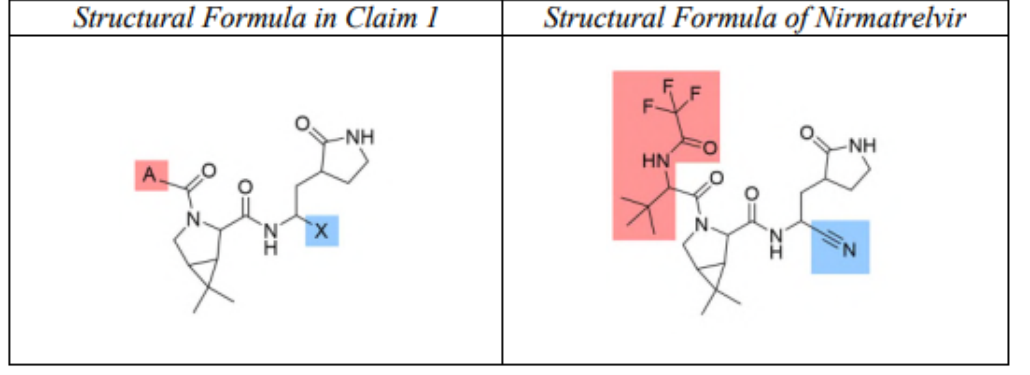
The Parties agreed that:
The term “optionally substituted” means that the referenced group may be unsubstituted (no substituents) or substituted, including with one or more additional groups individually and independently selected from groups described herein.
Pfizer moved to compel supplemental infringement contentions and a more substantive response to its interrogatory inquiring why Enanta asserts that the group in red qualifies as an “optionally substituted C1-C8 alkyl.”
Enanta moved to compel a more fulsome response to its interrogatory inquiring why Pfizer disputes the claim mapping, which Pfizer claimed it was unable to answer without first understanding Enanta’s affirmative theory.
The Court first found that Enanta’s infringement contentions were sufficient because they mapped the elements of the claims to the accused chemical structure, and debates about the merits of that mapping are beyond the scope of such contentions.
The Court next found that Enanta’s response to Pfizer’s contention interrogatory was lacking, as it does not explain why the group shaded in red can qualify as “optionally substituted” where it is not one of the specifically enumerated groups referenced by the Parties’ agreed definition of the term.
Last, the Court found that Pfizer’s interrogatory response was sufficient, as Enanta bears the burden of showing infringement and Pfizer is unable to explain why it disagrees with an infringement theory that has not yet been sufficiently articulated.
Thus, the Court granted Pfizer’s motion to compel a further response to its interrogatory seeking to understand Enanta’s infringement theory, and otherwise denied the Parties’ motions to compel.
In Gratuity Solutions, LLC et. al. v. Toast, Inc., No. 22-11539, Judge Saris allowed in part and denied in part Toast’s Motion to Dismiss and allowed Toast’s Motion to Strike Gratuity’s expert declaration.
Gratuity develops, commercializes, and sells a gratuity distribution and management software to hospitality businesses. Toast offers point of sale, operations, and financial technology solutions to restaurants. Gratuity and Toast entered into two non-disclosure agreements, first in 2016 while Toast considered using Gratuity’s software, and later in 2019 when Toast considered acquiring Gratuity altogether. In 2021, Toast launched a new gratuity management software.
Gratuity sued Toast on three counts. Counts I and II alleged infringement of two U.S. Patents. Count III alleged Toast breached the two non-disclosure agreements.
Toast moved to dismiss Counts I and II on the grounds that both patents-in-suit involve patent-ineligible subject matter under 35 U.S.C. § 101, and moved to dismiss Count III on the grounds that Gratuity failed to plausibly allege a breach of contract claim. Toast also moved to strike an expert declaration that Gratuity submitted and cited to in their opposition to the motion to dismiss.
Motion to Strike
The Court first addressed the motion to strike. Gratuity submitted an expert declaration with their opposition brief, discussing whether the claims at issue were technical improvements over the prior art.
Toast argued that such a declaration was improper at the motion to dismiss stage, and that the declaration contained improper legal conclusions. Gratuity urged the Court to convert the motion to dismiss into a motion for summary judgment and consider the expert’s declaration.
The Court declined to consider the expert declaration because it was not part of the pleadings. The Court noted that unlike the patents or the prosecution history, which are considered at the motion to dismiss stage, the declaration is not a public record. Furthermore, patent eligibility under § 101 is a matter of law, which the Court could decide without relying on the expert declaration. Therefore, the Court allowed Toast’s Motion to Strike.
Motion to Dismiss Counts I and II (Patent Infringement)
Toast moved to dismiss the two counts of patent infringement, asserting that both patents were directed to patent ineligible subject matter under 35 U.S.C. § 101. Gratuity disputed this assertion, arguing that the claims “bring together numerous unconventional concepts and features in a system that offers tangible improvements.”
Both patents-in-suit are titled “System and Method for Managing Gratuities” and are directed to “managing gratuities, and more particularly to calculating, allocating, and distributing gratuities among service employees.”
The Court considered both patents under the Alice/Mayo framework. At step one of the Alice test, the Court held the claims were directed to the abstract idea of “extracting, receiving, and storing of transaction and employee information . . . followed by the executing of gratuity distribution rules and returning of gratuity allocations to client business systems.” The Court noted that those steps are directed to “the collection, analysis, and display of available information in a particular field” which the Federal Circuit has previously held to be a patent ineligible abstract idea.
Under step two of the Alice test, the Court held that Gratuity had sufficiently pled that the claims of one – and only one – of the asserted patents contain an additional inventive concept. Specifically, the relevant claim is to “a cloud computing [gratuity management] system remote from the plurality of client business systems” that performs the necessary calculations “on remote servers using data received from local systems,” which enables the execution of “gratuity distribution calculations without additional on-site hardware.”
The Court ruled that these claim elements “plausibly improve[] computer functionality by ‘offload[ing] the computationally intensive tasks from local, legacy hardware into the cloud.’”
As the other asserted patent lacked the remote, cloud-based system, the Court found that it lacked an inventive concept.
Therefore, the Court denied the motion to dismiss as to Count I (infringement of the ’050 patent) and allowed the motion to dismiss with respect to Count II (infringement of the ’436 patent).
Motion to Dismiss Count III (Breach of Contract)
Regarding Count III for breach of the two non-disclosure agreements, Toast argued that Gratuity had failed to allege the elements of a breach of contract claim. The Court disagreed.
Massachusetts law requires (1) the existence of a valid and binding contract, (2) breach of the contract’s terms, and (3) damages as a result of that breach.
First, the Court held that Gratuity plausibly alleged the existence of two valid and binding contracts, over Toast’s objections that they had not signed each NDA. The Court noted that “[a] written contract, signed by only one party, may be binding and enforceable even without the other party’s signature if the other party manifests acceptance” and that “Gratuity’s continuation in conversations with Toast in light of the [second] NDA was evidence of its willingness to be bound.”
Second, the Court held that Gratuity plausibly alleged breach of the contract’s terms by
- describing “the specific contractual promise [Toast] failed to keep”;
- alleging that Toast breached the terms of the NDAs by causing the disclosure of Gratuity’s propriety information; and
- alleging that Toast improperly used “the proprietary information disclosed to it by [Gratuity] to [Gratuity’s] detriment.”
Third, the Court held that Gratuity alleged that it was harmed by Toast’s alleged breach and did not need to plead damages in detail.
Thus, the Court denied the Motion to Dismiss as to Count III.
Tags
Article Series: D. Mass. Patent Litigation Update, motion to dismiss, subject matter eligibility, Alice Corp. v. CLS Bank International, 35 U.S.C. § 101, Motion to Compel
Related Practices
Related Offices
Related Professionals


Copyright © Finnegan, Henderson, Farabow, Garrett & Dunner, LLP. This article is for informational purposes, is not intended to constitute legal advice, and may be considered advertising under applicable state laws. This article is only the opinion of the authors and is not attributable to Finnegan, Henderson, Farabow, Garrett & Dunner, LLP, or the firm’s clients.