
Analyzing the PTAB in the First Half of 2016
August 10, 2016
Managing Intellectual Property
By Joshua L. Goldberg; Daniel F. Klodowski; David C. Seastrunk
Authored by Joshua L. Goldberg, Daniel F. Klodowski, and David C. Seastrunk
All post-grant proceedings at the USPTO start with the filing of a petition and progress through two general phases—a pre-institution phase and a post-institution phase. The USPTO’s Patent Trial and Appeal Board (PTAB) must decide if the petition raises sufficient grounds to institute trial in view of any arguments submitted by the patent owner in a preliminary response. While the rate of institution varies by technology, in general, the percentage of institution ranges between 55% and 75% on a per-claim basis. In the first half of 2016, institution rates declined compared to the lifetime average.
If the PTAB determines the petition warrants institution, it issues a written institution decision and initiates trial. At the conclusion of trial, the PTAB issues a final written decision. To date, and as discussed in more detail below, inter partes review (IPR) and covered business method (CBM) proceedings have strongly favoured petitioners at the expense of patent owners. Case outcomes vary by technology, but on average, less than 20% of the claims that are instituted in IPRs and CBMs survive a full trial. While survival rates increased slightly in the first half of the year, this still paints a challenging picture for patent owners.
Institution Decisions
Source: Lex Machina
According to Lex Machina’s database, institution rates in the first half of 2016 continued their downward trend compared to the lifetime average. In 686 institution decisions issued between January 1 and June 30, the Board granted institution in 486 (70.85%) cases and denied institution in 200 (29.15%) cases. This number falls 6.35% short of the lifetime institution rate of 77.19%. Only the month of May saw an institution rate above the lifetime average, where 77 out of 94 (81.91%) petitions were granted institution. April was the worst month for petitioners, where the Board instituted only 66 out of 107 (61.68%) cases.
In determining institution rates, we only consider decisions made by the Board on the merits, and therefore have excluded settlements, procedural terminations, and pre-institution disclaimers by the patent owner of every challenged claim.
Final Written Decisions
Post-grant proceedings have historically been more favourable to petitioners than patent owners, and the first half of 2016 has been no different. Combining the outcomes of both IPR and CBM final written decisions issued by the PTAB from January 1 to June 30, the Board cancelled 3,339 (76.58%) of the instituted claims and maintained just 853 (19.56%) of the instituted claims. Patent owners conceded 168 (3.85%) of the instituted claims through motions to amend or disclaimer. These numbers are slightly more favourable to patent owners than the lifetime statistics, where the Board cancelled 11,319 (79.05%) of the instituted claims and maintained just 2,492 (17.40%) of the instituted claims, with patent owners conceding 507 (3.54%) of the instituted claims.
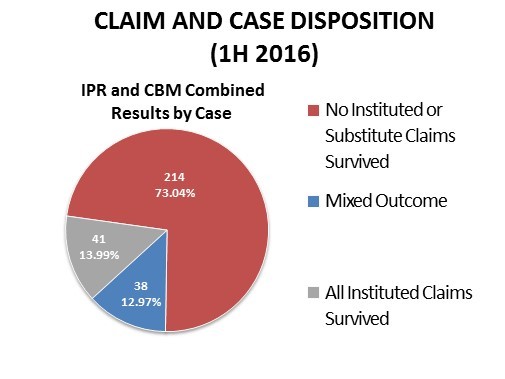
On a per-case basis, for all combined IPR and CBM final written decisions issued from January 1 to June 30, 214 (73.04%) of the decisions resulted in all instituted claims being cancelled, 41 (13.99%) of the decisions resulted in all instituted claims being maintained, and 38 (12.97%) of the decisions resulted in a mixed outcome. A mixed outcome, where at least one instituted claim was cancelled and one instituted claim was maintained, occurred in just 36 (13.90%) of IPR final written decisions. Once again, these numbers are slightly more favorable to patent owners when compared to the lifetime statistics, where 731 (74.06%) of the decisions resulted in all instituted claims being cancelled, 127 (12.87%) of the decisions resulted in all instituted claims being maintained, and 129 (13.07%) of the decisions resulted in a mixed outcome.
Based purely on statistics, there is a high likelihood that if claims are instituted, they will be cancelled. This reality has led many patent owners to focus their preliminary responses on reducing the number of claims or grounds on which the PTAB institutes trial. Some try to take advantage of the new PTAB rules that went into effect on May 2 2016, permitting patent owners to submit new testimonial evidence from technical and industry experts before the PTAB decides whether to institute trial.
Substitute Claims
In all post-grant proceedings, patent owners are entitled to propose substitute (i.e., amended) claims either by conceding the unpatentability of the corresponding instituted claims outright along with the proposed substitute claims, or by making the Board’s consideration of the substitute claims contingent on the instituted claims first being held unpatentable.
To date, patent owners have struggled to obtain substitute claims. Through June 30 2016, the PTAB has issued only 31 (4.87%) of 637 proposed substitute claims included in motions to amend in IPR proceedings. In the first half of 2016, only 2 out of 28 (7.14%) motions to amend were granted, for a total of six substitute claims. Notably, and as previously reported, one of the successful motions to amend was granted in a CBM proceeding–the first substitute claim to be granted out of 183 substitute CBM claims presented to the PTAB.
Against this backdrop, it is perhaps not surprising that the number of patent owners pursuing substitute claims is decreasing over time. Of the 293 final written decisions issued between January 1 and June 30, only 28 (9.56%) referenced motions to amend, down from a lifetime average of 124 motions in 987 decisions (12.46%). Patent owners struggle to satisfy the PTAB’s stringent requirements to sufficiently demonstrate the patentability of the proposed substitute claims–even after the May 2015 rule change increasing the maximum length of a motion to amend from 15 pages to 25 pages. However, amendment practice may be changing to make the practice more favorable to patent owners. For example, the Board recently approved the practice of grouping prior art references together in a motion to amend according to the references’ particular teachings, rather than requiring the patentee to explain each individual reference in detail.
Technology Centres
IPR and CBM petitions are sorted among the various Technology Centres at the USPTO. In the first half of 2016, the top three technology centres by number of final written decisions were, respectively, electrical systems (60 decisions, 21% of total), communications (53 decisions, 18% of total), and transportation and e-commerce (51, 17% of total). Taken together, electrical-based technologies represent 240 (82.19%) of all post-grant proceedings. The smallest technology centers include design patents (2 decisions, less than 1% of total) and biotechnology and organic chemistry (11, 4% of total). The percentages shown above are historically typical, with each falling within 2.5% of the lifetime average of decisions issued per tech centre.
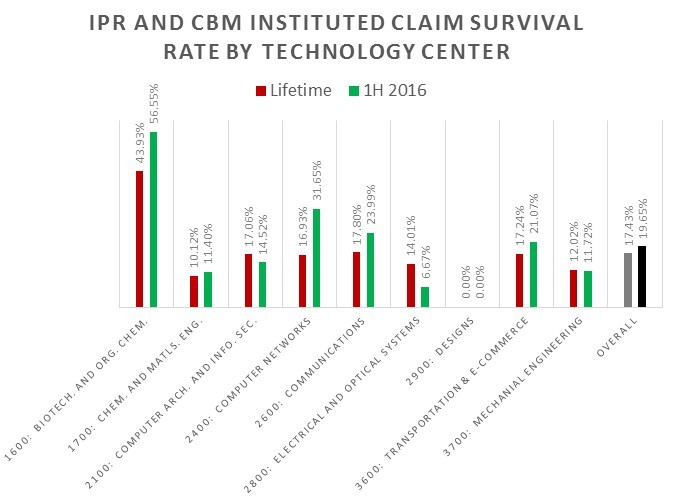
Although the PTAB has generally cancelled instituted claims about 75% of the time, the PTAB has not cancelled claims at the same rate across all technologies. For example, instituted claims in Technology Centre 1600, which covers patents in the fields of biotechnology and organic chemistry (including pharmaceuticals), have had the highest instituted claim survival rate at 56.55% (43.93% lifetime). This is nearly three times higher than the average survival rate for all technologies, and is perhaps explained by the unique unpredictability of this subject matter, differences in patent quality, tight petition page limits for petitioners to address relatively complex legal and factual issues, and the smaller number of decisions relative to other technologies.
Additionally, in the first half of 2016, the instituted claim survival rate for the most popular technology centre, 2800 (Electrical), decreased significantly compared to its lifetime average, while 2400 (Computer Networks), 2600 (Communications), and 3600 (Transportation & E-Commerce) all saw significant increases in survival rates over the respective lifetime averages.
Related Offices
Related Professionals


Originally printed in Managing Intellectual Property on August 10, 2016. This article is for informational purposes, is not intended to constitute legal advice, and may be considered advertising under applicable state laws. This article is only the opinion of the authors and is not attributable to Finnegan, Henderson, Farabow, Garrett & Dunner, LLP, or the firm's clients.