
RCE Statistics - Is There Still a Backlog?
February 08, 2016
Authored and Edited by Jessica L. Roberts, Ph.D.; Adriana L. Burgy
When patent prosecution ends in no claims allowed, applicants have the opportunity to file Requests for Continued Examination (RCEs). Of all new utility, plant, and reissue filings received at the USPTO within the last 12 months, nearly 30% of those applications were not actually “new”, but RCEs filed by applicants in already pending cases. These statistics indicate RCEs have become a common vehicle for entering rejected claims back into prosecution.
Over the years, the USPTO vacillated on how it treats RCEs. In 2009, the USPTO adopted a system that led to a delay of further consideration of RCE’d applications. These changes included slightly decreased “counts” for Examiners towards their production goals for patent applications. As shown in the graph below, these actions resulted in a rapid growth of RCE filings awaiting examination.
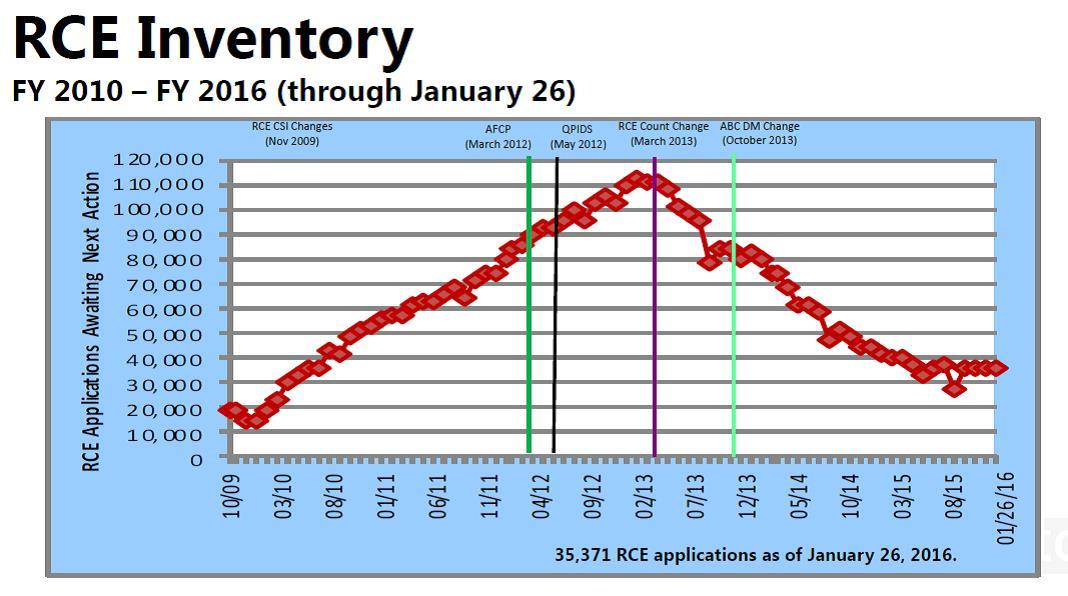
The USPTO recognized the rapid growth in RCE backlog and began implementing various initiatives to address the problem. As a stop-gap measure, the USPTO temporarily reverted to the old count system. They also began pushing initiatives including the Quick Path Information Disclosure Statement (QPIDS) and After Final Consideration Pilot (AFCP 2.0) programs. To further reduce the RCE inventory, the USPTO devised a two-phase approach where the first phase, beginning March, 2013, featured a temporary increase in production credit for RCEs. The second phase, implemented October, 2013 focused on a longer term approach to reorganize new application dockets and improve the workflow for RCEs. Looking at the statistics, the USPTO appears to have the RCE backlog largely under control today with a flatting of the number of RCE applications waiting for a next action.
USPTO statistics can be found here.
Contacts

Copyright © 2016 Finnegan, Henderson, Farabow, Garrett & Dunner, LLP.
DISCLAIMER: Although we wish to hear from you, information exchanged in this blog cannot and does not create an attorney-client relationship. Please do not post any information that you consider to be personal or confidential. If you wish for Finnegan, Henderson, Farabow, Garrett & Dunner, LLP to consider representing you, in order to establish an attorney-client relationship you must first enter a written representation agreement with Finnegan. Contact us for additional information. One of our lawyers will be happy to discuss the possibility of representation with you. Additional disclaimer information.