
AIA First Inventor to File Statistics
March 04, 2016
Authored and Edited by Rachael P. Dippold, Ph.D.; Amanda K. Murphy, Ph.D.
In the February installment of its Patent Quality Chats, the USPTO presented statistics on AIA First Inventor to File (FITF) applications. FITF applications are those applications that (1) were filed after March 15, 2013, without claiming priority to an application filed before March 16, 2013; or (2) is a “transition application.” A transition application is an application that claims priority to an application filed before March 16, 2013, but at some point contained a claim that has an effective filing date after March 15, 2013. As expected, the number of pending FITF applications has increased each year since March 16, 2013. However, the USPTO reports that First to Invent (FTI) applications still represent over half of the applications pending through November of the USPTO’s 2016 fiscal year.
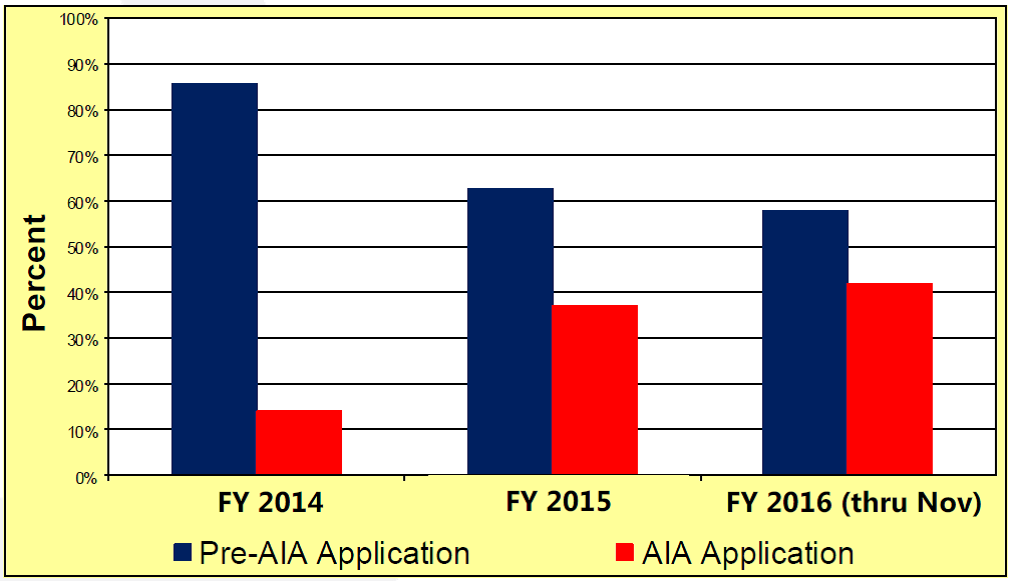
The number of pending FTI applications is due in part to a back log of FTI applications pending at the USPTO, and also is due in part to the large percentage of FTI applications still being filed. Somewhat surprisingly, the number of FITF applications being filed has only recently surpassed that of FTI applications.
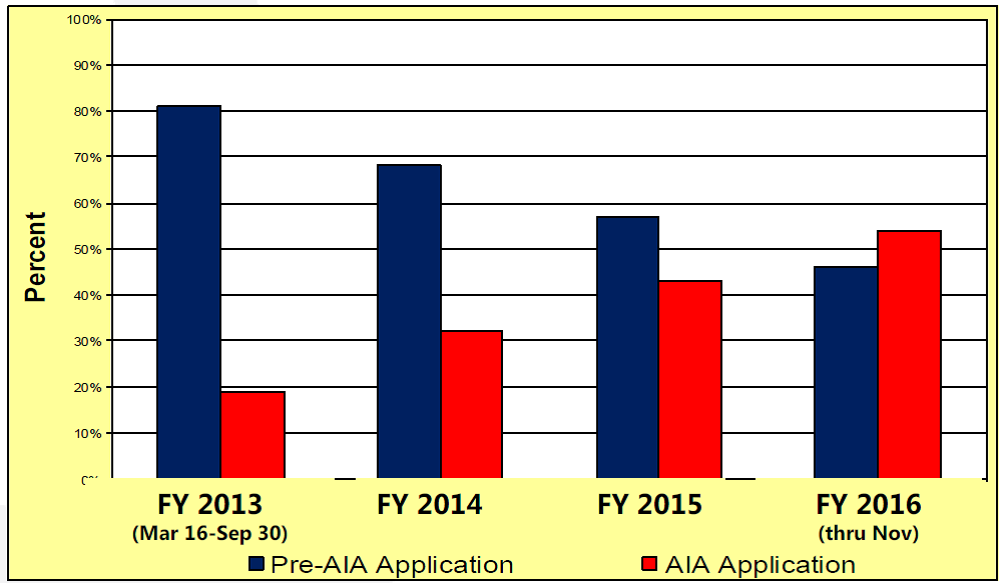
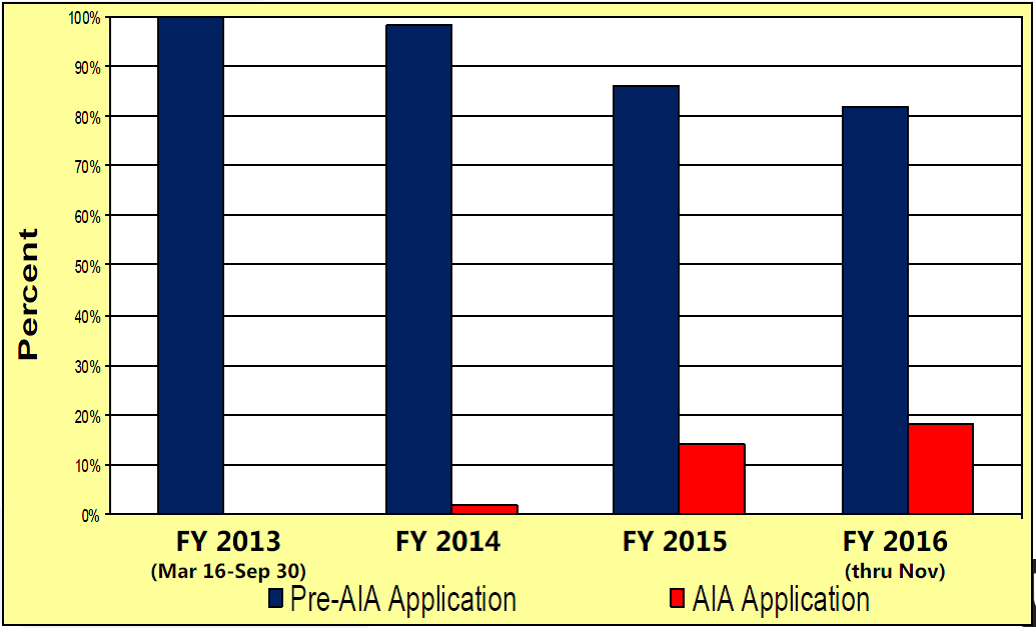
Taking these data together, and considering that even the oldest pending FITF applications are now only about 3 years old, it’s not surprising that the overwhelming majority of allowed applications are still FTI applications.
The Patent Quality Chat also provided statistics for the percentage of FITF First Actions completed by Technology Center (TC). As shown below, the percentage of applications receiving first actions that are FITF varies greatly between TCs. Except for TC 2900, which handles Design applications, the most recent statistics show that, at most, only about 50% of the first actions completed by any TC are for FITF applications. The TCs with the highest percentage of first actions completed in FITF applications are 2600 and 2800, which handle communications (2600) and semiconductors, electrical and optical systems, and components (2800), respectively. The TC with the lowest percentage of FITF first actions is 1600, which handles biotechnology and organic chemistry.
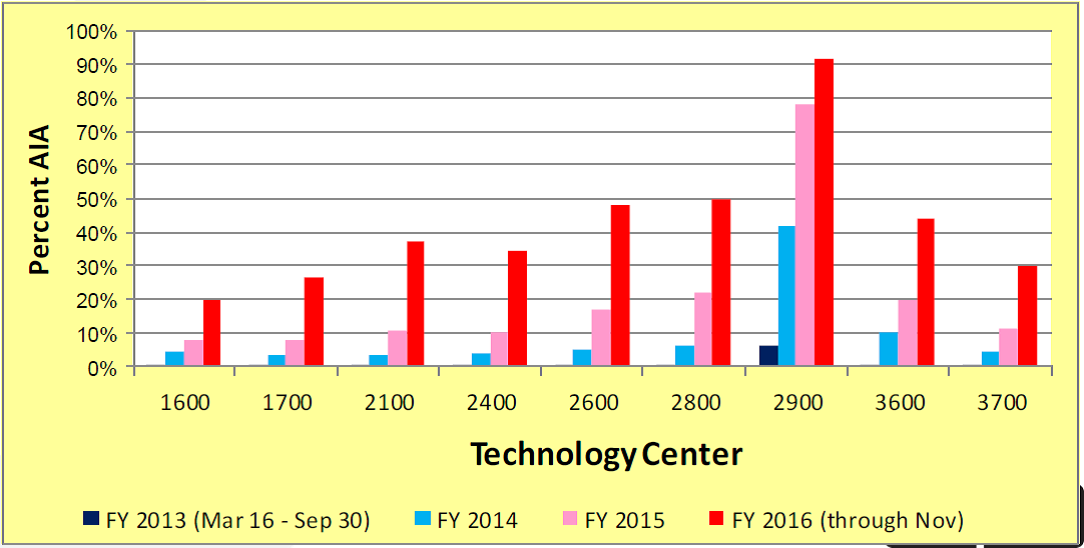
However, statistics on the FITF vs. FTI pendency and filing for individual TCs were not presented in the Patent Quality Chat, making it difficult to know how much either back log or new filings of FTI applications contribute to the above TC first action statistics.
As with other Patent Quality Chats, the USPTO has provided the presentation materials to the public, selections from which were incorporated into this post.
* Data do not include Design applications
‡ FY = fiscal year. The USPTO fiscal year currently runs from October 1 to September 30.
Contacts


Copyright © 2016 Finnegan, Henderson, Farabow, Garrett & Dunner, LLP.
DISCLAIMER: Although we wish to hear from you, information exchanged in this blog cannot and does not create an attorney-client relationship. Please do not post any information that you consider to be personal or confidential. If you wish for Finnegan, Henderson, Farabow, Garrett & Dunner, LLP to consider representing you, in order to establish an attorney-client relationship you must first enter a written representation agreement with Finnegan. Contact us for additional information. One of our lawyers will be happy to discuss the possibility of representation with you. Additional disclaimer information.


