
Voilà: French Press Coffeemaker Design Is Not Functional According to the Seventh Circuit
July 22, 2019
Authored and Edited by B. Brett Heavner; Margaret A. Esquenet
Since 1983, Plaintiff Bodum USA Inc. (“Bodum”) has been selling the iconic “Chambord” line of French Press coffeemaker, which features the following proprietary design elements: (1) a metal cage with a band around the top of the carafe, (2) four metal pillars ending in four curved feet, (3) a C‐shaped handle, and (4) a domed lid topped with a spherical knob. The design has been recognized as a classic by various arts and cultural institutions. Bodum has spent millions of dollars promoting the design and has successfully policed its rights over the past 25 years.
In 2014, Defendant A Top New Casting Inc. (“A Top”) began selling a competing French press coffeemaker through Amazon featuring the exact same four design elements as the Chambord product. The two coffeemakers are pictured side-by-side below, with the Chambord on the left and the A Top product on the right.
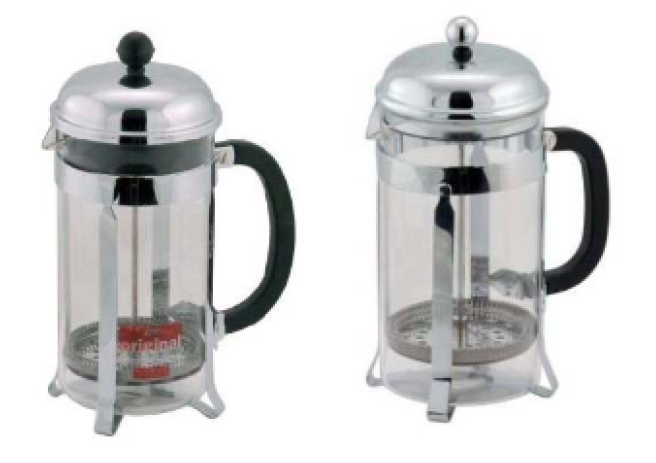
Chambord A Top
In response to Bodum’s infringement suit, A Top filed motions for summary judgment alleging that the Chambord design was functional. However, the trial court denied the motions and, after trial, a jury returned a verdict in favor of Bodum, awarding it $2 million in damages. This damage award was later enhanced to $4 million. A Top appealed the decision to the Seventh Circuit arguing (A) that it was entitled to judgment as a matter of law, and (B) that it was entitled to a new trial because the trial court erred in excluding certain utility patent evidence.
A. Legal Functionality with a Capital “F”
The protectability of trade dress is evaluated using the following factors:
- the existence of a utility patent covering the design element;
- the utilitarian properties of the design elements;
- plaintiff’s advertising that touts the utilitarian advantages of the design elements;
- the absence of alternative designs for the product; and
- the effect of the design feature on an item’s quality or cost.
A Top argued that the Chambord design was “functional” because handles, domed tops, metal framing around the carafe, and feet below the carafe were utilitarian features that were necessary to the function of any French press coffeemaker. The Seventh Circuit rejected this argument noting that A Top had conflated the everyday meaning of “functionality” with the specific legal term of art, “Functionality,” which is different. As a legal term, “Functionality” addresses the overall appearance of the design in question. So, the analysis is not whether a French press coffeemaker needs some sort of handle, top, metal frame, and feet to “function.” Rather, legal “Functionality” asks whether A Top’s coffeemaker will only work properly if it uses the same C-shaped handle, the same smooth domed lid, the same columns and curve-shaped feet, the same rounded knob, and the same shaped metal frame as the Chambord design. Because A Top’s own expert testified that the utilitarian advantages of these particular Chambord design elements were “unclear,” and because there was ample evidence that the particular shape and placement of the Chambord design elements were merely ornamental, the Seventh Circuit determined that the jury was justified in finding the Chambord design to be nonfunctional and affirmed the verdict.
B. Utility Patent Evidence
A Top also argued that the trial court erred by excluding evidence of a third-party utility patent that one of its experts testified encompasses the Chambord design elements. Bodum’s expert, however, testified that the utility patent in question only disclosed a plunger rod and a cylindrical carafe, features that were not part of the Chambord trade dress. Further the record only contained illustrations from that utility patent. A Top did not submit the written portion of that utility patent explaining the claims. When the trial court asked A Top to point to language in the utility patent identifying the four design elements embodying the Chambord trade dress, it was not able to do so. Because the claims in the utility patent were unclear, the trial court determined that the utility patent was of minimal probative value. Accordingly, since such limited value was outweighed by the potential for jury confusion, the judge excluded the third-party utility patent from the evidence given to the jury. The Seventh Circuit ultimately decided that the trial court was within its discretion to exclude the evidence and declined to second-guess the judge’s decision. As such, A Top was not entitled to a new trial.
The case is Bodum USA, Inc. v. A Top New Casting Inc., 7th Cir., No. 18-3020, 6/12/19
Related Practices
Contacts

Copyright © 2019 Finnegan, Henderson, Farabow, Garrett & Dunner, LLP.
DISCLAIMER: Although we wish to hear from you, information exchanged in this blog cannot and does not create an attorney-client relationship. Please do not post any information that you consider to be personal or confidential. If you wish for Finnegan, Henderson, Farabow, Garrett & Dunner, LLP to consider representing you, in order to establish an attorney-client relationship you must first enter a written representation agreement with Finnegan. Contact us for additional information. One of our lawyers will be happy to discuss the possibility of representation with you. Additional disclaimer information.


