
Tenth Circuit Breathes New Life into a Spooky Skeleton Copyright Dispute
October 30, 2020
Authored and Edited by Zachery D. Olah; Margaret A. Esquenet
The United States Court of Appeals for the Tenth Circuit breathed life back into Zahourek Systems’s copyright claim involving its skeletal sculpture, the Maniken.
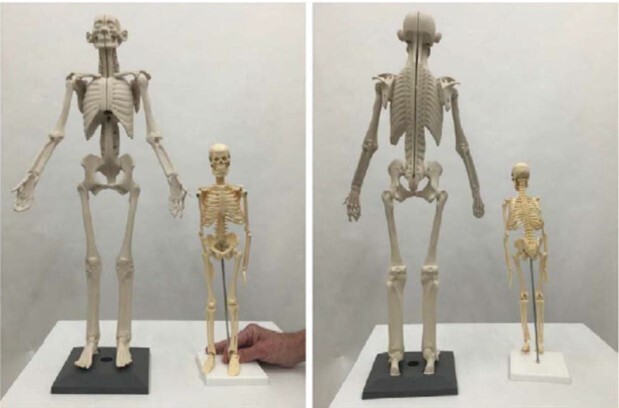
This case started when Jon Zahourek and his company sued Balanced Body University in the United States District Court for the District of Colorado alleging copyright infringement of the Maniken. The Maniken portrays the human body in a manner that aids in education about the human anatomy. It allows students to apply clay on the sculpture’s surface to represent where tissue would typically appear. Balanced Body University purchased several Maniken sculptures to advertise its services and instruct its students on human anatomy, prompting Zahourek to file suit. On summary judgment, the District of Colorado held that the Maniken is a “useful article,” and thus, it is unprotectable under copyright law. Zahourek appealed.
On appeal, the Tenth Circuit addressed whether the Maniken could be categorized as a “useful article” such that Balanced Body University was entitled to summary judgment. Because the Tenth Circuit concluded that a reasonable fact finder could conclude that the Maniken is not a useful article, it reversed the district court’s ruling.
According to the Tenth Circuit, a useful article has “an intrinsic utilitarian function that is not merely to portray the appearance of the article or to convey information” and is not subject to copyright protection. The Court ultimately concluded that the Maniken’s only utility stemmed from its portrayal of the human body. Further, the Court stated that, if the Maniken did not so accurately depict the human body, it “could lack any utilitarian function.”
Balanced Body University argued that the Maniken’s primary purpose was to teach anatomy, making it a useful article. The Tenth Circuit rejected this argument, stating that this argument incorrectly assumes that anything that can serve to educate must be a useful article. Comparing the Maniken to a textbook, the Court stated that a reasonable jury could find that the sculpture’s utility stems only from the information that it provides about the human anatomy, and if that were the case, the Maniken would not be a useful article barred from copyright protection.
Balanced Body University attempted to argue that the Maniken did more than convey information, but the Tenth Circuit noted that Balanced Body University did not make this argument at the summary judgment stage in the district court. Additionally, the Tenth Circuit stated that, even if a fact finder could reasonably infer that the Maniken could showcase the location and movement of human muscles, because of the arguments made by Balanced Body University, and because the fact finder must view the evidence in the light most favorable to the non-movant on summary judgment, it would be reasonable for the fact finder to conclude that the Maniken was useful only because of its accurate portrayal of the human anatomy.
Because a fact finder could reasonably find that the Maniken was useful only because it accurately represents a human skeleton and thus potentially protected by copyright, the Tenth Circuit reversed the award of summary judgment to Balanced Body University.
This case is Zahourek Systems, Inc. v. Balanced Body University, LLC, 1:13-cv-01812-RM-MLC (10th Cir. 2020).
Related Practices
Related Offices
Copyright © 2020 Finnegan, Henderson, Farabow, Garrett & Dunner, LLP.
DISCLAIMER: Although we wish to hear from you, information exchanged in this blog cannot and does not create an attorney-client relationship. Please do not post any information that you consider to be personal or confidential. If you wish for Finnegan, Henderson, Farabow, Garrett & Dunner, LLP to consider representing you, in order to establish an attorney-client relationship you must first enter a written representation agreement with Finnegan. Contact us for additional information. One of our lawyers will be happy to discuss the possibility of representation with you. Additional disclaimer information.
