
Sixth Circuit Finds That in Context, Attractive Ingredient Photos Are Mere Puffery
June 15, 2018
Authored and Edited by Samuel V. Eichner; Margaret A. Esquenet; Naresh Kilaru
In Wysong Corp. v. APN, Inc. 889 F.3d 267 (6th Cir., May 3, 2018), the U.S. Court of Appeals for the Sixth Circuit affirmed the lower court’s dismissal of false advertising claims targeting photos on pet food packaging, finding plaintiff’s complaint for false advertising did not plausibly allege consumer deception in the context of the pet food market.
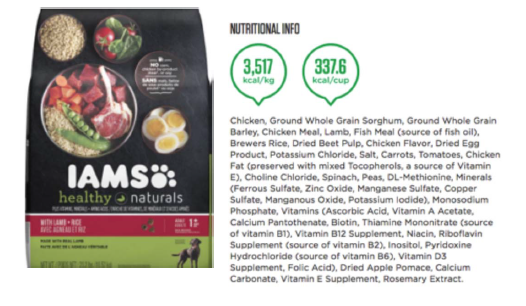
At issue were Iams pet food packages bearing photos of premium cuts of meat, which Plaintiff alleged were deceptive because Iams pet food was actually made from meat trimmings or leftovers and not the premium cuts shown on Iams’ packaging. An example of the packaging, shown below, was selected by the Court for inclusion in its opinion:
In affirming dismissal, the Court recounted the two routes by which plaintiffs can establish Lanham Act false advertising: literal falsity (which is accompanied by a presumption of consumer deception) or deceptively misleading (which requires plaintiff to prove that a significant portion of reasonable consumers were actually deceived by the advertisement at issue).
The Court summarily rejected Wysong’s argument that its amended complaint plausibly stated a false advertising claim for literal falsity, finding that the reasonable consumer could understand Iams’ packaging “as indicating the type of animal from which the food was made (e.g., chicken) but not the precise cut used (e.g., chicken breast).” As for Wysong’s argument that its amended complaint plausibly alleged deceptively misleading advertising, the Court found that Wysong “did not explain how the photographs are supposed to have misled consumers in light of the whole context of the challenged advertisements. And that is a problem.”
Noting that mere puffery is not actionable under the Lanham Act, the Court reasoned this was especially so “where the challenged practice seems to be the industry standard[,]” as illustrated by typical fast-food drive-through menus, which routinely contain photos that exaggerate the appearance of the food served. Using this example, the Court concluded that a reasonable consumer of fast-food “knows that puffery is a fact of life. The same is true here.” In effect, the Court dismissed the false advertising claims because Wysong’s legal theory failed to plausibly allege that reasonable consumers, familiar with appealing advertising photography, were deceived by Iams’ pet food packaging.
In doing so, the Court also addressed Wysong’s argument that its allegations were plausible because some pet food (such as Plaintiff’s) is made from premium ingredients. Specifically, the Court reasoned that Wysong’s amended complaint remained “too threadbare” because it failed to allege that reasonable consumers’ were aware of these premium pet foods or their ingredients, and failed to explain why truthful descriptions of Iams’ pet food ingredients did not dispel any alleged deception:
Are these premium sellers even known to the Defendants’ intended audience? Do their products compete with the Defendants’, or do they cater to a niche market? Are there obvious ways consumers can distinguish between the Defendants’ products and the fancier brands? Wysong does not say. Neither does Wysong explain why the packages’ ingredient lists, themselves pictured in Wysong’s complaints, do not dispel the photographs’ allegedly misleading effects. Contrary to Wysong’s suggestion that the packages proclaim the Defendants’ pet food is made from premium cuts, many of their packages list various kinds of animal “meal” or “by-product” as an ingredient.
In sum, the Court found that “context matters,” i.e. that Wysong’s failure to allege facts regarding the relevant market and the products’ labeling were fatal to its claims, and that “[e]ven drawing all reasonable inferences in Wysong’s favor, the fact remains: The Defendants’ product is dog food. Common sense dictates that reasonable consumers are unlikely to expect that dog food is made from the same meat that people eat.”
Accordingly, the Court affirmed the lower court’s dismissal with prejudice, finding that the lower court did not abuse its discretion in denying Wysong a second round of amendments, as it was on notice of the deficiencies in its claims but failed to correct them in its amended pleadings. Considering that the district court “expended considerable judicial resources in considering 300-plus pages of briefing and holding a three-hour motions hearing,” the Court found it was within the lower court’s discretion to “refus[e] another bite at the apple.”
Related Practices
Contacts

Copyright © 2018 Finnegan, Henderson, Farabow, Garrett & Dunner, LLP.
DISCLAIMER: Although we wish to hear from you, information exchanged in this blog cannot and does not create an attorney-client relationship. Please do not post any information that you consider to be personal or confidential. If you wish for Finnegan, Henderson, Farabow, Garrett & Dunner, LLP to consider representing you, in order to establish an attorney-client relationship you must first enter a written representation agreement with Finnegan. Contact us for additional information. One of our lawyers will be happy to discuss the possibility of representation with you. Additional disclaimer information.