
Is Kanye Really a Creative Genius? Yeezy Boost Designs Could Confirm
May 22, 2019
Authored and Edited by Rosie Norwood-Kelly; Margaret A. Esquenet
Having disrupted the music industry through his controversial and thought-provoking music, it is no wonder that Kanye West had a similar effect on the fashion industry when he launched his apparel line, Yeezy, in 2011.
Kanye partnered with Adidas and launched the much-anticipated Yeezy Boost 350 sneaker in 2015. The design quickly sold out and created an instant and insatiable desire in the marketplace. Kanye has since launched additional versions of the exclusive footwear.
With such great demand and an impressive following in the fashion industry, it must have come as an unwelcome surprise to Adidas when the Registration Policy and Practice division (“RPP”) of the United States Copyright Office denied copyright registration to two of the latest Yeezy Boost designs on February 14, 2018.
Believing in Kanye’s artistic genius, Adidas requested further consideration for copyright registration of the designs titled, Yeezy Boost 350 Version 1 and Yeezy Boost 350 Version 2. As a result, the Review Board at the United States Copyright Office reassessed the prior decision of the RPP and reached its own conclusion about Kanye’s fashion ingenuity on May 8, 2019 (see Letter from Karyn A. Temple, Reg. of Copyrights and Dir., U.S. Copyright Off., to Joseph Petersen, Esq., Kilpatrick Townsend & Stockton, LLP (May 8, 2019).)
Submitted with the application to the Review Board were images of the two designs. As pictured below, the Yeezy Boost 350 Version 1 design “consists of irregular black lines of various lengths and shapes on a gray fabric with a black semi-circle in the arch and an orange dotted stripe on an off-white heel loop.”
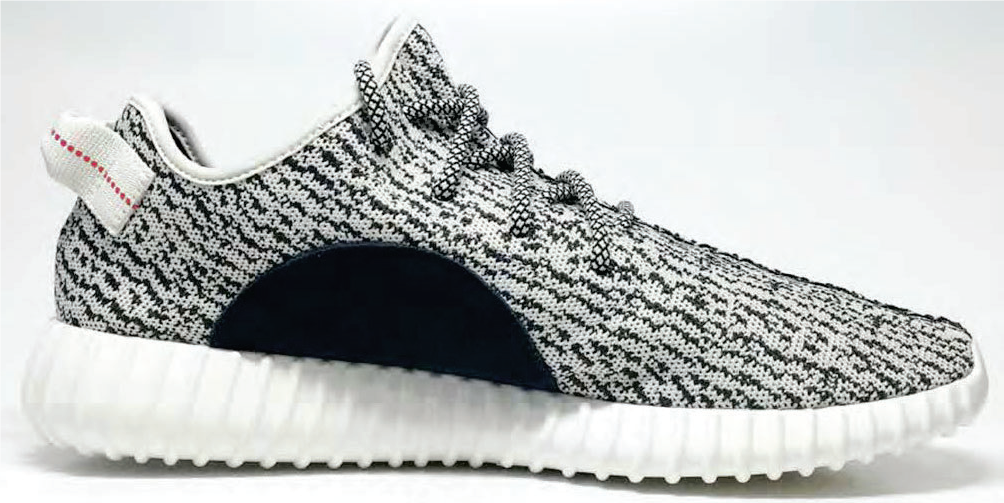
Similarly, the Yeezy Boost 350 Version 2 design “includes several grey lines in a wave pattern with a thick orange stripe on the outsole that fades toward the heel of the sneaker.” Notably, the Yeezy Boost 350 Version 2 features an inner layer of orange cloth, resulting in sporadic speckling. It is pictured below:
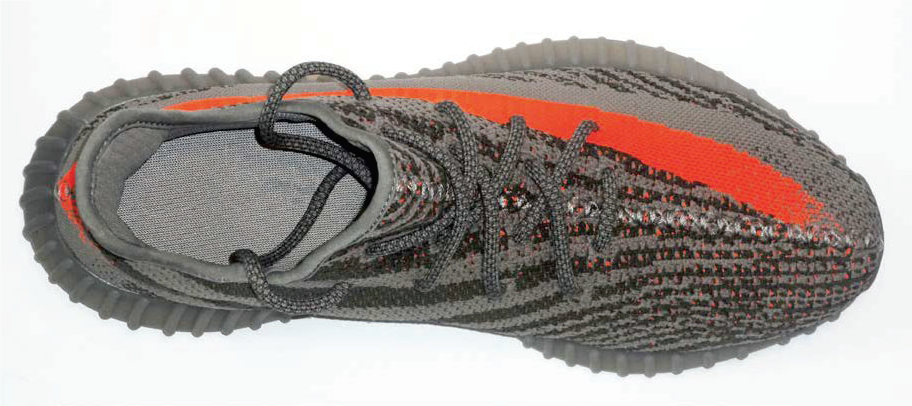
Upon first review, the RPP denied registration based on a finding that the designs were “useful articles.” With prices ranging from $200 to $2,000, it may be hard to imagine how ‘useful’ the Yeezy Boosts can be while still preserving that new shoe smell that makes the resale value of these shoes skyrocket.
A useful article under the Copyright Act is an article that has an “intrinsic utilitarian function” that exists separately from any artistic ornamentation. 17 U.S.C. § 101. While copyright protections do not extend to the utilitarian aspects of articles such as clothing or shoes, designs which are identified separately, may be protected. However, while the RPP determined that Kanye’s designs could be viewed as works of art separate from the sneaker, it also determined that they were not sufficiently original based on the simplistic shapes and patterns they incorporated.
On review, it was then the task of the Review Board to evaluate the creativity of Kanye’s designs, such that they might be eligible for copyright protection.
In its decision reversing the refusal of registration, the Review Board implemented the test for copyright eligibility set forth in Star Athletica, LLC v. Varsity Brands, Inc., 137 S. Ct. 1002, 1007 (2017), which it analyzed under the low standard of copyright eligibility laid out in Feist Publications v. Rural Telephone Service Co., 499 U.S. 340 (1991). In doing so, the Review Board determined although Kanye’s designs contained common and familiar shapes that are not typically subject to copyright protection, the creative and distinctive manner in which the lines, stripes and speckles were combined was sufficient to warrant copyright protection when viewed as a whole. 37 C.F.R § 202.1(a).
Music to Kanye’s ears.
Related Practices
Related Industries
Copyright © 2019 Finnegan, Henderson, Farabow, Garrett & Dunner, LLP.
DISCLAIMER: Although we wish to hear from you, information exchanged in this blog cannot and does not create an attorney-client relationship. Please do not post any information that you consider to be personal or confidential. If you wish for Finnegan, Henderson, Farabow, Garrett & Dunner, LLP to consider representing you, in order to establish an attorney-client relationship you must first enter a written representation agreement with Finnegan. Contact us for additional information. One of our lawyers will be happy to discuss the possibility of representation with you. Additional disclaimer information.