
Good Day for Bad Spaniels: Ninth Circuit Holds Dog Toys Do Not Infringe Jack Daniel’s Marks
April 9, 2020
Authored and Edited by Jessica L. Hannah; Margaret A. Esquenet
Whiskey aficionados hoping to treat their dogs to a “Bad Spaniels” chew toy are in luck: the Ninth Circuit recently vacated a permanent injunction that prevented VIP Products LLC from manufacturing and selling its Bad Spaniels Silly Squeakers dog toys, emblazoned with a picture of a spaniel and the words “The Old No. 2 on your Tennessee Carpet.” The Ninth Circuit concluded that the squeaky toys were expressive works that conveyed a humorous message and that VIP’s use of trademarks and trade dress similar to those of Jack Daniel’s was protected by the First Amendment.
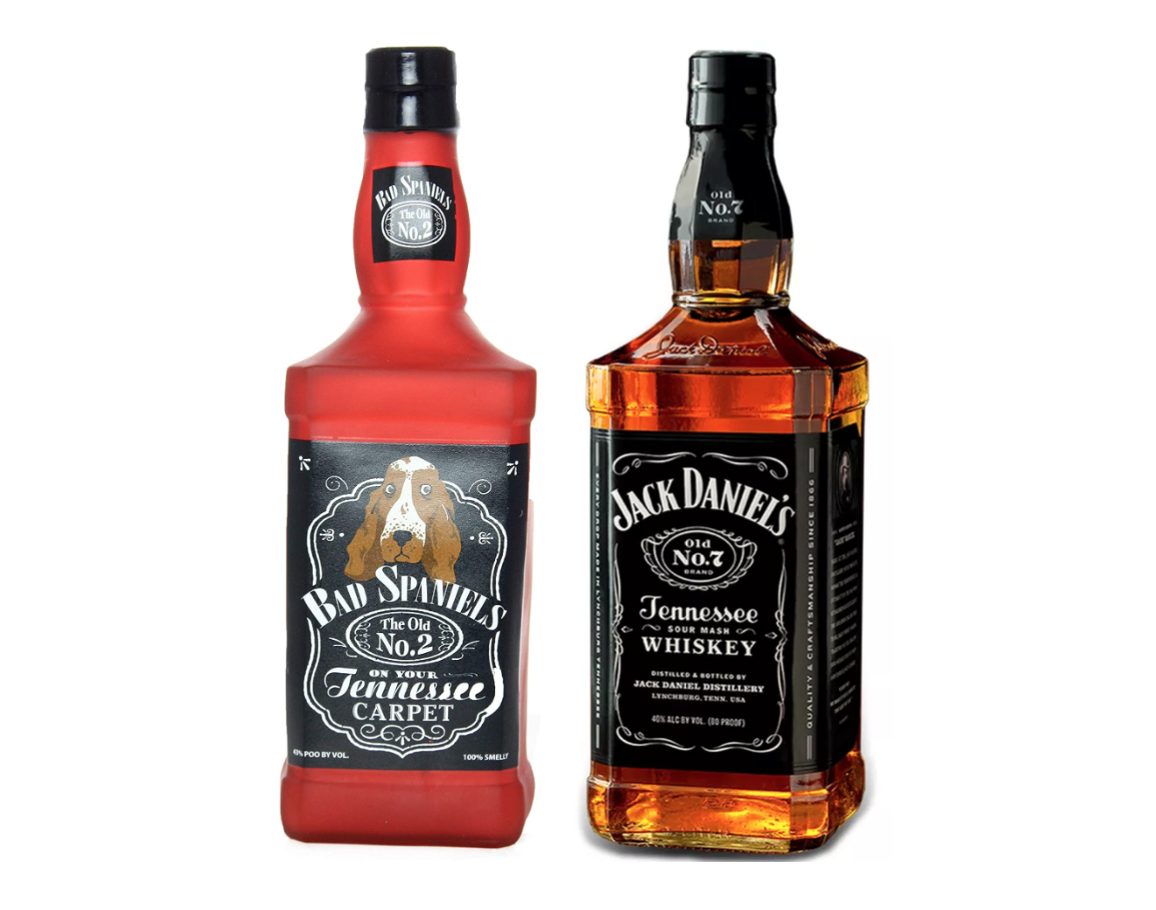
The parties’ disagreement began when Jack Daniel’s demanded that VIP stop selling the Bad Spaniels toys. VIP filed a declaratory judgment action in the U.S. District Court for the District of Arizona and sought to cancel the Jack Daniel’s registered bottle design trade dress. Jack Daniel’s then counterclaimed for state and federal trademark and trade dress infringement and dilution by tarnishment.
The district court found for Jack Daniel’s on all claims and entered a permanent injunction prohibiting VIP from selling the Bad Spaniels toys. The court rejected VIP’s defense of nominative fair use because VIP did not use Jack Daniel’s’ exact marks. VIP unsuccessfully argued that its toy was an expressive work entitled to First Amendment protection. The court determined that the Bad Spaniels toy was not an expressive work and that VIP used the protected marks and trade dress to promote its “somewhat non-expressive, commercial product.” Additionally, Jack Daniel’s successfully established that its trademarks and trade dress were famous and proved its claim of dilution by tarnishment. The court also concluded that VIP had infringed the Jack Daniel’s trademarks and trade dress, rejecting VIP’s claim of parody because VIP had a clear intent to capitalize on Jack Daniel’s’ popularity and good will for VIP’s own commercial gain.
On appeal, the Ninth Circuit affirmed the district court’s ruling that the Jack Daniel’s trade dress and bottle design were distinctive and aesthetically nonfunctional. VIP failed to overcome the presumption of nonfunctionality and distinctiveness that accompanied Jack Daniel’s’ federally registered bottle design; therefore, the court rejected VIP’s request to cancel Jack Daniel’s’ registration. The court also agreed that VIP’s nominative fair use defense was inapplicable because there were “significant differences” between the Bad Spaniels toy and the Jack Daniel’s trade dress and bottle design.
The Ninth Circuit diverged from the district court on VIP’s First Amendment defense. Unlike the district court, the Ninth Circuit concluded that the Bad Spaniels toy was an expressive work entitled to First Amendment protection and was “not rendered non-expressive simply because it is sold commercially.” Specifically, VIP used word play and other elements to “comment[] humorously on precisely those elements” that Jack Daniel’s sought to protect. The Bad Spaniels toys’ clear imitation of the Jack Daniel’s bottles juxtaposed an “irreverent expression of the trademark with the idealized image created by the mark’s owner.” In similar circumstances, the Fourth Circuit held in 2007 that “Chewy Vuiton”-branded dog toys that clearly imitated small Louis Vuitton handbags were “successful parodies” that did not infringe the Louis Vuitton trademarks. The Ninth Circuit cited approvingly the Fourth Circuit’s finding of non-infringement and stated that no different conclusion was possible in this case. Additionally, because the Bad Spaniels toys were expressive works, the district court erred by not applying the Rogers test for trademark infringement in expressive works to determine if VIP’s use of the Jack Daniel’s marks was relevant to the toy or explicitly misleading as to the source of the toy. Accordingly, the Ninth Circuit vacated and remanded the determination of infringement.
Finally, VIP was entitled to judgment on the federal and state law dilution claims. When the use of a mark does more than propose a commercial transaction, the use is noncommercial and there can be no dilution by tarnishment. Because VIP used the Jack Daniel’s trade dress and bottle design to convey a humorous message, its use of the marks was noncommercial even though VIP also used them to sell Bad Spaniels toys.
The case is VIP Prods. LLC v. Jack Daniel’s Props., No. 18-16012 (9th Cir. Mar. 31, 2020).
Copyright © 2020 Finnegan, Henderson, Farabow, Garrett & Dunner, LLP.
DISCLAIMER: Although we wish to hear from you, information exchanged in this blog cannot and does not create an attorney-client relationship. Please do not post any information that you consider to be personal or confidential. If you wish for Finnegan, Henderson, Farabow, Garrett & Dunner, LLP to consider representing you, in order to establish an attorney-client relationship you must first enter a written representation agreement with Finnegan. Contact us for additional information. One of our lawyers will be happy to discuss the possibility of representation with you. Additional disclaimer information.