
Glossier’s Pink Pouch TM Registration Could Mean a Rosy Future for Non-Traditional Marks
November 3, 2020
Authored and Edited by B. Brett Heavner; Rosie Norwood-Kelly; Margaret A. Esquenet
In a world of infinite open tabs, thousands of unread marketing emails, and hundreds of sponsored social media posts, how can brands leave a lasting impression on consumers? One answer is to rely less on traditional identifiers like brand names and logos and more on creative devices such as unique product packaging, trade dress, and color . Supporting this shift, the USPTO recently issued several non-traditional trademark registrations, potentially signaling the USPTO’s greater openness to allowing federal protection for evolving branding strategies.
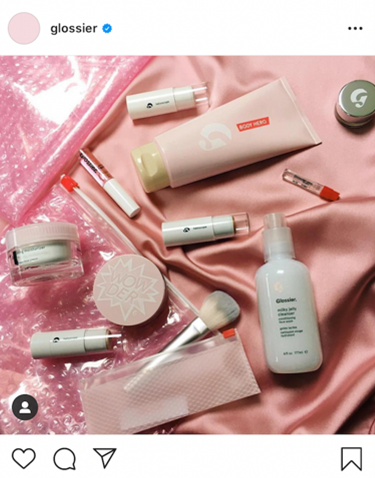
Glossier took the beauty world by storm in 2014 when the then online-only brand launched its first line of cosmetics, featuring a set of everyday essentials. Six years later, the brand has opened permanent physical locations in fashion and beauty capitals like New York, Los Angeles, and London, and is known for its cult following, “no-makeup” beauty products, and most importantly–at least in the USPTO’s mind–the millennial pink, bubble-wrap lined, resealable pouches in which all Glossier products are packaged and shipped.
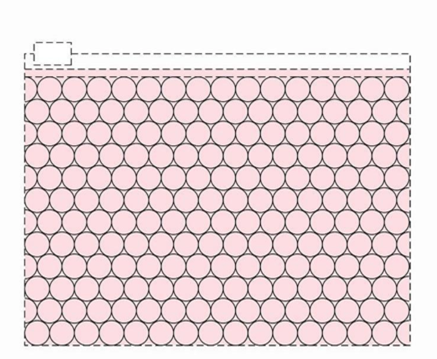
To formally establish the pouches as a brand trademark, Glossier filed an application (Serial No. 88,422,357) with the USPTO in 2019 claiming rights in the “color pink as applied to bags featuring lining of translucent circular air bubbles and a zipper closure” as pictured below:
 |
 |
The examining attorney determined the bubble-wrap lining had a “specific utilitarian advantage,” namely, to protect the goods from being damaged while mailed or stored and refused registration on the basis that the proposed mark was functional. The examining attorney further refused the application on the basis that the packaging was nondistinctive, assuming the applied-for mark was not completely functional. According to the USPTO, other brands sell similar pouches, advertising the protective quality of the bubble wrap lining. Therefore, without Glossier’s showing that the mark would be considered an indicator of source by consumers, the examining attorney determined the application could not move forward.
 |
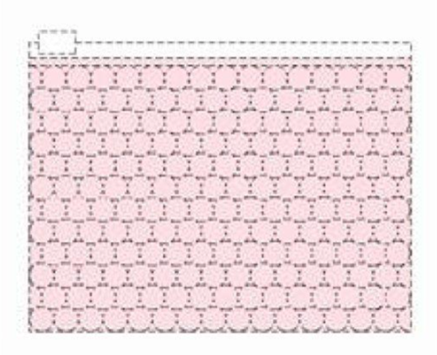 |
| Original Drawing | Amended Drawing |
In January, Glossier filed a 252-page response in which it 1) amended its original drawing indicating that it did not claim the “translucent circular air bubbles as part of the mark” and 2) asserted a Section 2(f) claim of acquired distinctiveness, supported by extensive evidence that “when relevant consumers see the color pink on a bubble-lined, zip-top pouch, they immediately recognize it as Glossier’s.” Glossier therefore entered a Section 2(f) claim of acquired distinctiveness and submitted 98 customer declarations, third-party social media posts, media coverage, and examples of parodies and copies of the pouch, focusing primarily on its signature pink color. With no additional analysis from the examining attorney, the USPTO issued Glossier’s registration in late August (Registration No. 6,133,237).
Although Glossier has an additional product packaging application pending at the USPTO, the pink pouch registration may be a source of hope for brands with pending applications for unconventional brand identifiers. For example, Virgil Abloh’s streetwear-meets-high fashion brand, Off-White, has been sparring with the USPTO since 2018 over its use of a red zip tie attached to footwear and apparel. The mark “consists of a zip tie with a substantially rectangular end, all in the color red.” Off-White claims the color red as part of the mark (serial no. 88,041,456). An example of the tag is pictured below:
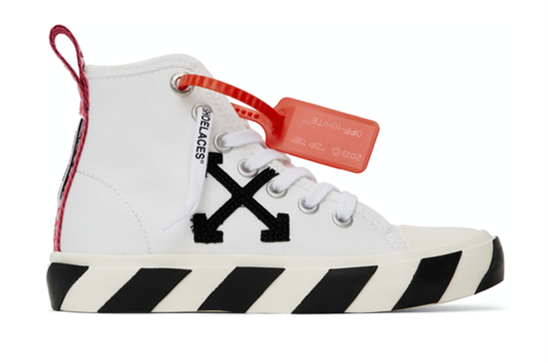
Although Off-White provided evidence that consumers consider the zip tie to be a “glorified status symbol,” the examining attorney maintained refusal of the zip tie based on functionality, arguing that “tags are used on a variety of goods as a means of conveying information, i.e., price, weight, size, or providing a function, such as binding things together or security.” The examining attorney also maintained the refusal of the zip tie as a nondistinctive product design or configuration despite Off-White’s argument that the zip tie was inherently distinctive. However, the Office Action also requested that Off-White answer a list of clarifying questions regarding the manner and circumstances in which the zip tie is attached, if it features any design or wording, and what features, if any, differentiate it from other zip ties. Off-White has until November 7, 2020 to respond to the examining attorney.
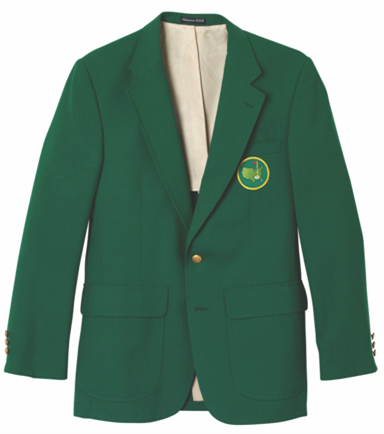
The USPTO’s litany of requests from Off-White and other recent registrations could indicate that the USPTO may be trending towards lessening its tight grip on non-traditional trademark registrations and more readily granting registrations asserting a Section 2(f) claim of acquired distinctiveness. For example, Augusta National, Inc. registered the green and gold of the Masters’ highly coveted green jacket for the “[p]romotion of goods and services through sponsorship of sports events,” a service Augusta National argued is performed through awarding the distinctive jacket to the champion of the Tournament. (Registration No. 6,000,045). After initial refusal as a nondistinctive product design, Augusta National claimed Section 2(f) acquired distinctiveness, arguing there is significant third-party recognition of the trade dress as a symbol of success at the Masters golf tournament.
 |
 |
| Masters Tournament Green Jacket |
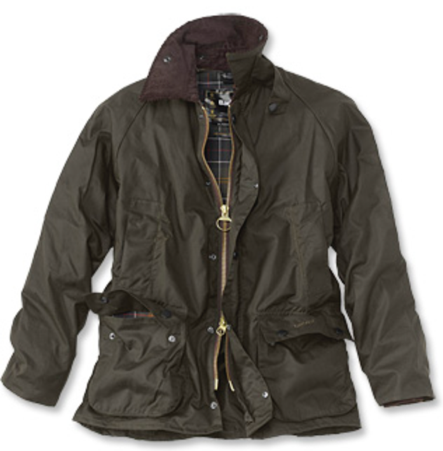
Barbour Wax Jacket |
Similarly, Barbour, the British company known for its classic wax jacket, secured trade dress registration for its staple piece after overcoming initial refusal as a nondistinctive product design. The mark for clothing, namely coats and jackets, consists of “a three-dimensional configuration of an outerwear design featuring a combination of [four] elements,” including the placement of four pockets, a metal zipper pull configured in a ring shape, a corduroy collar, and a studded flap that closes over the entirety of the front and central zipper for coats and jackets (Registration No. 5,947,682). Once again, the brand asserted a Section 2(f) claim of acquired distinctiveness for the mark and provided evidence that the jacket had become “one of the most iconic pieces of [] outerwear there is.”
With these registrations established on the Principal Register, Off-White and other brands using non-traditional marks may have a better chance securing registration with a claim of acquired distinctiveness, as long as they have the evidence to back up their claims of consumer recognition.
Related Practices
Related Industries
Related Offices
Contacts

Copyright © 2020 Finnegan, Henderson, Farabow, Garrett & Dunner, LLP.
DISCLAIMER: Although we wish to hear from you, information exchanged in this blog cannot and does not create an attorney-client relationship. Please do not post any information that you consider to be personal or confidential. If you wish for Finnegan, Henderson, Farabow, Garrett & Dunner, LLP to consider representing you, in order to establish an attorney-client relationship you must first enter a written representation agreement with Finnegan. Contact us for additional information. One of our lawyers will be happy to discuss the possibility of representation with you. Additional disclaimer information.