
Timeline for Receiving a Certificate for Amended Claims in an Inter Partes Review
April 25, 2023
Authored and Edited by Alexander M. Boyer; Elliot C. Cook; Daniel F. Klodowski
Congratulations! You received an IPR final written decision granting your motion to amend. Now what happens? According to Rule 42.80, the Office will issue an IPR certificate reflecting any canceled, confirmed, new, or amended claim. 37 C.F.R. § 42.80. The rule requires the Office to issue and publish a certificate “[a]fter the Board issues a final written decision . . . and the time for appeal has expired or any appeal has terminated.” Id. The exact timing of the certificate, however, is unspecified.
For more clarity on this issue, we considered all IPR proceedings that resulted in a granted motion to amend and analyzed when the Office issued an IPR certificate. The underlying data included final written decisions from May 2014 through February 2023, and is current as of April 18, 2023. We separated proceedings into three scenarios: (1) final written decisions issued but not appealed to the Federal Circuit; (2) final written decisions appealed but voluntarily dismissed under Fed. R. App. P. 42(b); and (3) final written decisions appealed and concluding with either a written opinion or Rule 36 affirmance. The timelines were different for each scenario.
Scenario 1 (no appeal): since the start of the AIA, twenty-six final written decisions have issued granting a motion to amend with no appeal. In these cases, the median time it took to receive an IPR certificate from the final written decision or subsequent decision on rehearing was 9.2 months. This is about seven months after the 63-day period for parties to file a notice of appeal.
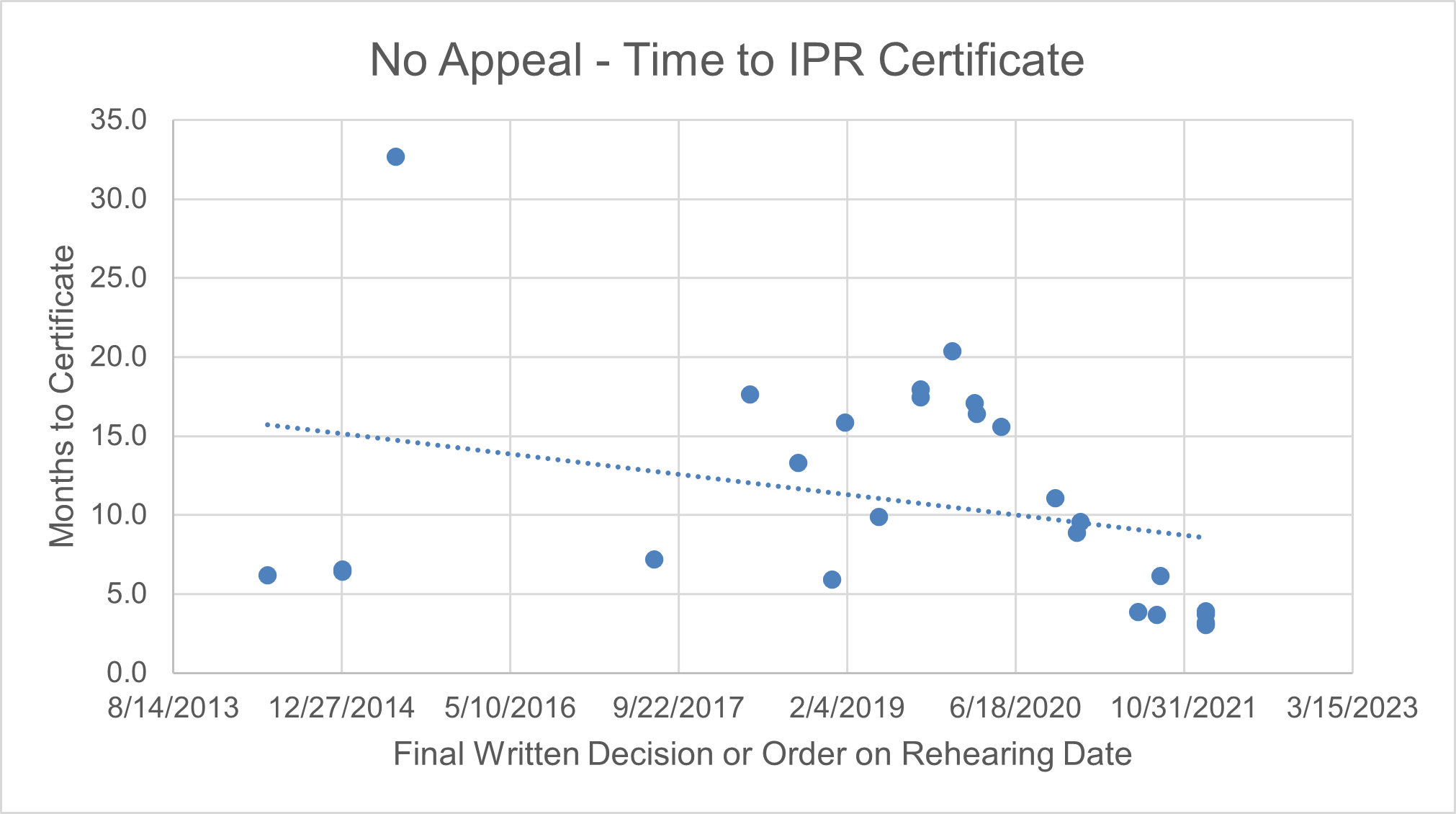
While this delay may seem significant, recent data reflects a shorter timeline. Reducing the dataset to non-appealed final written decisions issued since 2020 (thirteen proceedings), the median time to certificate drops to 6.1 months, or about four months after the appeal period. Considering final written decisions since 2021 (seven proceedings), the median time is even shorter, at 3.7 months. This is only weeks after the 63-day deadline to file a notice of appeal. This trend indicates the Office may be accelerating its processes for issuing IPR certificates.
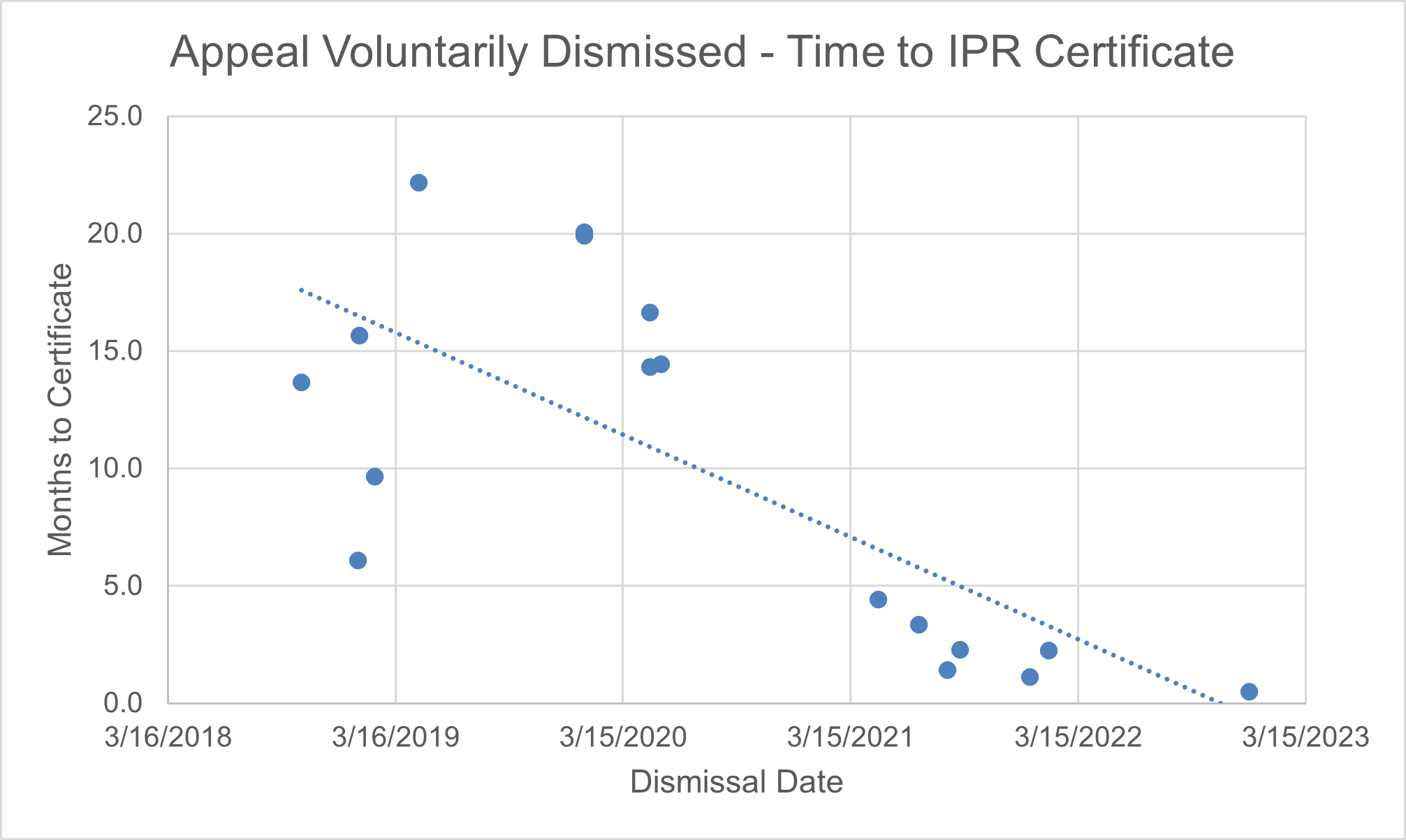
Scenario 2 (appeal voluntarily dismissed): seventeen proceedings granting a motion to amend were appealed to the Federal Circuit that resulted in voluntary dismissal under Fed. R. App. P. 42(b) and a subsequent IPR certificate. The median time for the IPR certificate to issue from the dismissal date was 9.7 months. Like the first scenario, the most recent data from 2020 shows a shorter median time to certificate, at 3.9 months. Dismissals from 2021 were even shorter, at 2.2 months. This follows the trend that the Office has been acting quicker to issue IPR certificates.
Scenario 3 (appeal opinion or affirmance): sixteen final written decisions granting a motion to amend were appealed to the Federal Circuit and resulted in an IPR certificate. These appeals resulted in a written opinion, Rule 36 affirmance, and/or remand to the Board. The median time from the Federal Circuit’s mandate or the Board’s final written decision on remand to issuance of the certificate was 5.2 months. The earliest decision in this data set was in December 2018 and the timeline has remained fairly consistent since then.
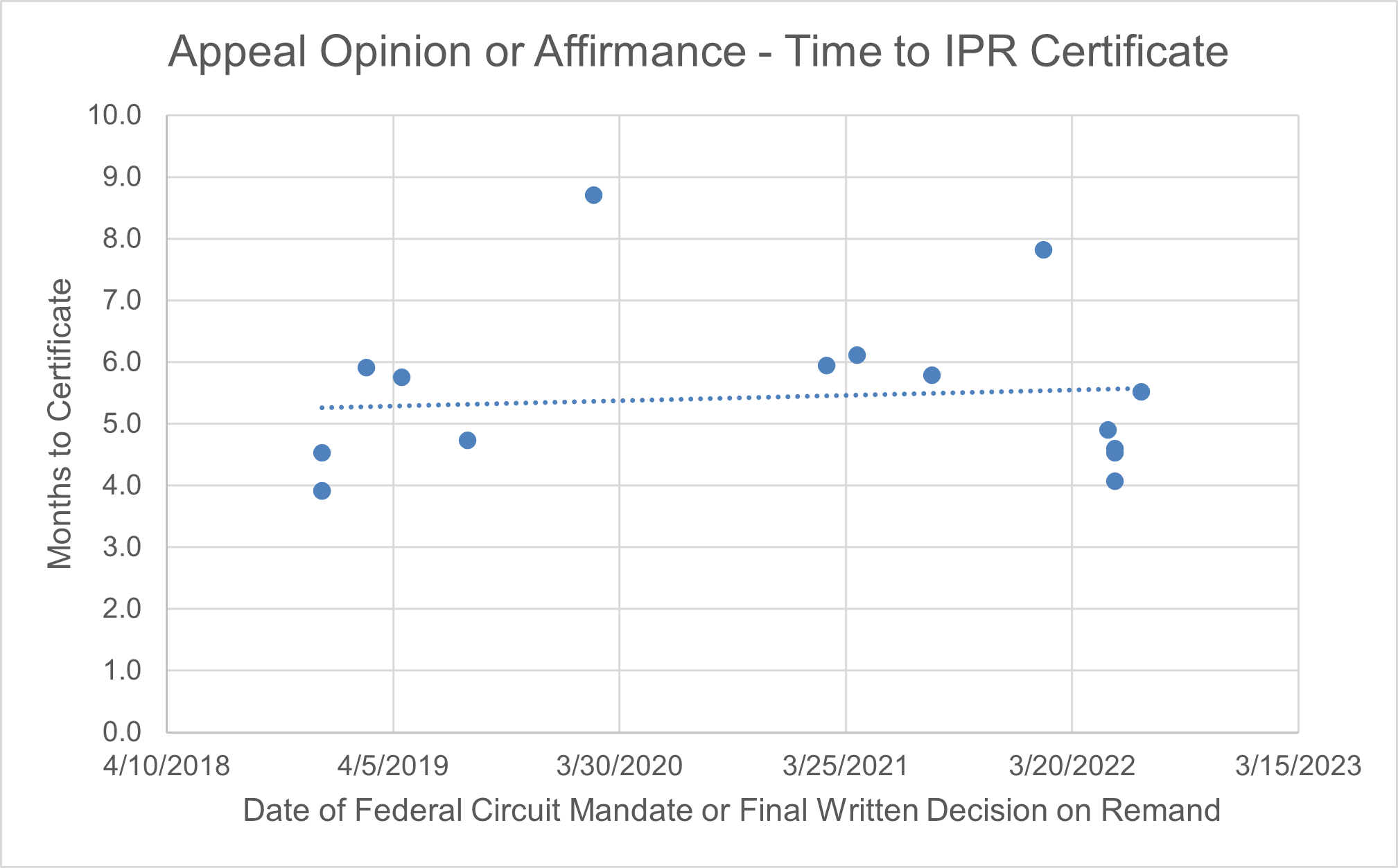
Practitioners dealing with motions to amend should consider the overall timeline for appealed cases. The USPTO will not issue a certificate until after all appeals are exhausted, which can delay the issuance of an IPR certificate by months or even years. 37 C.F.R. § 42.80 (certificate issued “[a]fter the Board issues a final written decision in an inter partes review . . . and the time for appeal has expired or any appeal has terminated”). Either party may file a notice of appeal within 63‑days of the final written decision or within 63-days of an order on rehearing (35 U.S.C. § 319; 37 C.F.R. §§ 90.3(a)(1), (b)(1)), and briefing and issuance of an opinion by the Federal Circuit could take well over a year. Fed. Cir. Rule 41; Fed. R. App. P. 41. The timeline can be further delayed if the final written decision is remanded, en banc review is requested, and/or a writ of certiorari to the Supreme Court is filed. Once the appeal period has expired or terminated, however, the data shows that the USPTO will issue the certificate in about five months.
More detailed cumulative statistics on the Board’s IPR, CBM, and PGR decisions, updated through January 2023 are available here on the AIA Blog.
Statistics regarding the outcome of appeals to the Federal Circuit are available here.
Numbers of final written decisions by technology center and instituted claim survival rates by technology center are available here.
Related Offices
Contacts


- Elliot C. Cook
- Partner
- Reston, VA
- +1 571 203 2738

Copyright © 2023 Finnegan, Henderson, Farabow, Garrett & Dunner, LLP.
DISCLAIMER: Although we wish to hear from you, information exchanged in this blog cannot and does not create an attorney-client relationship. Please do not post any information that you consider to be personal or confidential. If you wish for Finnegan, Henderson, Farabow, Garrett & Dunner, LLP to consider representing you, in order to establish an attorney-client relationship you must first enter a written representation agreement with Finnegan. Contact us for additional information. One of our lawyers will be happy to discuss the possibility of representation with you. Additional disclaimer information.