
Patent Trial and Appeal Board Canceled over 90% of Claims Decided in February and Often Relies on Extrinsic Evidence That May Be Entitled to Deference on Appeal
March 26, 2015
Authored and Edited by Daniel F. Klodowski; Aaron L. Parker
February was a particularly brutal month for patent owners before the Board. Considering only final written decisions, statistics show that the PTAB canceled over 90% of the IPR claims that reached Final Written Decision. Does this herald a greater trend, or just statistical anomaly?
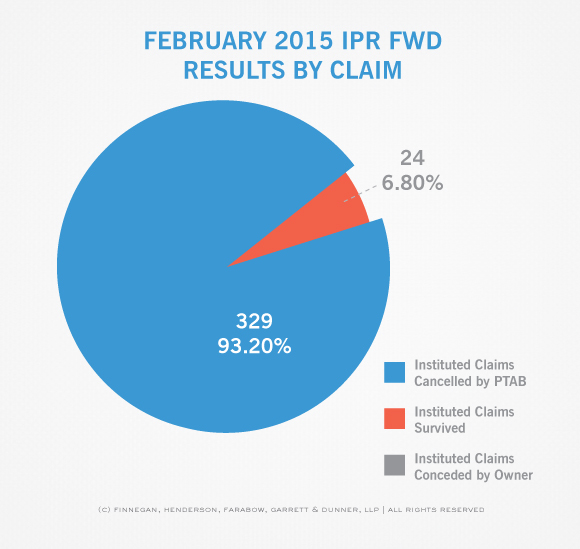
To contrast, for all IPRs decided to date, the Board has canceled roughly 70% of instituted claims—over 2,500 claims. That doesn’t include claims in which the board does not institute IPR, claims in challenged patents in which the parties to the IPR settled their dispute, and claims that have been canceled by a request for adverse judgment, a related reexamination, or a final court judgment. It also (quite obviously) excludes claims not challenged. So the February anomaly may be just that—noise in the data—or it may signify better odds by savvy petitioners who go the distance.
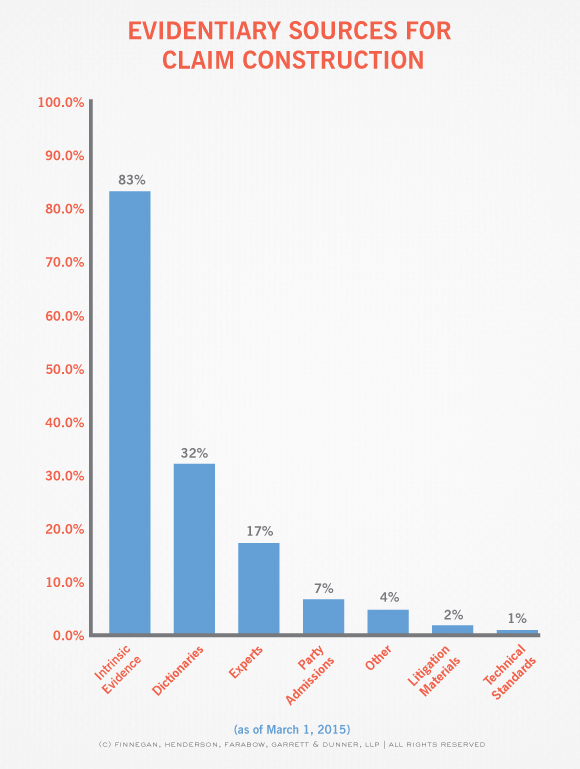
Our analysis also reveals that the Board often relies on extrinsic evidence when supporting claim construction positions it takes in final written decisions—evidence like dictionaries, experts, party admissions, litigation materials, party admissions, and technical standards. To date, in more than 31% of final written decisions, the Board cites a dictionary in at least partial support for a claim construction position; they rely on expert testimony in more than 17% of final written decisions; and that they sometimes rely on other evidence outside of the specification to bolster their claim construction positions.
This is all the more notable because in deciding In re Cuozzo Speed Technologies, LLC, No. 14-1301 (Fed. Cir. Feb. 4, 2015), the Federal Circuit held that the deferential “substantial evidence” standard applies to Board factual findings for claim construction, citing the Supreme Court’s recent decision in Teva Pharmaceuticals USA, Inc. v. Sandoz, Inc., 135 S. Ct. 831, 841 (2015).
As a result, Board decisions on appeal—particularly those hinging on claim construction—may be effectively protected from de novo review by the Federal Circuit, where the PTAB relies on extrinsic evidence to support its claim construction positions.
Contacts


Copyright © 2015 Finnegan, Henderson, Farabow, Garrett & Dunner, LLP.
DISCLAIMER: Although we wish to hear from you, information exchanged in this blog cannot and does not create an attorney-client relationship. Please do not post any information that you consider to be personal or confidential. If you wish for Finnegan, Henderson, Farabow, Garrett & Dunner, LLP to consider representing you, in order to establish an attorney-client relationship you must first enter a written representation agreement with Finnegan. Contact us for additional information. Additional disclaimer information.