
The Trademark and First Amendment Dance Continues: Application of the Rogers v. Grimaldi Test After Jack Daniel’s
September 2024
Practising Law Institute
Introduction
The lynchpin of trademark infringement is the likelihood of confusion.[1] And to determine whether that exists, courts apply a multi-factor test that varies by circuit. The test, however, has been applied more narrowly when allegedly infringing products are works of artistic expression, including things like movies, plays, books, and songs.[2] This narrowing is done to balance the objective of protecting against consumer confusion versus an individual’s First Amendment right to free expression.[3] To achieve this balance, courts have applied heightened scrutiny under a threshold First Amendment filter, set out in the seminal Second Circuit case Rogers v. Grimaldi, wherein expressive works are deemed infringing only if they are “explicitly misleading.”[4] After dancing around the circuits for over thirty years, the Rogers test stepped onto the United States Supreme Court stage where, in Jack Daniel’s Props., Inc. v. VIP Prods. LLC, the high court placed important limitations on its application, holding that the test does not apply “when an alleged infringer uses a trademark in the way the Lanham Act most cares about: as a designation of source for the infringer’s own goods.”[5] And in one concurrence, two Justices even questioned Rogers’s validity. This article discusses how Rogers has fared and been applied since Jack Daniel’s.
The Creation of the Rogers Test
In 1989, the Second Circuit held in Rogers v. Grimaldi, that the use of a trademark in an artistic work is actionable only if the use has no artistic relevance to the underlying work or, if it does, it explicitly misleads as to the work’s source or content.[6]
Rogers involved Ginger Rogers and the late Fred Astaire—one of the most famous duos in show business history. Celebrated as “paragons of style, elegance, and grace” from their performances in Hollywood musicals, the two were called and recognized by just their first names “Ginger and Fred.”[7] In March 1986, the defendants produced and distributed a film entitled “Ginger and Fred.”[8] It told the story of two fictional cabaret performers—Pippo and Amelia—who, in their heyday, imitated Rogers and Astaire and became known in Italy as “Ginger and Fred.”[9] The film focused on a televised reunion of Pippo and Amelia, and the defendants described the film as the “bittersweet story of these two fictional dancers and as a satire of contemporary television variety shows.”[10]
Shortly after distribution of the film began in the United States, Rogers sued, alleging the defendants violated section 43(a) of the Lanham Act by creating the false impression that the film was about her and/or that she sponsored, endorsed, or was otherwise involved in the film; violated her common-law right of publicity; and defamed her and violated her right to privacy by depicting her in a false light.[11] The district court granted summary judgment to the defendants and found that their use of Rogers’s first name in the film’s title and screenplay was an “exercise of artistic expression rather than commercial speech.”[12] Specifically, the court held that “‘[b]ecause the speech at issue here [was] not primarily intended to serve a commercial purpose, the prohibitions of the Lanham Act do not apply, and the Film is entitled to the full scope of protection under the First Amendment.’”[13]
Though it affirmed the district court’s ruling, the Second Circuit held that the district court went too far, noting that its “ruling would create a nearly absolute privilege for movie titles, insulating them from Lanham Act claims as long as the film itself is an artistic work, and the title is relevant to the film’s content.”[14] This approach, the Second Circuit believed, would “unduly narrow[] the scope of the [Lanham] Act.”[15]
Paring back the district court’s ruling, the Second Circuit held that titles of artistic works are not wholly insulated from Lanham Act claims because they are “of a hybrid nature, combining artistic expression and commercial promotion.”[16] Thus, consumers of artistic works have a “dual interest” in not being misled and enjoying the results of the author’s freedom of expression.[17] For her part, Rogers had argued that First Amendment concerns are implicated only where a title “is so intimately related to the subject matter of a work that the author has no alternative means of expressing what the work is about.”[18] The appeals court declined to follow this “no alternative avenues of communication” test, which had been applied by several other courts, because it did it did not sufficiently accommodate the public’s interest in free expression. Nor did it sufficiently protect the public against flagrant deception.
To balance these interests, the Second Circuit held that, in general, the Lanham Act should be construed to apply to artistic works only where “the public interest in avoiding confusion outweighs the public interest in free expression.”[19] Specifically as it relates to misleading titles using a celebrity’s name, “that balance will normally not support application of the [Lanham] Act unless the title has no artistic relevance to the underlying work whatsoever, or, if it has some artistic relevance, unless the title explicitly misleads as to the source or content of the work.”[20] The court noted that there is a low threshold for the minimal artistic-relevance factor, but there is a higher threshold for the explicitly misleading factor.[21] Moreover, though a mere suggestion of a celebrity endorsement may not be misleading enough to overcome First Amendment protections, “titles with at least minimal artistic relevance to the work may include explicit statements about the content of the work that are seriously misleading,” to which the Lanham Act can apply.[22]
On the facts, the court determined that the characters’ names “Ginger” and “Fred” were not arbitrarily chosen, but instead had genuine relevance to the film’s story.[23] Thus, the artistic relevance factor was met. The court also found that the title “Ginger and Fred” contained no explicit indication that Rogers endorsed the film or had a role in producing it.[24] Thus, the risk of misunderstanding “is so outweighed by the interests in artistic expression as to preclude the application of the Lanham Act.”[25]
Application of Rogers Across the Circuits Before Jack Daniel’s
The Rogers test has expanded throughout the years and varied in its application across circuits. Most circuits have adopted the two prongs, requiring that the use either have (1) no artistic relevance, or (2) be explicitly misleading as to the source to warrant Lanham Act protection.[26] Though the original case involved a dispute over a movie title, courts have applied Rogers to other types of “expressive” works and their content.[27] Additionally, “use of the Rogers test has almost always resulted in dismissal of the infringement claim, often on a pre-trial Rule 12(b)(6) dismissal or on summary judgment.”[28]
While courts across circuits have adopted the two prongs of the Rogers test, they have applied them inconsistently over the years. Regarding the first prong, most courts generally agree that the level of artistic relevance needed is an incredibly low bar, even finding artistic relevance when it is not immediately obvious.[29] Where things have varied is in the second prong of Rogers, i.e., whether the use is “explicitly misleading” as to the work’s source.[30] Some circuits, though adopting the Rogers test, “differed in their application” and “modified it to some degree.”[31] The Ninth Circuit, for example, requires that the senior trademark user show a “preponderance of the evidence that the junior user’s use was in fact explicitly misleading,” and the Fifth Circuit uses the likelihood-of-confusion factors to determine what is explicitly misleading in the first place.[32] This inconsistency has sown doubt as to when and how Rogers is and should be applied, leaving some to call for a uniform approach.[33]
Enter Jack Daniel’s
The Rogers test made center stage in Jack Daniel’s Props., Inc. v. VIP Prods. LLC, 599 U.S. 140 (2023). There, Jack Daniel’s sued over a parody dog toy that used the mark BAD SPANIELS and a copycat trade dress.[34]
Jack Daniel’s owns several federal registrations covering its famous whiskey bottle, including brand names appearing on the label, such as JACK DANIEL’S and OLD NO. 7, and the trade dress of the bottle itself.[35] VIP Products makes and sells a chewable rubber dog toy called BAD SPANIELS, designed to evoke Jack Daniel’s famous whiskey bottle, but adding scatological humor, such as “43% poo by vol.” and “100% smelly” for “40% alc. by vol. (80 proof),” and “Old No. 2 on your Tennessee Carpet” instead of “Old No. 7” and “Tennessee Whiskey.”[36]
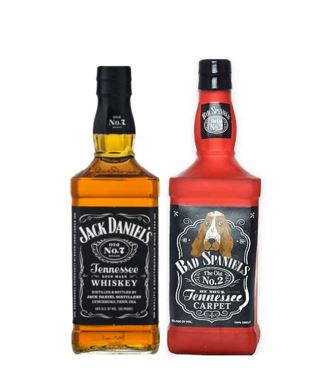
Jack Daniel’s sent VIP demand letter asking it to stop making the infringing dog toy. VIP then filed a lawsuit seeking declaratory judgment that the BAD SPANIELS dog toy neither infringed nor diluted Jack Daniel’s marks.[37] Jack Daniel’s responded by counterclaiming for trademark infringement and dilution by tarnishment.[38] After a bench trial, the United States District Court for the Central District of California ruled for Jack Daniel’s on both claims, finding, among other things, that survey evidence established that consumers were likely to be confused as to the source of the BAD SPANIELS toy.[39]
VIP then appealed to the Ninth Circuit, arguing that the expressive and parodic nature of the BAD SPANIELS mark and trade dress were sufficient to shield it from trademark infringement and dilution liability.[40] Though the Ninth Circuit did not disturb the lower court’s finding on likelihood of confusion, it nonetheless reversed and held that Jack Daniel’s infringement claim was subject to the threshold of the Rogers test. On remand, the district court found that Jack Daniel’s failed to show that the use of the Jack Daniel’s trademarks was artistically irrelevant to the dog toy and that it was explicitly misleading as to source. Thus, the court granted VIP summary judgment on the infringement claim.[41]
The Supreme Court disagreed with the Ninth Circuit’s analysis, vacated VIP’s victory, and remanded the case to the district court. Writing for the court, Justice Kagan noted that the primary mission of trademark law is to prevent confusion about a product’s or service’s source.[42] Making consumers “think that one producer’s products are another’s,” the Court explained, is the “cardinal sin” of the Lanham Act. Accordingly, the Court held that Rogers (or any other threshold First Amendment filter) does not apply “when an alleged infringer uses a trademark in the way the Lanham Act most cares about: as a designation of source for the infringer’s own goods.”[43]
This fundamental rule holds true, the Court held, even where the allegedly infringing mark includes expressive content or conveys some message beyond source. The Court noted that “few cases would even get to the likelihood-of confusion inquiry if all expressive content triggered the Rogers filter” and “[i]n that event, the Rogers exception would become the general rule, in conflict with the courts’ long-standing view of trademark law.”[44] In such cases, however, the expressive use of a mark is not wholly irrelevant. The parodic nature of BAD SPANIELS remained pertinent to the likelihood-of-confusion inquiry “because consumers are not so likely to think that the maker of a mocked product is itself doing the mocking.”[45]
The Court held that VIP already conceded that it used BAD SPANIELS as a source identifier, and while it owned no registered rights, VIP’s complaint alleged that it both “owned” and “used” the BAD SPANIELS trademark and trade dress for its dog toys. Responding to VIP’s attempt to deny the issue, the Court noted that the BAD SPANIELS logo sat directly opposite the trademarked Silly Squeakers logo on the BAD SPANIELS product hangtag, “with both appearing to serve the same source-identifying function.”[46] VIP also owned several registered trademarks and trade dress rights in its other parodic dog toy products, further showing that it was using the marks as source identifiers.[47] With all that, the Court concluded that VIP used BAD SPANIELS as a trademark – i.e., as a source identifier.[48]
The Court also made short work of VIP’s dilution defense. Under the dilution statute, exceptions are made for “noncommercial use[s] of a mark” and for “fair use” of a mark in connection with parodies or criticism.[49] But the Court held that the fair-use exception does not apply if a defendant goes beyond parody or criticism and uses the mimicking mark as a source identifier. In such cases, “no parody, criticism, or commentary will rescue the alleged diluter.”[50]
Accordingly, on remand, the district court is tasked with determining whether VIP’s products are likely to cause confusion with the JACK DANIEL’s mark and trade dress and/or whether they dilute those marks by tarnishment.
Justice Sotomayor concurred, joined by Justice Alito. Addressing the use of consumer surveys in trademark infringement cases, the Sotomayor concurrence warned lower courts to treat survey results with caution. Specifically, Justice Sotomayor noted that “surveys should be understood as merely one piece of the multifaceted likelihood of confusion analysis,” and courts should carefully consider the structure, methodology, and various facets of these surveys.[51] Moreover, “[w]hen an alleged trademark infringement involves a parody,” Justice Sotomayor wrote, “there is particular risk in giving uncritical or undue weight to surveys.”[52] This concern arises out of the possibility that survey respondents may have a “mistaken belief” that “all parodies require permission from the owner of the parodied mark.”[53] Permitting survey results to be the driving factor in the infringement analysis would “risk silencing” many parodies, including those that, when looking at other evidence, would not cause consumer confusion as to the source of the product.[54]
Justice Gorsuch also concurred, joined by Justices Thomas and Barrett. The Gorsuch concurrence signaled a readiness to reconsider the Rogers test in its entirety should the issue be presented to the Court.[55] It noted that the Jack Daniel’s decision, though correctly decided in their opinions, leaves much of Rogers unaddressed.[56] The concurrence underscored that “it is not entirely clear where the Rogers test comes from.”[57] And uncertain whether the Rogers test was even constitutionally mandated, the Gorsuch concurrence further expressed doubt that the Rogers decision was “correct in all its particulars” and thus cautioned lower courts to treat Rogers with care.[58]
Following the Supreme Court’s directive to apply a traditional likelihood-of-confusion analysis instead of a Rogers analysis in cases where the defendant uses the mark as a source-identifier, courts have grappled with what this actually entails. But some patterns have emerged from these cases.
Cases Where Courts Have Refused to Apply Rogers
a. Punchbowl, Inc. v. AJ Press, LLC, 90 F.4th 1022 (9th Cir. 2024)
In Punchbowl, Inc. v. AJ Press, LLC, the Ninth Circuit reversed and remanded the district court and held that the defendant’s use of “Punchbowl News” for a news publication was as a source identifier, and thus Rogers does not apply.[59]
The plaintiff, Punchbowl, Inc., who used and registered the mark “Punchbowl,” provides online invitations and greeting cards as part of a subscription-based service and works with corporations, like The Walt Disney Company and Dave & Buster’s, to help promote their brands through the invitations and cards.[60]

The defendant, AJ Press, LLC, founded Punchbowl News, an online subscription-based news publication that covers topics in American government and politics.[61] The name “Punchbowl” was chosen because it is the nickname the Secret Service uses to refer to the U.S. Capitol, and AJ Press wanted to “elicit the theme and geographic location” of the publication.[62]

Before the Jack Daniel’s decision, Punchbowl sued AJ Press, alleging trademark infringement and unfair competition.[63] The district court converted AJ Press’s motion to dismiss into a motion for summary judgment and granted judgment to AJ Press.[64] It concluded that AJ Press’s use of the name “Punchbowl” did not give rise to liability under the Rogers test because it constituted protected expression and was not explicitly misleading.[65] The Ninth Circuit affirmed based on circuit precedent applying Rogers.[66] But after the Supreme Court’s opinion in Jack Daniel’s came down, the Ninth Circuit withdrew its prior decision, ordered supplemental briefing, and heard re-argument.[67]
In light of the Jack Daniel’s decision, the Ninth Circuit changed course and held that the Rogers test does not apply.[68] Instead, the traditional likelihood-of-confusion analysis should be conducted. The court held that AJ Press was using the “Punchbowl” mark to “designate the source of its own goods – in other words, has used a trademark as a trademark.”[69] The court then rejected AJ Press’s argument that the Rogers test should still apply because, unlike the defendant in Jack Daniel’s, AJ Press was not using “Punchbowl” to parody or otherwise refer to Punchbowl.[70] The court disagreed and stated that the Jack Daniel’s holding was not limited to direct references or parodies.[71] Rather, the Supreme Court held that “Rogers did not apply notwithstanding the parodic use of the mark, and notwithstanding that the Bad Spaniels toy explicitly disclaimed any affiliation with Jack Daniel’s the whiskey company.”[72] The Ninth Circuit also disagreed with AJ Press that there should be an exception for a trademark that includes a common word. The court explained that there is no reason to create a carve-out for common words in trademarks when the Supreme Court declined to create an exception for parodies.[73] The court did note, however, that the commonality of the word “punchbowl” will be relevant to the likelihood-of-confusion analysis.[74]
Thus, the court remanded to the district court to apply the likelihood-of-confusion factors to determine whether AJ Press was infringing Punchbowl, Inc.’s rights.[75]
b. Vans, Inc. v. MSCHF Product Studio, Inc., 88 F.4th 125 (2d Cir. 2023)
In Vans, Inc. v. MSCHF Product Studio, Inc. the Second Circuit affirmed the district court’s refusal to apply the Rogers test when analyzing whether MSCHF’s parody sneaker, the “Wavy Baby,” infringed Vans’ trademarks and “Old Skool” trade dress.[76]
The plaintiff, Vans, Inc., is a footwear and apparel company with roots in the skateboarding culture. In 1977, Vans debuted what would become one of its most popular products, the “Old Skool” skate shoe:[77]
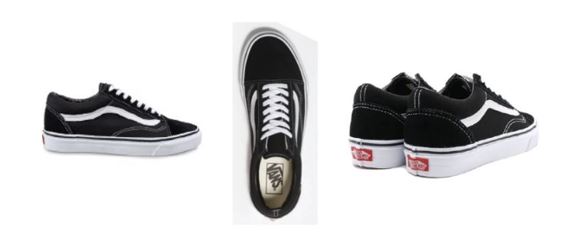
The Old Skool trade dress consists of a combination of elements, including: (1) the Vans Side Stripe Mark on the upper shoe, (2) a rubberized sidewall of uniform height around the shoe’s perimeter, (3) a three-tiered or grooved sidewall, (4) a textured toe box, (5) visible stitching, and (6) the placement and proportion of each of these elements in relation to one another.[78]
In 2022, Vans learned that MSCHF (pronounced “mischief”) intended to release a parody of Vans’ Old Skool shoe. MSCHF, a Brooklyn-based art collective, has made a name for itself by recontextualizing everyday objects as a means of commenting on contemporary society, including music, the political system, consumerism, digital media, and, recently, sneakerhead culture. MSCHF created the “Wavy Baby” sneaker (shown below) as a “parody” of the Old Skool trade dress by distorting it to “transform the once iconic shoe into the modern, wobbly, and unbalanced realities.”[79]
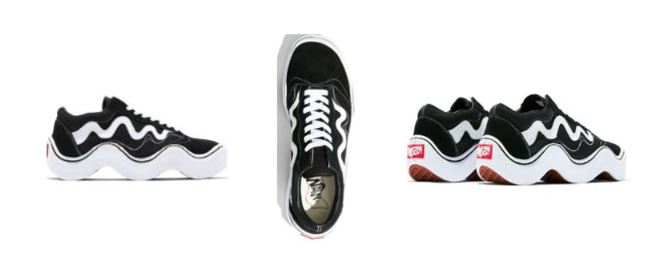
Upon learning of MSCHF’s planned release of the parody sneaker, Vans sent MSCHF a cease-and-desist letter asserting that the Wavy Baby infringed Vans’ marks and Old Skool trade dress. Rather than comply, MSCHF launched a one-hour sale of Wavy Baby sneakers, over Vans’ objection, and sold over 4,000 units during that time for a price of $220.[80] In response, Vans filed a complaint in the United States District Court for the Eastern District of New York, alleging infringement.[81] Vans also filed a motion for preliminary injunction to enjoin MSCHF from selling and promoting the Wavy Baby sneaker.[82]
The district court granted Vans’ motion, finding that Vans was likely to prevail on its infringement claims.[83] The court rejected MSCHF’s argument that the Wavy Baby shoe is an artistic expression subject to enhanced First Amendment protection under the Rogers test.[84] The court instead analyzed Vans’ claims applying the traditional likelihood-of-confusion factors, and determined that those factors, on balance, favored Vans.[85]
On appeal, MSCHF challenged the district court’s infringement finding, arguing that the court erred both in refusing to apply the Rogers test and in its analysis of the likelihood-of-confusion factors.[86] The Second Circuit rejected both arguments.
Relying on Jack Daniel’s, the Second Circuit held that “MSCHF used Vans’ marks in much the same way that VIP Products used Jack Daniel’s marks – as source identifiers.”[87] Specifically, MSCHF’s design “evoked myriad elements of the Old Skool trademarks and trade dress,” including the Old Skool black-and-white color scheme, the side stripe, the perforated sole, and the logo on the heel.[88] Though the court did acknowledge that MSCHF included its own branding on the label, the design of the MSCHF logo also evoked the Old Skool logo.[89] Finally, the court noted that although MSCHF did not purport to sell the Wavy Baby under the Vans brand, MSCHF admitted to “start[ing]” with Vans’ marks because “[n]o other shoe embodie[d] the dichotomies – niche and mass taste, functional and trendy, utilitarian and frivolous – as perfectly as the Old Skool.”[90] Thus, the court found, MSCHF used Vans’ trademarks in a source-identifying manner and the Rogers test thus does not apply.[91]
Finally, the second circuit further affirmed the district court’s analysis of the likelihood-of-confusion factors and found that, on balance, Vans was likely to prevail on the issue of whether the Wavy Baby shoe caused likely consumer confusion.[92]
HomeVestors of America, Inc. v. Warner Bros. Discovery, Inc., No. 22-1583-RGA, 2023 WL 6880341 (D. Del. Oct. 18, 2023), adopted by Homevestors of America, Inc. v. Warner Bros. Discovery, Inc., No. 22-1583-RGA, 2023 WL 8826729 (D. Del. Dec. 21, 2023).
In Homevestors of America, Inc. v. Warner Bros. Discovery, Inc., the district court adopted the magistrate judge’s report and recommendation, rejecting the application of the Rogers test when analyzing the defendant’s use of “Ugliest Home in America” for a television show, and denied the defendant’s motion to dismiss.[93]
The plaintiff, HomeVestors, is the franchisor of a business system relating to buying, renovating, and selling homes.[94] As a part of its business, HomeVestors owns more than thirty trademarks containing the word “ugly” in connection with buying homes and home renovations, including “THE UGLIEST HOUSE OF THE YEAR,” which is used for an annual home renovation contest that showcases one extreme home makeover that is voted on by the public.[95] HomeVestors alleged it was contacted by Big Fish Entertainment on behalf of the defendant, Warner Bros. Discovery, Inc., to possibly collaborate on a new show for Warner Bros. Discovery’s HGTV. But that never happened. Subsequently, HGTV premiered a new show entitled “Ugliest House in America.”[96] HGTV also ran a contest at the same time called “HGTV’s UGLIEST $5K GIVEAWAY,” with emphasis on the word “ugliest.”[97] HomeVestors subsequently filed suit, claiming trademark infringement, unfair competition, and dilution.[98]
When analyzing the trademark-infringement claim, the magistrate judge determined that the Rogers test should not be used.[99] The judge disagreed with the defendants’ argument that Jack Daniel’s is limited to branded consumer products, and does not apply to a descriptive television series title.[100] Noting that Jack Daniel’s made clear “that a First Amendment defense under Rogers does not apply if an alleged infringer’s use of the mark is source-identifying,” the judge continued that neither party “could articulate a test or method for determining, at the motion to dismiss stage or otherwise, whether an allegedly infringing mark is being used in a source-identifying way.”[101] Regardless of whether the question is of law, fact, or mixed, the judge agreed with the plaintiff that, taking its First Amended Complaint as true, it sufficiently pled that the defendant’s use of its mark was source-identifying.[102] The judge elaborated that “a motion to dismiss based on [an] affirmative defense, as is the case here, is only appropriate when [the] defense is ‘apparent on the face of the complaint and documents relied on in the complaint.’”[103] In this instance, the judge could not conclude that Warner Bros. Discovery’s use of HomeVestors’ mark was so clearly non-source-identifying as to be apparent in the First Amended Complaint.[104] To show that Warner Bros. Discovery used HomeVestors’ mark in a source identifying manner, HomeVestors pled that the parties’ marks were similar, both parties ran a contest related to the ugliest homes, internet searches for HomeVestors’ marks returned results for the HGTV show, and, among other factors, Warner Bros. Discovery initially sought to take advantage of consumer recognition of the HomeVestors’ brand for casting purposes. Given these allegations, the judge determined that Rogers should not apply at this stage of the proceeding.[105]
The district court adopted the magistrate judge’s Report and Recommendation. The court noted that Rogers should not be applied simply because a mark is used in connection with an expressive work.[106] Post Jack Daniel’s, the court explained, there now must be an initial inquiry to determine whether a mark is used for source-identification.[107] The court noted that titles of artistic works can serve multiple functions, in that they can be both expressive and source-identifying.[108] And here, on a motion to dismiss, Rogers does not apply because the plaintiff alleged that the mark was used in a source-identifying manner—even though it was in the title of a television series.[109]
d. Davis v. Amazon.com, Inc., No. 2:21-cv-02090-JVS(JDEx), 2023 WL 8113299 (C.D. Cal. Nov. 2, 2023)
In Davis v. Amazon.com, Inc., the district court granted the defendants’ motion to dismiss Plaintiff’s Second Amended Complaint with prejudice and declined to apply the Rogers test to the plaintiff’s book title, “GRINGO.”[110]
Plaintiffs Davis and Conti are co-authors of a book entitled “GRINGO,” and plaintiff Gringo Holdings is a company owned by Davis.[111] The plaintiffs’ book, published in November 2016, is a first-hand account of “Davis’s thirteen years as an American fugitive after fleeing to Mexico to avoid imprisonment on a drug conviction for distributing marijuana due to being ‘set up’ by a friend who turned out to be a cooperating witness-drug dealer.”[112] Upon publication, “GRINGO” quickly became an Amazon number one best seller remains a bestseller on several Amazon lists as of November 2023.[113]
The defendants released a film in March 2018, also entitled “GRINGO,” which is “a fictionalized account of an American who, like Davis, is on the run after being set-up by his ‘friends for distributing marijuana.”[114] When production began for the film around 2014, the working title was “American Express”; however, “by the time the [f]ilm was released in March 2018, after publication of the [b]ook, the title of the [f]ilm had been changed to ‘GRINGO,” with a somewhat distressed font in all capital letters that closely resembled the font and typeface of the [b]ook.”[115] The defendants distributed the “GRINGO” film via the Amazon Prime Video streaming service and in theaters and was primarily released as an “Amazon Original” movie.[116]
Raising infringement and unfair-competition claims, the plaintiffs alleged that the defendants changed the title of the film to “GRINGO” to confuse consumers into believing that there is an association with the “GRINGO” book.[117] And they contended that, since the release of the “GRINGO” film, “widespread confusion” arose among the public and within film industry as to the relationship between the “GRINGO” book and film.[118] All the while, according to the plaintiffs, interest in their book diminished, both for individual consumers who disliked the movie and then refused to buy the book, and for third parties who showed interest in the film rights to the book but then retreated when they thought the film was an adaptation of the book.[119]
In January 2022, the court granted the defendants’ motion to dismiss Plaintiffs’ First Amended Complaint on the grounds that “[d]efendants’ use of ‘GRINGO’ is protected by the First Amendment under Rogers and [that] [p]laintiffs ha[d] failed to allege sufficient facts to make out a plausible claim that survives that test.”[120] The plaintiffs then amended their complaint, which largely repeated the same allegations.[121] Then, in March 2022, the court granted the defendants’ motion to dismiss Plaintiffs’ Second Amended Complaints on the ground that plaintiffs failed to allege the “explicitly misleading” prong under the Rogers test.[122] The Ninth Circuit then vacated the dismissal of the Second Amended Complaint and remanded to the district court in light of the Jack Daniel’s decision.[123] In its analysis, the district court noted that in its first order, the court “did not reach the likelihood-of-confusion test because the [First Amended Complaint] and [Second Amended Complaint] failed under the Rogers test”; however, “[f]ollowing Jack Daniel’s, the threshold inquiry . . . is whether the disputed title is as a source identifier such that the holder of Jack Daniel’s applies to bypass Rogers.”[124]
The defendants argued that Jack Daniel’s should not apply because “in general film titles cannot be source identifiers, and accordingly they use ‘Gringo’ not as a source identifier for [p]laintiffs’ book but in the dictionary sense of the Spanish word ‘gringo.’”[125] The defendants continued that even if Jack Daniel’s applied, the plaintiffs’ claim would fail under the likelihood-of-confusion analysis. The plaintiffs, on the other hand, argued that the court in its order dismissing the First Amended Complaint held that “a secondary meaning entitles it to Lanham Act protection” and the defendants used “Gringo” as a source identifier with the purpose to mislead consumers.[126]
The district court first noted that “[t]he title of a single creative work, like a book or movie, cannot be registered as a trademark.”[127] However, a title may still be protected under the Lanham Act upon a showing of secondary meaning.[128] The court continued that “[a] finding of secondary meaning is largely congruent with source identification for the purposes of applying Jack Daniel’s, in that ‘a showing of a secondary meaning only requires proof that the public associates the movie with a single source.’”[129]
The court agreed with the plaintiffs’ argument that in a previous opinion it already held that the First Amended Complaint sufficiently alleged that the book “GRINGO” had acquired secondary meaning.[130] Thus, “GRINGO” was a source identifier.[131] Because the Second Amended Complaint largely made the same allegations, “[t]here [wa]s no reason for the [c]ourt to change the outcome of its analysis as it pertain[ed] to the same mark in the [Second Amended Complaint] – the secondary meaning persists. And where that secondary meaning is found, there is an ‘associat[ion] with a single source.’”[132] Thus, the court concluded that the Rogers does not apply and continued to a likelihood-of-confusion analysis.
The court further noted that simply because the plaintiffs succeeded in avoiding the Rogers test, that did not mean that there would be a full litigation.[133] In fact, the court continued, there are cases where the marks are so dissimilar that there is no likelihood of confusion and dismissal of the complaint for failure to state a claim is warranted.[134]
In analyzing the likelihood-of-confusion factors, the court determined that the “overall balance of the factors weigh[ed] against the [Second Amended Complaint’s] showing of a likelihood of confusion.”[135] Specifically, the “[c]ommercial strength, proximity of goods, and intent in selecting the mark provide[d] support for a likelihood of confusion, but not enough to outweigh those pointing against: conceptual strength, the similarity of the marks, marketing channels, type of goods, and purchaser care.”[136]
Thus, the court determined that the plaintiffs did not state a claim for trademark infringement under the Lanham Act and granted the defendants’ motion to dismiss with prejudice.[137] The plaintiffs have appealed this decision to the Court of Appeals for the Ninth Circuit.[138]
e. Sajahtera, Inc. v. Kitross Apparel Los Angeles, LLC, No. CV 23-8005-MWF (KSx), 2024 WL 3086551 (C.D. Cal. June 10, 2024)
In Sajahtera, Inc. v. Kitross Apparel Los Angeles, LLC, the district court granted the plaintiff’s motion for preliminary injunction and found that the Rogers test does not apply to Kitross’s use of the trademark Beverly Hills Coconut because Kitross failed to make a threshold showing that it was an expressive work entitled to protection under the First Amendment.
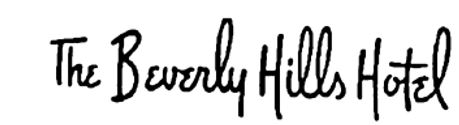
Plaintiff, a hotel in Beverly Hills, California, sued the defendant over its sale of products that “knowingly infringed” the following two of the plaintiff’s trademarks, used for hotel, restaurant, and catering services—the stylized version being “designed by architect Paul Revere Williams.”
 [139]
[139] [140]
[140]The plaintiff took issue with the defendant’s use of the phrase “Beverly Hills” in the stylized font and the defendant’s use of the phrase “The Beverly hills Hotel” in any font.[141]
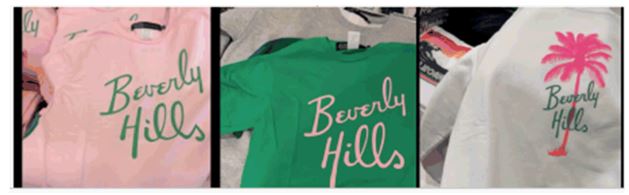 [142]
[142]The plaintiff also alleged trademark infringement, trademark dilution, and unfair competition as it related to the defendant’s sale of an image, entitled Beverly Hills Coconut (see below left), which is nearly identical to the plaintiff’s photograph (see below right) and has a nearly identical, stylized font.[143]
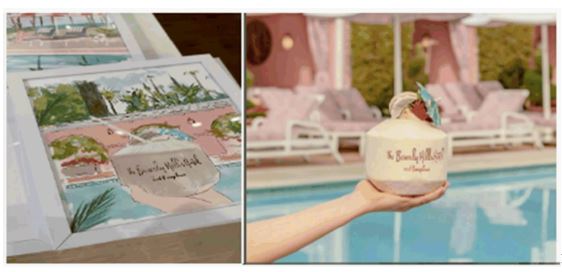 [144]
[144]As a preliminary argument, the defendant contended that the plaintiff’s asserted marks are not protectable because they are “aesthetically functional.”[145] The court disagreed, finding that the defendant failed to meet the two-step test for aesthetic functionally as articulated in Au-Tomotive Gold, Inc. v. Volkswagen of Am., Inc., 457 F.3d 1062, 1067 (9th Cir. 2006), because “(1) the allegedly infringing merchandise would still function as intended without bearing the Marks; and (2) protecting the Marks does not impose any non-reputation-related damages.”[146]
The defendant also contended that “the Lanham Act does not apply to the Beverly Hills Coconut artwork because it is an expressive work protected by the First Amendment,” and the Rogers test should apply.[147] The court disagreed, noting that post Jack Daniel’s, the Rogers test does not apply when an alleged infringer uses a trademark as an indication of the infringer’s own goods.[148] Here, the court concluded that the defendants failed to “make a threshold showing that Beverly Hills Coconut is an expressive work entitled to protection under the First Amendment.”[149] Specifically, the defendant’s contention that “Beverly Hills Coconut use[d] the Stylized Mark to accurately depict a pina colada sold by the plaintiff is exactly the kind of use the Supreme Court rejected in Jack Daniel’s.[150] Thus, the court concluded, the defendant was using the mark in a source identifying manner and the Rogers test does not apply.
The court then applied the Ninth Circuit’s Sleekcraft likelihood-of-confusion factors.[151] The court determined that four factors weighed in the plaintiff’s favor: (1) similarity of the marks, (2) proximity of the goods, (3) market channel convergence, and (4) the defendant’s intent in choosing the mark.[152] The other four factors – (1) strength of the mark, (2) degree of care, (3) actual confusion, and (4) likelihood of expansion – were deemed neutral. On balance, the court found a likelihood of confusion.[153]
Finally, the court granted the plaintiff’s motion for a preliminary injunction, finding it established a likelihood of success on the merits, irreparable harm, that the balance of hardships weighed in its favor, and that an injunction served the public interest.
f. Mar Vista Ent., LLC v. THQ Nordic AB, No. 2:23-cv-06924-MEMF-SSC (C.D. Cal. July 8, 2024)
In Mar Vista Ent., LLC v. THQ Nordic AB, the district court granted in part the plaintiff and counter-defendant’s motion to dismiss amended counterclaims and for judgment on the pleadings.[154] The court denied Mar Vista’s motion to dismiss as to whether the Rogers test applied because Mar Vista’s movie title “Alone in the Dark” was used as a source-identifier to THQ’s series of video games Alone in the Dark.
Defendant and counterclaim-plaintiff THQ Nordic AB is a Swedish video game publisher well-known for making games based on some of the world’s most famous entertainment brands.[155] THQ owns the rights to the storied video game franchise Alone in the Dark—the first ever 3D survival horror game.[156] Given the popularity of the Alone in the Dark video games, which currently have seven installments, THQ licensed the rights for two Alone in the Dark films.[157] The plaintiffs and counterclaim-defendants Mar Vista Entertainment, LLC; The Ninth House, LLC; and Ninth Dark LLC (collectively “Mar Vista”) released a horror film entitled Alone in the Dark.[158] When Mar Vista named and released its film, it was aware of THQ’s mark and that consumers are accustomed to video games being turned into movies.[159]
The court determined that the Rogers test should not apply because THQ’s first amended complaint “includes allegations that Mar Vista purposefully chose to title its movie ‘Alone in the Dark’ so that consumers would be misled into believing that Mar Vista’s film (the ‘goods’) were affiliated with THQ and its video games (the source).”[160] THQ’s complaint also included allegations that the movie “Alone in the Dark” was created to purposefully mislead consumers into believing that THQ and/or the ALONE IN THE DARK Mark were affiliated with Mar Vista, and that consumers would in fact be misled into believing that the movie “Alone in the Dark” was based off THQ’s ALONE IN THE DARK video games.[161]
Construing the allegations in a light most favorable to THQ, as it must at the motion to dismiss stage, the court held that THQ sufficiently alleged that Mar Vista’s use of “Alone in the Dark” is as a trademark and, as such, Jack Daniel’s precludes application of the Rogers test.[162] In so doing, the court disagreed with Mar Vista’s argument that “Jack Daniel’s only covers situations where a junior user uses a mark to signify that it, as opposed to the senior user, is responsible for the goods or services at issue.”[163] The court noted that accepting this argument would “insulate” cases where a junior user intended to confuse consumers and used a trademark to designate that the source of its good or services was the senior user.[164]
Mar Vista also argued that “because the title of a single creative work is not entitled to trademark protection as a matter of law, Mar Vista could not use Alone in the Dark as a source identifier.”[165] The court acknowledged while that the cases Mar Vista cited do demonstrate this point, they are limited to the registration of titles for single works.[166] But that rule, the court held, does not apply because THQ has used Alone in the Dark to designate a series of creative works through its seven installments.[167] Thus, Alone in the Dark can function as a trademark, and Mar Vista can be prevented from attempting to use it as a source identifier.[168] “Put another way, the fact that generally an entity cannot protect the title of a single work as a trademark does not mean that an entity can use another entity’s trademark with impunity as the title for a single work.”[169] Thus, the court denied Mar Vista’s motion to dismiss the amended counterclaims as it related to the application of Rogers without prejudice.[170]
Additionally, the court noted that even ignoring Jack Daniel’s, the Ninth Circuit’s holding in Gordon v. Drape Creative, Inc., 909 F.3d 257 (9th Cir. 2018) would preclude the application of Rogers at this stage because there is a common trend of converting video games into movies and consumers would be misled as to source.[171]
The court then analyzed Mar Vista’s request for judgment on the pleadings as to the trademark dilution claim.[172] THQ withdrew that claim and did not address the issue in its opposition.[173] Deeming this a waiver, the court granted Mar Vista’s request for judgment on the pleadings as to THQ’s trademark dilution claim.[174]
Cases Where Courts Have Elected to Apply Rogers
a. JTH Tax LLC v. AMC Networks Inc., 694 F. Supp. 3d 315 (S.D.N.Y. 2023)
In JTH Tax LLC v. AMC Networks Inc., the district court granted the defendant’s motion to dismiss for failure to state a claim and applied the Rogers test to the defendants’ use of “Sweet Liberty Tax Services” in the television show Better Call Saul.[175]
The plaintiff, JTH Tax LLC, is a tax preparation service that does business under the name Liberty Tax Service.[176] Liberty Tax uses trademarks and a trade dress that include a red-white-and-blue motif and Statue of Liberty sculptures and inflatables.[177]
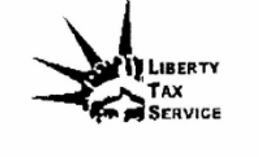
At issue here was the television show Better Call Saul, which Sony distributed and AMC premiered.[179] On April 18, 2022, an episode of Better Call Saul entitled “Carrot and Stick” included a fictional tax preparation business called “Sweet Liberty Tax Services.”[180] The plaintiff alleged that the use of “Sweet Liberty Tax Services” was an obvious imitation of its own Liberty Tax Services but “twisted” to paint the plaintiff in a negative light and “infringed and tarnished Liberty Trademarks and Trade Dress.”[181]
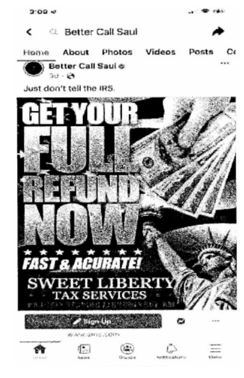 [182]
[182]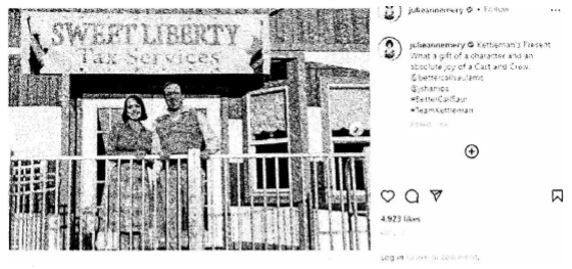 [183]
[183]The district court held that the Rogers test applies because the defendants did not use the plaintiff’s trademarks and trade dress as source identifiers. Specifically, to the extent the defendants used the plaintiff’s marks and trade dress, it was in furtherance of the show’s plot, not in a manner “to identify the source of Better Call Saul or any of Defendants’ products, and Defendants are not alleged to have ‘use[d]’ the ‘[Sweet Liberty Tax Services] trademark and trade dress’ for any product they sell.”[184]
After determining to apply Rogers, the court analyzed its two prongs: (1) whether there was any artistic relevance to the use of “Sweet Liberty Tax Services” and (2) whether the use was explicitly misleading as to its source.[185] The court determined that the use was artistically relevant to the series because it shows the return of a character, who was previously imprisoned for embezzlement, and continues to commit fraud under the business name “Sweet Liberty.”[186] Continuing its analysis under Rogers, the district court determined that the use was not explicitly misleading by applying each of the Polaroid factors and and finding that the plaintiff’s allegations of consumer confusion were not plausible or particularly compelling.[187] It thus granted the defendant’s motion to dismiss the plaintiff’s Lanham Act claims.[188]
b. Hara v. Netflix, Inc., No. 2:23-cv-03456-RGK-AS, 2023 WL 6812769 (C.D. Cal. Aug. 23, 2023)
In Hara v. Netflix, Inc., the district court granted the defendant’s motion to dismiss the plaintiff’s Lanham Act claim of misappropriation of a person’s likeness because the defendants did not use the plaintiff’s likeness in the television show Q-Force.
The plaintiff, Lance Hara, is professionally known as Vicky Vox—a well-known Hollywood drag queen who has appeared in numerous forms of media, including television, radio, and music videos.[189] The defendants are involved in the creation and distribution of an animated television series called Q-Force, which will be made available on Netflix.[190] As described by the defendants, the series is “a fanciful animated television series that subverts the traditional ultra-masculine spy genre and instead focuses on a cast of misfit LGBTQ spies who come together to fight international crime while simultaneously navigating queer life in West Hollywood, California.”[191] Hara alleged that the defendants misappropriated her “name, image, and/or likeness in a profile shot of a cartoon representation of [her] face, followed by four seconds of a full-body shot of the same cartoon representation.”[192]
The district court applied the Rogers test because “the alleged infringement does not identify Plaintiff as the source of the Series,” and the Jack Daniel’s Court “held that the Rogers test is inapplicable in trademark cases involving misappropriation that may result in consumer confusion regarding who manufactured or created a product.”[193] Analyzing the two prongs of the Rogers test, the court found that the depiction of the cartoon was artistically relevant to the show featuring LGBTQ+ characters that took place in West Hollywood.[194] Additionally, the plaintiff only argued that including her likeness in the television series was enough to have misled viewers.[195] This, the court held, was insufficient evidence to find that the show was explicitly misleading under Rogers, which requires “an explicit indication, over claim, or explicit misstatement to mislead.”[196] But the court threw the plaintiff a lifeline and granted leave to amend the claim to support this element.[197]
c. Down to Earth Organics, LLC v. Efron et al, No. 22-cv-06218 (NSR), 2024 WL 1376532 (S.D.N.Y. March 31, 2024)
In Down to Earth Organics, LLC v. Efron et al, the district court granted the defendants’ motion to dismiss for failure to state a claim and applied the Rogers test in analyzing defendants’ use of its online series entitled Down to Earth with Zac Efron.[198]
The plaintiff, Down to Earth Organics, LLC, engages in various forms of media production, including health-related podcasts online and through various media channels, including a podcast promoting health, wellness, nutrition, lifestyle, and travel, and also makes and sells bottled health-focused iced teas and clothing under the “Down to Earth” title and brand.[199] In 2020, Defendant Netflix premiered Down to Earth with Zac Efron, an eight-episode online series focused on wellness and travel.[200] In conjunction with the series, Efron also launched marketing campaigns using the online series to cross promote Nature Valley snack bars on his personal Instagram account.[201] The plaintiff claimed that because it offers dried fruit and nut mixes on its own website, Efron’s cross-promotional campaign was intended “to create a Down to Earth brand by Defendant Efron that infringe[d] upon and dilute[d] [Plaintiff’s] Marks.”[202]
The district court applied the Rogers test because the defendants were “undoubtedly” using “Down to Earth” simply to identify the subject matter and tone of the online series, rather than as a source-identifier.[203]
After making the determination to apply Rogers, the court analyzed whether there was an artistic relevance to the use of “Down to Earth” and whether it was explicitly misleading as to its source.[204] The court held that the use of “Down to Earth” clearly had an artistic relevance to the message of the show, i.e., Zac Efron traveling to various countries to search for health and sustainable living solutions for the planet.[205] Additionally, the court found that there was little worry that “the public would interpret the title ‘Down to Earth with Zac Efron’ as denoting the source, publisher, or producer of the product as Plaintiff.”[206] Thus, the court found that the plaintiff failed to allege that the defendants’ use of “Down to Earth” was explicitly misleading, and dismissed the plaintiff’s claims for trademark infringement and false designation of origin.[207]
Key Takeaways
With guidance from Jack Daniel’s, the dance goes on as courts continue to wrestle with Rogers and its applicability. All the while, some trends have emerged in how and when courts interpret and apply Rogers and, in particular, decide when a trademark is being used as a source identifier (in which case Rogers does not apply).
First, in cases involving physical products, courts seem readily apt to apply the traditional likelihood-of-confusion analysis instead of Rogers.
Second, when pleading infringement and dilution claims, a plaintiff should carefully draft its complaint to indicate that the defendant is using the allegedly infringing mark as a source identifier. With that, the plaintiff has good shot at avoiding a Rogers analysis at the motion-to-dismiss stage—but not necessarily later in the case. This is particularly important in cases involving television shows or goods and services that would be traditionally analyzed under Rogers, for example HomeVestors and Mar Vista.
Of course, in the world of trademarks, jurisdiction matters. In the Ninth Circuit, and the one case in the Third Circuit, courts have been more willing to look at the sufficiency of a complaint and accept allegations of “trademark use” as true—even in cases involving titles of television shows or movies. On the other hand, the Second Circuit has so far held strong in its application of Rogers and has been unwilling to analyze expressive works under a likelihood-of-confusion analysis, notwithstanding how the claim is pled. As stated in JTH Tax LLC, “[w]hile the Supreme Court declined to decide ‘whether Rogers has merit in other contexts,’ this Court remains bound by Rogers where an expressive work does not use a mark ‘as a designation of source for the infringer’s own goods.”[208]
The Jack Daniel’s ruling both narrowed the scope of Rogers and called into question when it should be applied. One court even stated that the “Jack Daniel’s opinion “raises some serious questions about the widespread applicability of the Rogers test” and “revert[ed] to a traditional trademark analysis out of an abundance of caution.”[209] Where exactly that takes us is yet to been seen in the next act.
Endnotes
[1] Cosm. Dermatology & Vein Ctrs. v. New Faces Skin Care Ctrs., Ltd., 91 F. Supp. 2d 1045, 1049 (E.D. Mich. 2000) (citing Champions Golf Club, Inc. v. The Champions Golf Club, Inc., 78 F.3d 1111,1116 (6th Cir. 1996)).
[2] J. Thomas McCarthy, 4 McCarthy on Trademarks and Unfair Competition § 27:86 (5th ed. 2024).
[3] Id. at § 31:144.5.
[3] Jack Daniel’s Props., Inc. v. VIP Prods. LLC, 599 U.S. 140 (2023).
[4] The Second, Third, Fifth, Sixth, Seventh, Ninth, Tenth, and Eleventh Circuits all applied the Rogers test. See J. Thomas McCarthy, 4 McCarthy on Trademarks and Unfair Competition § 31:144.5 (5th ed. 2024).
[5] Jack Daniel’s Props., Inc. v. VIP Prods. LLC, 599 U.S. 140 (2023).
[6] Rogers v. Grimaldi, 875 F.2d 994 (2d Cir. 1989).
[7] Id. at 996.
[8] Id.
[9] Id. at 996-97.
[10] Id. at 997.
[11] Id.
[12] Id.
[13] Id. (quoting Rogers v. Grimaldi, 695 F. Supp. 112, 120-21 (S.D.N.Y. 1988)).
[14] Rogers v. Grimaldi, 875 F.2d at 997.
[15] Id.
[16] Id. at 998.
[17] Id.
[18] Id.
[19] Id.
[20] Id.
[21] Id. at 999-1000.
[22] Id. at 1000.
[23] Id. at 1001.
[24] Id.
[25] Id.
[26] J. Thomas McCarthy, 4 McCarthy on Trademarks and Unfair Competition §31:144.5 (5th ed. 2024)
[27] Id.; see also Cliffs Notes, Inc. v. Bantam Doubleday Dell Publ’g Grp., 886 F.2d 490, 495 (2d Cir. 1989) (expanding the reach of the Rogers test to go beyond titles of works to include elements of the work itself).
[28] J. Thomas McCarthy, 4 McCarthy on Trademarks and Unfair Competition §31:144.5 (5th ed. 2024).
[29] Id. (“All courts agree that any degree of artistic relevance is sufficient to meet the test.”).
[30] Anthony Zangrillo, The Split on the Rogers v. Grimaldi Gridiron: An Analysis of Unauthorized Trademark Use in Artistic Mediums, 27 Fordham Intell. Prop., Media and Ent. L. J. 385, 404 (2017).
[31] Sabina Nedkova, Replacing the Rogers Test: Will an Inquiry Into Non-Artistic Motive in Selecting Titles of Expressive Works Remedy the Possibility of Flagrant Deception?, 20 UIC Rev. Intell. Prop. L. 429, 435-36 (2021).
[32] Id. at 437.
[33] See Zangrillo, supra note 29 at 421; Nedkova, supra note 31 at 448.
[34] Jack Daniel’s Props., Inc. v. VIP Prods. LLC, 599 U.S. 140 (2023); Trade dress is the visual appearance of a product or its packaging that identifies the product’s source to consumers.
[35] Jack Daniel’s Props., Inc. v. VIP Prods. LLC, 599 U.S. at 148.
[36] Id. at 149.
[37] Id. at 150.
[38] Id.
[39] Id. at 151.
[40] Id. at 152.
[41] Id.
[42] Id. at 153.
[43] Id. at 157.
[44] Id. at 158-59.
[45] Id. at 153.
[46] Id. at 160.
[47] Id.; see, e.g., SMELLA ARPAW, Reg. No. 6,262,975; DOS PERROS, Reg. No. 6,176,781; BLAMESON, Reg. No. 5,591,829.
[48] Jack Daniel’s Props., Inc. v. VIP Prods. LLC, 599 U.S. at 160.
[49] Id. at 147.
[50] Id. at 148.
[51] Id. at 163.
[52] Id. at 163-64.
[53] Id. at 164.
[54] Id.
[55] Id. at 165.
[56] Id.
[57] Id.
[58] Id.
[59] Punchbowl, Inc. v. AJ Press, LLC, 90 F.4th 1022 (9th Cir. 2024).
[60] Id. at 1025.
[61] Id.
[62] Id. at 1026.
[63] Id.
[64] Id.
[65] Id.
[66] Id. at 1027.
[67] Id.
[68] Id.
[69] Id. at 1031.
[70] Id.
[71] Id. at 1032.
[72] Id.
[73] Id.
[74] Id.
[75] Id.
[76] Vans, Inc. v. MSCHF Prod. Studio, Inc., 88 F.4th 125 (2d Cir. 2023).
[77] Id. at 129.
[78] Id.
[79] Id. at 130.
[80] Id. at 133.
[81] Id.
[82] Id.
[83] Id.
[84] Id.
[85] Id. at 134.
[86] Id. at 135.
[87] Id. at 138.
[88] Id.
[89] Id.
[90] Id. at 139.
[91] Id.
[92] Id. at 141-42.
[93] Homevestors of Am., Inc. v. Warner Bros. Discovery, Inc., No. 22-1583-RGA, 2023 WL 8826729 (D. Del. Dec. 21, 2023).
[94] HomeVestors of Am., Inc. v. Warner Bros. Discovery, Inc., No. 22-1583-RGA, 2023 WL 6880341, at *1 (D. Del. Oct. 18, 2023).
[95] Id.
[96] Id.
[97] Id.
[98] Id.
[99] Id. at *5.
[100] Id. at *3.
[101] Id. at *4.
[102] Id.
[103] Id. at *5.
[104] Id.
[105] Id.
[106] Homevestors of Am., Inc. v. Warner Bros. Discovery, Inc., Civ. Action No. 22-1583-RGA, 2023 WL 8826729, at *1 (D. Del. Dec. 21, 2023).
[107] Id.
[108] Id. at *2.
[109] Id.
[110] Davis v. Amazon.com, Inc., No. 2:21-cv-02090-JVS(JDEx), 2023 WL 8113299 (C.D. Cal. Nov. 2, 2023).
[111] Id. at *1.
[112] Id. at *2.
[113] Id.
[114] Id.
[115] Id.
[116] Id.
[117] Id.
[118] Id.
[119] Id.
[120] Id. at *1 (internal citation omitted).
[121] Id.
[122] Id.
[123] Id.
[124] Id. at *4.
[125] Id. at *5.
[126] Id.
[127] Id.
[128] Id.
[129] Id. (quoting Maljack Prods., Inc. v. GoodTimes Home Video Corp., 81 F.3d 881, 887 (9th Cir. 1996)) (emphasis in original).
[130] Davis v. Amazon.com, Inc, 2023 WL 8113299, at *6.
[131] Id.
[132] Id.
[133] Id.
[134] Id.
[135] Id. at *10.
[136] Id.
[137] Id.
[138] Davis v. Blue Tongue Films, No. 23-2968, (9th Cir. Dec. 6, 2023).
[139] THE BEVERLY HILLS HOTEL Reg. No. 1516814.
[140] THE BEVERLY HILLS HOTEL Reg. No. 1498143.
[141] Id.
[142] Defendant’s use of the phrase “Beverly Hills” in the font designed by Paul Williams.
[143] Id.
[144] Defendant’s use of “The Beverly Hills Hotel” in any font.
[145] Id. at *3.
[146] Id.
[147] Id.
[148] Id.
[149] Id.
[150] Id.
[151] Id.
[152] Id. at *7.
[153] Id.
[154] Mar Vista Ent., LLC v. THQ Nordic AB, Case No. 2:23-cv-06924-MEMF-SSC (C.D. Cal. July 8, 2024)
[155] Id. at *1.
[156] Id.
[157] Id.
[158] Id.
[159] Id.
[160] Id. at *4-5.
[161] Id. at *5.
[162] Id.
[163] Id. at *6 (emphasis in original).
[164] Id.
[165] Id.
[166] Id.
[167] Id.
[168] Id.
[169] Id.
[170] Id. at *7.
[171] Id.
[172] Id. at *8.
[173] Id.
[174] Id.
[175] JTH Tax LLC v. AMC Networks Inc., No. 22 CIV 6526 (PGG), 694 F. Supp. 315 (S.D.N.Y. Sept. 25, 2023).
[176] Id. at *1.
[177] Id.
[178] Plaintiff’s use of the “Liberty Tax Services.”
[179] Id.
[180] Id.
[181] Id. at *2.
[182] Defendants’ use of “Sweet Liberty Tax Services” in advertising for Better Call Saul.
[183] A Better Call Saul actor’s post on their social media to promote the show using “Sweet Liberty Tax Services.”
[184] Id. at *7.
[185] Id.
[186] Id. at *8.
[187] Id. at *10-15.
[188] Id. at *15.
[189] Id. at *1.
[190] Id.
[191] Id. (internal quotation omitted).
[192] Id.
[193] Id. at *2 n.1.
[194] Id. at *3.
[195] Id. at *4.
[196] Id. (internal quotations and citations omitted).
[197] Id.
[198] Down to Earth Organics, LLC v. Efron, No. 22-cv-06218 (NSR), 2024 WL 1376532 (S.D.N.Y. Mar. 31, 2024).
[199] Id. at *1.
[200] Id.at *2.
[201] Id.
[202] Id.
[203] Id. at *4.
[204] Id. at *5.
[205] Id.
[206] Id. at *6.
[207] Id. at *8.
[208] JTH Tax LLC v. AMC Networks Inc., 694 F. Supp. 3d 315 (S.D.N.Y. 2023).
[209] Morlu v. Amazon.com, Inc., No. SAG-23-03387, 2024 WL 415347, at *2 n.1 (D. Md. Feb. 5, 2024).
Tags
Lanham Act, trademark dilution, trademark registration, willful infringement, motion to dismiss, unfair competition, likelihood of confusion
Related Practices
Related Offices
Related Professionals

Originally printed in Practising Law Institute in September 2024. This article is for informational purposes, is not intended to constitute legal advice, and may be considered advertising under applicable state laws. This article is only the opinion of the authors and is not attributable to Finnegan, Henderson, Farabow, Garrett & Dunner, LLP, or the firm’s client.