
Lennon Image Technologies, LLC v. Ulta Beauty, Inc.
August 21, 2020
By Zachery D. Olah; Karthik Kumar, Ph.D.; Rajeev Gupta, Ph.D.
This is our next thread of articles in our Augmented Reality/Virtual Reality Litigation Update series. In this series, we shine the spotlight on legal proceedings involving AR/VR technology. As we follow the proceedings in a continuously updated thread of articles, we discuss the AR/VR technologies involved, the intellectual properties at issue, and the litigation strategies and tactical maneuvers of the parties in litigation.
Lennon Image Technologies’s Complaints
In this installment, we highlight a recent case filed in the Eastern District of Texas. On August 4, 2020, Lennon Image Technologies, LLC sued Ulta Beauty, Inc. alleging that it infringes U.S. Patent No. 6,624,843 (the ’843 patent). The case is captioned Lennon Image Techs., LLC v. Ulta Beauty, Inc., 2-20-cv-00249 (E.D. Tex. 2020).
On June 20, 2012, Lennon Image Technologies acquired ownership of the ’843 patent by assignment. As such, Lennon Image Technologies owns the rights associated with the ’843 patent. In this action, the complaint alleges that Ulta Beauty is responsible for direct and indirect infringement of the patent at issue through its mobile application utilizing product sampling with an image overlay feature. The complaint further alleges that Ulta Beauty distributes and makes available to the public its mobile application to customers for their own use. Lennon Image Technologies alleges that Ulta Beauty’s distribution of its application is the basis for its indirect infringement, induced infringement specifically. Lennon Image Technologies alleges that Ulta Beauty “induces such infringement” by making its mobile application available to potential customers and by providing customers links with directions providing instructions on how to use the application that allegedly includes the infringing technology. Lennon Image Technologies concludes its complaint by asking the Court to find infringement and award money damages, including a judgment awarding treble damages for willful infringement, and damages covering Lennon Image Technologies’ costs.
The ’843 Patent
The ’843 patent is titled “Customer Image Capture and Use Thereof in a Retailing System.” The ’843 patent claims a system, apparatus, and method for manipulating an image of a customer based on a model image to allow the customer to virtually assess the desired product without having to physically try it on. To accomplish the intended use described above, the system stores reference images associated with the products in a store. A user can input an image of himself or herself, and the system generates a composite image of the reference image and the user-input image. The composite image shows the user how the desired product would appear when worn. This process is described in Figure 2 of the ’843 patent.
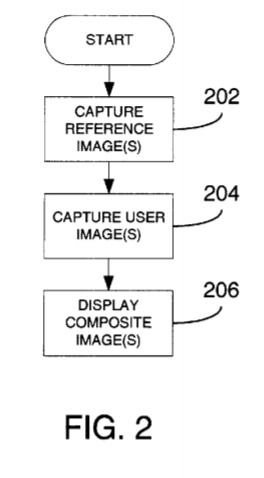
The ’843 patent identifies its improvement over the prior art as the ability to provide a customer with actual detail of what his or her appearance would be when wearing the desired product. Previous attempts in the prior art fail to provide any customer-specific detail in the image or fail to allow for movement when virtually assessing the product. As such, the technology in the ’843 patent states that it provides improvements over the prior art that would lead to a reduction in shopping time and a reduced chance that the customer would need to return the item later.
The Accused AR/VR Products
As discussed previously, the complaint alleges that Ulta Beauty directly and indirectly infringes the ’843 patent via its mobile application, which allows users to virtually test products prior to purchasing them. The complaint alleges that Ulta Beauty’s Ulta GLAMlab App allows the customer to capture an image of themselves to be used in a composite image including the customer image and an image corresponding to a potential purchase item. The complaint further alleges that the user can select from a variety of makeup products, and the GLAMlab App will create corresponding composite images for each selected product. As such, the application allows customers to assess potential purchase items without having to physically put the makeup on. To support its claims against Ulta Beauty and the Ulta GLAMlab App, Lennon Image Technologies includes screenshots of a user operating the application interface to try on lipstick in its complaint.
Next Steps
If this case does not settle, we may see the defendant answer the complaint, or perhaps move to dismiss the complaint as deficient in some respect. Ulta Beauty may choose to take other action against the ’843 patent, including filing a petition for inter partes review challenging the patentability of the ’843 patent. We will keep you posted of future developments in this AR/VR litigation.
Related Practices
Related Offices
Related Professionals


Copyright © Finnegan, Henderson, Farabow, Garrett & Dunner, LLP. This article is for informational purposes, is not intended to constitute legal advice, and may be considered advertising under applicable state laws. This article is only the opinion of the authors and is not attributable to Finnegan, Henderson, Farabow, Garrett & Dunner, LLP, or the firm’s clients.