
Who Has the Power? Granting Power of Attorney in AIA Applications
January 07, 2016
Authored and Edited by Adriana L. Burgy; Stephanie M. Sanders
For applications having an actual filing date on or after September 16, 2012, a party applying for a patent has the option of naming the inventor or joint inventors of the invention as the applicant or naming the assignee, an obligated assignee, or a person who otherwise shows sufficient proprietary interest in the application as the applicant. To File or Not to File as an Applicant-Assignee: That is the Question, a post on the Finnegan AIA Blog, provides insight into the strategy behind determining which entity to list as the applicant.
The identity of the applicant has implications on a number of actions and procedures that will occur during prosecution. For example, 37 CFR § 1.32, which applies to applications filed on or after September 16, 2012, notes that “A power of attorney must: . . . (4) Be signed by the applicant for patent (§ 1.42) or the patent owner . . . ” As such, the party named as the applicant when an application is filed is the party who must sign a Power of Attorney. If the applicant changes during prosecution, then a new Power of Attorney must be executed and filed with the U.S. Patent and Trademark Office for the appointed practitioners to remain of record.
The following flow-chart is useful in determining the party that can effectively sign a Power of Attorney based on when the application was filed and which entity was named as the applicant.
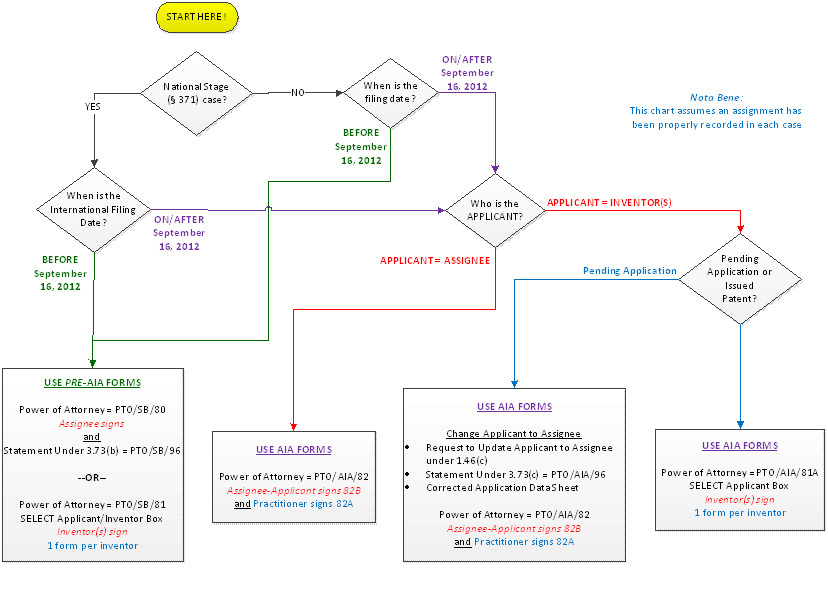
You can access Patents Forms on the USPTO website here.
Contacts

Copyright © 2016 Finnegan, Henderson, Farabow, Garrett & Dunner, LLP.
DISCLAIMER: Although we wish to hear from you, information exchanged in this blog cannot and does not create an attorney-client relationship. Please do not post any information that you consider to be personal or confidential. If you wish for Finnegan, Henderson, Farabow, Garrett & Dunner, LLP to consider representing you, in order to establish an attorney-client relationship you must first enter a written representation agreement with Finnegan. Contact us for additional information. One of our lawyers will be happy to discuss the possibility of representation with you. Additional disclaimer information.