
The Internet of Things: Divided Infringement
November 10, 2016
Authored and Edited by James D. Stein; Matthew J. Hlinka; Kenie Ho; Stephanie M. Sanders
Some analysts predict the Internet of Things (IoT) market will grow from nearly $2 trillion in 2013 to $7 trillion in 2020. With this rapid growth comes new challenges for companies trying to protect and enforce their patent rights. Of particular concern for IoT companies is divided or joint infringement issues.
To prove infringement, a patent owner typically must show that a single party sells a product or performs a process that meets all elements of a patent claim. IoT inventions, however, often create value for consumers by connecting disparate devices—usually made by different entities—in creative ways.
For example, in an IoT smart home, entertainment systems, lighting, appliances, climate control, and power meters may all work together to optimize the home environment while minimizing power consumption. In the real world, each of these devices could be made, sold, or used by different entities. An IoT patent might be directed to using all of these devices together in a novel way; thus no single entity by itself practices the patented invention. This situation is known as divided or joint infringement, which can be difficult to prove.
Smart Home System
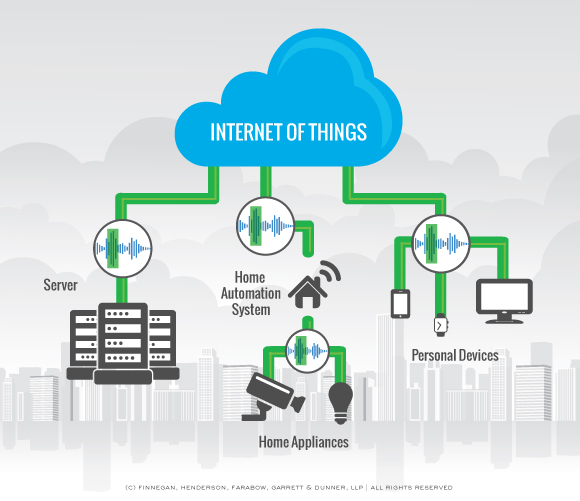
One way to mitigate or avoid divided infringement situations is to draft patent claims from the perspective of only one device in the IoT system, capturing only the entity that makes, uses, or sells that device. In the above smart home example, that device might be a novel internet server that receives data from the different IoT home devices, analyzes the data, and provides instructions to the devices controlling the home environment. But, not all IoT devices lend themselves to this drafting technique. It might only be possible to obtain a patent on the way that a customer controls the entire system because that might be the only novel aspect of the system. Even in this case, the patentee can still show direct infringement of the claim by proving that the customer “puts the system as a whole into service, i.e., controls the system and obtains benefit from it.”1
The patent owner can still prove infringement against another entity, such as the service provider, by showing that the service provider exercises sufficient control or direction over the entire process such that its customer’s use of the entire system can be attributed to the service provider under a theory of induced infringement. Induced infringement is a more difficult standard to meet, but it is not impossible to prove.
Conclusion
As the IoT market continues to grow, protecting IoT inventions will become ever more important. Keeping the above principles in mind when drafting patent applications will help build a stronger IoT patent portfolio or help defend against a weak one.
1 Centillion Data Sys., LLC. v. Qwest Commc’ns. Int'l, Inc., 631 F.3d 1279, 1285 (Fed. Cir. 2011).
Contacts

Copyright © 2016 Finnegan, Henderson, Farabow, Garrett & Dunner, LLP.
DISCLAIMER: Although we wish to hear from you, information exchanged in this blog cannot and does not create an attorney-client relationship. Please do not post any information that you consider to be personal or confidential. If you wish for Finnegan, Henderson, Farabow, Garrett & Dunner, LLP to consider representing you, in order to establish an attorney-client relationship you must first enter a written representation agreement with Finnegan. Contact us for additional information. One of our lawyers will be happy to discuss the possibility of representation with you. Additional disclaimer information.

