
Life on the Patent Prosecution Highway
April 26, 2016
Authored and Edited by Ashley M. Winkler; Matthew J. Hlinka; Adriana L. Burgy
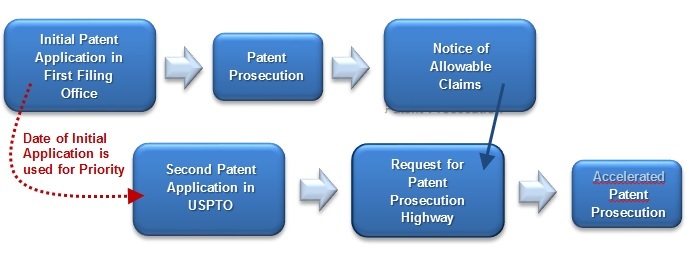
The Patent Prosecution Highway (PPH) accelerates the examination of an application that has already had at least one claim allowed by a participating foreign patent office by advancing it out of turn in a patent office’s queue.
Both patent offices and applicants benefit from the PPH. For example, patent offices become more efficient by reusing the work performed by partner patent offices; applicants receive a first action much faster than through the standard examination process.
When can the Patent Prosecution Highway be used?
A U.S. application is eligible for the PPH if the applicant has received an indication of allowable subject matter in a related application from one of the 30 foreign partner patent offices. The applications must share a common earliest priority date, and substantive examination of the U.S. application cannot have begun. New U.S. continuations and divisionals can participate in the PPH program, but provisional applications, plant applications, design applications, and applications subject to a secrecy order are not eligible.
The claims in the U.S. application must “sufficiently correspond” with the claims allowed by the earlier examining patent office. In some instances, it may be necessary to file a preliminary amendment to ensure that the U.S. claims either match the foreign filed application or are narrower.
Additionally, a PPH applicant must submit a Request Form through EFS-Web. The applicant must identify the priority application and provide the relevant office actions, any references, and a translation if necessary. There is no fee.
Why use the Patent Prosecution Highway?
While the work sharing aspects of the PPH do not guarantee the issuance of a patent and substantive examination still occurs under U.S. law and regulations, the examination process, however, is expedited significantly. The decision to grant a PPH request is generally made within 4 months of filing. PPH applications are typically examined within 2-3 months after a granted request.
A hurdle for PPH applicants is ensuring the claims “sufficiently correspond” with the previously allowed material. This similarity must be shown with the initial PPH petition and then with every amendment made during U.S. phase prosecution. On the balance, the PPH is an option for applicants that are PPH-eligible and want quicker examination.
Contacts


Copyright © 2016 Finnegan, Henderson, Farabow, Garrett & Dunner, LLP.
DISCLAIMER: Although we wish to hear from you, information exchanged in this blog cannot and does not create an attorney-client relationship. Please do not post any information that you consider to be personal or confidential. If you wish for Finnegan, Henderson, Farabow, Garrett & Dunner, LLP to consider representing you, in order to establish an attorney-client relationship you must first enter a written representation agreement with Finnegan. Contact us for additional information. One of our lawyers will be happy to discuss the possibility of representation with you. Additional disclaimer information.