
I Do Declare: Inventor Declarations in AIA Applications
November 10, 2015
Authored and Edited by Adriana L. Burgy; Stephanie M. Sanders
What’s the situation?
After the America Invents Act (AIA) changed the US patent system from First-To-Invent (FTI) to First-Inventor-To-File (FITF), the USPTO updated the Inventor Oath or Declaration rules to reflect this monumental change. In the pre-AIA world, by signing a declaration, (PTO/SB/01), an inventor declared that “I believe the inventor(s) named below to be the original and first inventor(s) of the subject matter which is claimed and for which a patent is sought” (emphasis added). Now in the post-AIA world, it is no longer required that an inventor be the first inventor of the claimed subject matter and, as such, an AIA declaration (PTO/AIA/01) merely requires an inventor to state “I believe that I am the original inventor or an original joint inventor of a claimed invention in the application” (emphasis added). In other words, an inventor who is filing an application for a utility or design patent application with the USPTO on or after September 16, 2012, need only declare that he or she is an inventor, not necessarily the first inventor of the claimed subject matter.
Can a declaration from a parent application be re-used in a child case?
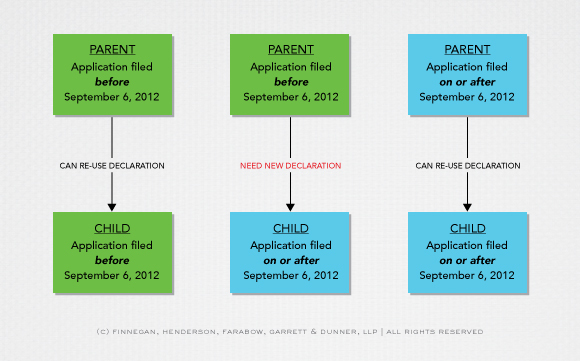
It depends. Although a declaration from each inventor is required in every application, 37 CFR § 1.63(d) states that a newly-executed declaration is not required in a continuing application if a compliant declaration was filed in the parent application. In practical terms, this means that a copy of a declaration by an inventor that was filed in a parent application can be filed in a child application, but only if both the parent and child application are on the same side of the September 16, 2012 dividing line. If the child and parent applications straddle the September 16, 2012 date, i.e., if the parent application was filed before September 16, 2012 and the child application was filed on or after September 16, 2012, then an AIA-compliant declaration must be newly-executed by each inventor and filed in the child case. This is illustrated in the infographic below. More information on using copies of declarations from prior applications can be found in the USPTO AIA Inventor’s Oath or Declaration Quick Reference Guide.
What if an inventor can’t or won’t sign a new declaration?
The AIA does not affect the rules for when a Substitute Statement in Lieu of an Oath or Declaration (PTO/AIA/02) may be filed, i.e., if (1) the inventor is deceased or legally incapacitated, (2) the inventor refuses to sign a declaration, or (3) the inventor cannot be found after diligent effort. A Substitute Statement, however, may be filed in an application filed on or after September 16, 2012, only if the applicant in the case is the assignee, a party to whom the inventor is under an obligation to assign, or a party who otherwise shows a sufficient proprietary interest in the matter. More information on when it is appropriate to use a Substitute Statement can be found in the USPTO AIA Inventor’s Oath or Declaration Quick Reference Guide.
When will the USPTO recognize the assignee as the applicant?
For the USPTO to recognize such a party as the applicant in an application, the Applicant Information section of the Application Data Sheet (ADS) (PTO/AIA/14) must list the assignee (or other party). If the Applicant Information section is blank, the USPTO will recognize the inventor or joint inventors as the applicant.
Tags
patent application, Assignee-Applicant, assignment, United States Patent and Trademark Office (USPTO)
Contacts

Copyright © 2015 Finnegan, Henderson, Farabow, Garrett & Dunner, LLP.
DISCLAIMER: Although we wish to hear from you, information exchanged in this blog cannot and does not create an attorney-client relationship. Please do not post any information that you consider to be personal or confidential. If you wish for Finnegan, Henderson, Farabow, Garrett & Dunner, LLP to consider representing you, in order to establish an attorney-client relationship you must first enter a written representation agreement with Finnegan. Contact us for additional information. One of our lawyers will be happy to discuss the possibility of representation with you. Additional disclaimer information.