
Five Tips for Filing Preissuance Submissions in Design Patent Applications
July 30, 2013
Authored and Edited by Elizabeth D. Ferrill; Michele C. Bosch
Back in April, we outlined the nuts and bolts of the AIA preissuance submission procedure. In short, third parties unrelated to the applicant may submit patents, published applications, and other printed publications to the USPTO for consideration during the examination of a pending application.
Curiously, the USPTO states that a third party may file such a submission for design patent applications. But, design patent applications are not published and remain secret until the design patent issues. So, the opportunity to file a submission would likely be limited to a third party that had prior knowledge of the content of a pending design patent application, either through notice letters, discovery, or closely following a competitor’s recently issued patents.
When a third party does have this knowledge, how can it take advantage of the preissuance submission process for a pending design patent?
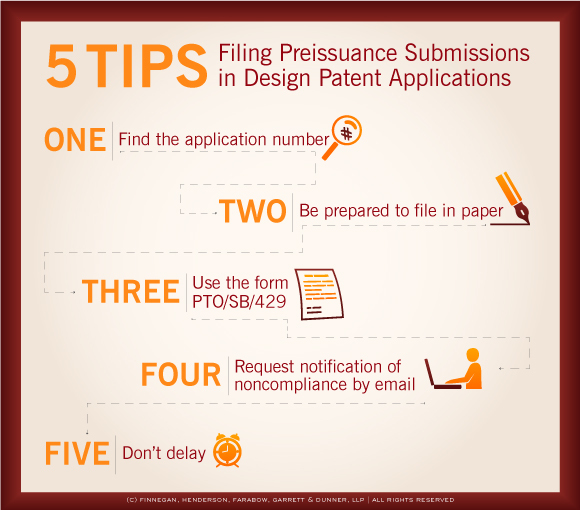
- Find the application number. The only piece of information that a third party must know to file a preissuance submission is the pending application’s serial number. If the pending application is a continuation of an issued patent, then this information is available under the Continuity Data tab in Public PAIR. Or a third party may know the number from a notice letter or discovery in litigation. Prior to filing, third parties should confirm that the application number is not protected by a confidentiality agreement.
- Be prepared to file in paper. Unless the third party has the confirmation number of the pending application, it is not possible to file using the USPTO’s electronic third-party submission system. So, third parties should plan to file the submission in paper.
- Use the Form PTO/SB/429. If the submission does not meet the USPTO’s requirements, then it will be rejected. Thus, the USPTO highly recommends using its Form PTO/SB/429, so that important requirements are not overlooked.
- Request notification of non-compliance by email. The USPTO offers third parties the opportunity to receive an email if the preissuance submission is rejected. Because third parties cannot see the file wrapper for the pending design application, it is essential to request notification of noncompliance. If the submission is rejected, then the third party may have time to resubmit the materials.
- Don’t delay. The preissuance submission must be received at the USPTO before a notice of allowance or first rejection issues. Currently, the USPTO issues the first action in design patent applications in less than a year of filing. Third parties should not delay. Keep in mind there is no “mailbox rule” for preissuance submissions. The date that matters is the date that the submission arrives at the USPTO.
Tags
preissuance submission, Third-Party Submissions, United States Patent and Trademark Office (USPTO)
Related Practices
Contacts


Copyright © 2013 Finnegan, Henderson, Farabow, Garrett & Dunner, LLP.
DISCLAIMER: Although we wish to hear from you, information exchanged in this blog cannot and does not create an attorney-client relationship. Please do not post any information that you consider to be personal or confidential. If you wish for Finnegan, Henderson, Farabow, Garrett & Dunner, LLP to consider representing you, in order to establish an attorney-client relationship you must first enter a written representation agreement with Finnegan. Contact us for additional information. Additional disclaimer information.