
Five Things About Design Patent IPRs that You Probably Don’t Know
September 30, 2013
Authored and Edited by Elizabeth D. Ferrill; Michele C. Bosch
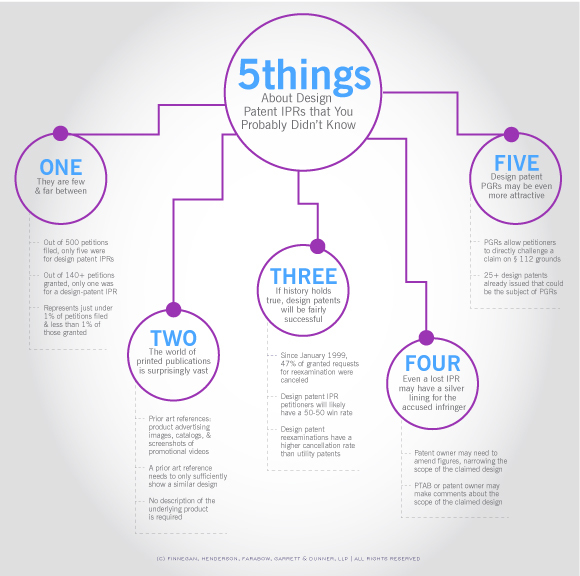
1. They are few and far between. Only five petitions for design patent IPRs have been filed (out of over 500 petitions). And only one of those petitions has been granted (out of over 140). So, the design patent IPRs currently represent just under 1% of these petitions and less than 1% of the granted petitions.
2. The world of printed publications is surprisingly vast. While IPRs are limited to challenges based on printed publications and patents, a prior art reference for a design patent needs to only sufficiently show a similar design. No description of the underlying product is required. So, helpful prior art references may include product advertising images, catalogs, and even screenshots of promotional videos.
3. If history holds true, design patent IPRs will be fairly successful. As compared to their utility patent cousins, design patent reexaminations have a considerably higher cancelation rate. From January 1999 to present, of those requests for reexamination of design patents that were granted by the USPTO, approximately 47% were cancelled. So it follows that design patent IPR petitioners will likely enjoy a similar 50-50 win rate.
4. Even a lost IPR may have a silver lining for the accused infringer. Many design patents issue without an office action, leading to a sparse prosecution history that offers little help to an accused infringer during litigation. But during an IPR, the PTAB or the patent owner may make comments about the scope of the claimed design. Moreover, the patent owner may be forced to amend the figures of its design patent, narrowing the scope of the claimed design. Either event may help the accused infringer avoid infringement when the case returns back to the district court or ITC.
5. Design patent PGRs may be even more attractive. Design patent claims are most often rejected for lack of clarity or indefiniteness under 35 U.S.C. § 112. Unlike IPRs, PGRs allow petitioners to directly challenge a claim on § 112 grounds. Because of the relatively short prosecution period for a design patent, more than 25 design patents have already issued that could be the subject of PGRs (because they were filed after March 16, 2013). These patents include designs for athletic shoes, a fountain, and turbine rotors. Given the additional flexibility of PGRs, it seems likely that PGRs will be even more attractive to petitioners, provided the request is made before the nine-month deadline passes.
Related Practices
Contacts


Copyright © 2013 Finnegan, Henderson, Farabow, Garrett & Dunner, LLP.
DISCLAIMER: Although we wish to hear from you, information exchanged in this blog cannot and does not create an attorney-client relationship. Please do not post any information that you consider to be personal or confidential. If you wish for Finnegan, Henderson, Farabow, Garrett & Dunner, LLP to consider representing you, in order to establish an attorney-client relationship you must first enter a written representation agreement with Finnegan. Contact us for additional information. Additional disclaimer information.