
The Empire Strikes Out: Disney, Marvel, And LucasFilm Lose Summary Judgment On Trademark Infringement Claims
September 5, 2018
Authored and Edited by Jonathan D. Uffelman; Margaret A. Esquenet; Naresh Kilaru
On August 9, 2018, a judge in the Southern District of New York held, in essence, that a company that copies trademarked characters, but does not confuse its customers regarding the source of its copies, is not liable for trademark infringement—and granted summary judgment on that claim. But the court denied summary judgment on Plaintiffs’ trademark dilution and copyright infringement claims, allowing them to proceed.
Plaintiffs Disney, Marvel, and LucasFilm own the rights to numerous fictional characters, including Hulk and Darth Vader, while Defendant Sarelli and his company, Characters for Hire, LLC (“CFH”), operate a business that supplies costumed actors to portray these characters at private parties and corporate events. Instead of using Plaintiffs’ trademarked names, however, CFH identifies them with generic names like “Big Green Guy” (Hulk) and “The Dark Lord” (Darth Vader). Similarly, CFH advertised themed parties that referenced Plaintiffs’ movies, such as “Frozen Themed” (Frozen), “Avenging Team” (The Avengers), and “Star Battles” (Star Wars) using images of Plaintiffs’ characters:
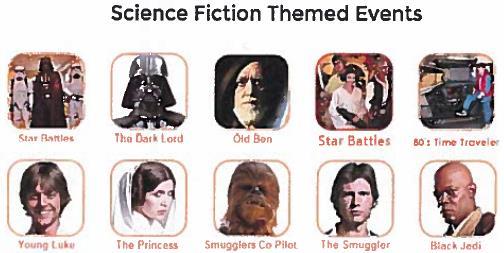
Further, when CFH did use Plaintiffs’ trademarked names, it typically used different fonts, styles, and colors, and CFH disclaimed (in contracts, for example) any similarity between its characters’ costumes and Plaintiffs’ characters. In alleging customer confusion, though, Plaintiffs pointed to reviews on CFH’s website that referenced Plaintiffs’ characters by their trademarked names, and they relied on both Better Business Bureau complaints about CFH and unfavorable Yelp reviews.
After sending CFH three cease-and-desist letters but allegedly getting no meaningful response, Plaintiffs sued, asserting claims under federal and New York law for trademark and copyright infringement, unfair competition, false designation of origin, and trademark dilution. Both parties moved for summary judgment.
Trademark Infringement, Unfair Competition, and False Designation of Origin
The court analyzed Plaintiffs’ claims for trademark infringement, unfair competition, and false designation of origin together, finding that they ultimately depended on the same issue—whether Plaintiffs could demonstrate a likelihood of consumer confusion under the eight-factor Polaroid test. The court held that they could not, granting CFH summary judgment on all three claims.
The court noted that the Polaroid test is “not mechanical,” but instead focuses “on the ultimate question of whether, looking at the products in their totality, consumers are likely to be confused.” Accordingly, while the court analyzed each factor separately—finding that two favored Plaintiffs but the rest favored CFH—it ultimately concluded that the balance of factors favored CFH.
The court appeared most strongly swayed by Plaintiffs’ inability to show any actual consumer confusion or bad faith on CFH’s part in adopting Plaintiffs’ marks. For example, the court found that while some negative reviews on CFH’s website referenced the trademarked names of Plaintiffs’ characters, none of these reviews (and no other evidence) showed any sign of confusion as to the origin or source of CFH’s services. Similarly, the court found it irrelevant that children might be confused as to the source of CFH’s services because CFH’s actual customers are adults. Moreover, while Plaintiffs had argued that disclaimers in CFH’s event contracts, the use of slightly altered character names, and CFH’s removal of Plaintiffs’ trademarked names from its online customer reviews all evidenced CFH’s bad faith, the court disagreed. Instead, it found that these actions were more likely to put customers on notice that CFH’s services were not affiliated with Plaintiffs.
Trademark Dilution and Copyright Infringement
The court found the record before it insufficient to justify granting either party summary judgment on Plaintiffs’ trademark dilution and copyright infringement claims. Regarding dilution, the court found that if CFH’s services were of a markedly poor quality, a jury could conclude that Plaintiffs’ marks would suffer from the negative associations formed as a result of CFH’s conduct. Further, while the court seemed sympathetic to Plaintiffs’ copyright claims, it concluded that Plaintiffs were not entitled to summary judgment because they had not “point[ed] to any admissible evidence demonstrating that [CFH had] engaged in the alleged infringing conduct.” Specifically, it found that Plaintiffs had relied on poor-quality screenshots from CFH’s website and social media sites, as well as videos from the same sources, none of which had been properly authenticated.
The case is Disney Enterprises, Inc. v. Sarelli, Case No. 1:16-cv-02340-GBD-GWG (S.D.N.Y.).
Related Practices
Contacts

- Jonathan D. Uffelman
- Domain Name Specialist / Attorney
- Washington, DC
- +1 202 408 4328

Copyright © 2018 Finnegan, Henderson, Farabow, Garrett & Dunner, LLP.
DISCLAIMER: Although we wish to hear from you, information exchanged in this blog cannot and does not create an attorney-client relationship. Please do not post any information that you consider to be personal or confidential. If you wish for Finnegan, Henderson, Farabow, Garrett & Dunner, LLP to consider representing you, in order to establish an attorney-client relationship you must first enter a written representation agreement with Finnegan. Contact us for additional information. One of our lawyers will be happy to discuss the possibility of representation with you. Additional disclaimer information.