
The Copyright “Meme” Game: Can an Internet Meme Containing a Copyrighted Work Be Considered Infringing?
January 29, 2019
Authored and Edited by Y. Leon Lin; Margaret A. Esquenet
The abundant use of memes in social media raises many legal issues, including copyright infringement and fair use, that are now beginning to be addressed. Philpot v. AlterNet Media Inc., 18-4479 (N.D. Cal. filed Jul. 24, 2018), involves a battle between Larry Philpot, a concert photographer, and AlterNet Media Inc., a liberal activist news service, over AlterNet’s use of one of Philpot’s photos. AlterNet had posted on its social media accounts a photo Philpot had taken of artist Willie Nelson alongside a quote from an interview Nelson gave in 2010 to Parade Magazine (see Figure 1, below). The quote read, “Rednecks, hippies, misfits—we’re all the same. Gay or straight? So what? It doesn’t matter to me. We have to be concerned about other people, regardless. I don’t like seeing anybody treated unfairly. It sticks in my craw. I hold on to the values from my childhood.” Additionally, AlterNet added its own comment above the photo that simply stated, “We need more values like this.”
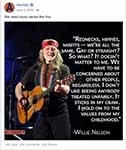
Figure 1: AlterNet's post containing the allegedly infringed photograph of Willie Nelson.
Although Philpot originally posted his photo to Wikimedia pursuant to the site’s Creative Commons Attribute 2.0 Generic License (“the Commons License”), which allows others to use posted photos for free for any purpose, the Commons License requires the photographer to be given credit for the photo when it is used. But when AlterNet posted the photo (with the added quote and comment) on its social media accounts, it made no mention of Philpot. Subsequently, Philpot sued, alleging that AlterNet’s use of the photo was outside the Commons License and violated both the Copyright Act, 17 U.S.C. § 501, and the Digital Millennium Copyright Act (“DMCA”), 17 U.S.C. § 1202. In his complaint, Philpot sought monetary damages, alleging that because the image proved extremely popular—as of the date the complaint was filed, it had generated 14,000 likes, 33,000 shares, and 306 comments—he lost marketing opportunities by not being credited.
In a recent decision, the court considered AlterNet’s 12(b)(6) motion to dismiss both claims against it, and issued a mixed decision. Philpot v. AlterNet Media Inc., 2018 WL 6267876 (N.D. Cal. Nov. 30, 2018). Addressing AlterNet’s first argument—that the fair-use doctrine barred Philpot’s copyright infringement claim—the court initially recognized that it was unusual, given the “narrow inquiry on a Rule 12(b)(6) motion,” to conduct a fair-use analysis in that context. Nonetheless, it proceeded to consider four factors: (1) the purpose and character of AlterNet’s use of the photo, including whether it was for a commercial purpose or for non-profit educational purposes; (2) the nature of the copyrighted work; (3) the amount and substantiality of the portion of the work used in relation to the work as a whole; and (4) the effect of the use of the photo on the potential market for, or the value of, the work. Ultimately, however, the court concluded that the allegations in the pleadings were insufficient to allow it to weigh these factors and determine whether AlterNet’s use of the copyrighted work constituted a fair use—and that a factual inquiry was necessary. In particular, according to the court, it could not say based on the pleadings where AlterNet’s use of the photo was “transformative” (which it recognized was the “main inquiry” to be made in a fair-use analysis). Therefore, the court denied AlterNet’s motion to dismiss Philpot’s copyright infringement claim.
The court then addressed AlterNet’s second argument—that Philpot had not sufficiently pled the intent required to establish a violation of the DMCA, which requires a showing that the alleged infringer was aware (or had reasonable grounds to know) that its actions would induce, enable, facilitate, or conceal infringement. See 17 U.S.C. § 1202(b). This time, the court agreed with AlterNet, finding that Philpot had failed to plead facts showing that AlterNet had the required mental state. Accordingly, the court granted AlterNet’s motion to dismiss Philpot’s DMCA claim. However, the court did not make its decision “with prejudice” and instead gave Philpot leave to amend his DMCA claim and adequately allege AlterNet’s wrongful intent.
Related Practices
*Leon Lin is a Law Clerk at Finnegan
Copyright © 2019 Finnegan, Henderson, Farabow, Garrett & Dunner, LLP.
DISCLAIMER: Although we wish to hear from you, information exchanged in this blog cannot and does not create an attorney-client relationship. Please do not post any information that you consider to be personal or confidential. If you wish for Finnegan, Henderson, Farabow, Garrett & Dunner, LLP to consider representing you, in order to establish an attorney-client relationship you must first enter a written representation agreement with Finnegan. Contact us for additional information. One of our lawyers will be happy to discuss the possibility of representation with you. Additional disclaimer information.
